A Dutch television station admitted this week that an Amsterdam ex-resident whose death in Lebanon it had covered sympathetically last month was “probably” a Hezbollah gunman who had returned to fight against Israel.
The May 25 admission by AT5, the main television station covering the Amsterdam area, about the death of Ali Dia (spelled elsewhere also Ali Diya and Ali Diyab) last month in Lebanon followed an exposé by De Telegraaf daily about his alleged ties to Hezbollah.
The affair encapsulates competing media narratives in the Netherlands around Israel and asylum seekers, Freek Vergeer of the Center for Information and Documentation on Israel (CIDI), a watchdog on antisemitism and Israel-hatred in the Netherlands.
Dia died in Lebanon in April shortly after leaving Amsterdam, where he has been living as an asylum seekers since 2021 along with some of his relatives, AT5 reported in an article titled “Grief over the death of Ali (23) after his return. ‘This should never have happened.’”
The article implied that he left the Netherlands because authorities would not renew his asylum visa. The article didn’t say why he had been declined further asylum. Dia was given 28 days to leave with government assistance, including funding for flight tickets, or face a deportation order and possible arrest if he stayed past that period.
The article by AT5, a left-leaning publication, which has often been accused of ignoring or downplaying the Netherlands’ immigration crisis, implied that Dia’s death was the result of the Netherlands’ immigration policy and Israel’s actions.
Lisette Tuijn, a friend of Dia, told AT5: “It was already unsafe there, certainly in Southern Lebanon, where he had to return, so it made no sense. This should never have been allowed to happen,” she said. The Netherlands does not determine or control where deportees settle in their country of return after they leave.
Following the expose of De Telegraaf, whose editorial line is widely seen as more conservative and more pro-Israel than many other mainstream Dutch dailies, AT5 added a paragraph to their item, reading: “Ali probably returned to fight in Lebanon,” adding that “You can read more about his motives” in a new article by AT5 about Ali Dia, whose title spoke of “questions” around his death.
His sister was quoted in the article as saying that he wasn’t affiliated with Hezbollah. The article also mentioned that photos of him in uniform were “artificially altered.” Hezbollah often releases edited photos of its slain terrorists after they are killed.
The De Telegraaf article showed photos of Dia in uniform and testimonies that he died fighting for Hezbollah.
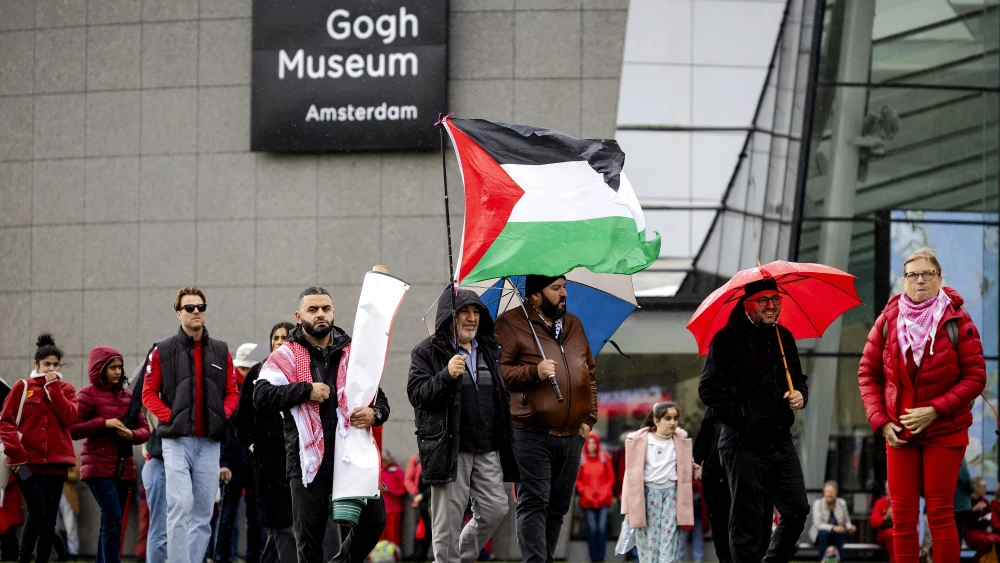
Friends of Dia had laid several wreaths in Dia’s memory, Israel’s Channel 12 reported. An Israeli resident of Amsterdam complained about the wreaths after learning Dia’s true identity but the municipality initially did not remove the wreaths from Amsterdam’s Museum Square, the report said. It was eventually removed.
Vergeer, the CIDI analyst, told JNS that the coverage underlined “The dividing lines of the political spectrum determine how you view this event. The fact that Hezbollah is on the European Union Terror List no longer seems to matter to some media. AT5 initially views it through an ideologically convenient lens: Israel is killing innocent civilians. The fact that the person in question is a Hezbollah fighter no longer matters,” he observed.