Newsletter
Newsletter Support JNS

Hebrew U study finds link between name, facial appearance

Findings suggest that the congruence is not innate but develops with age.

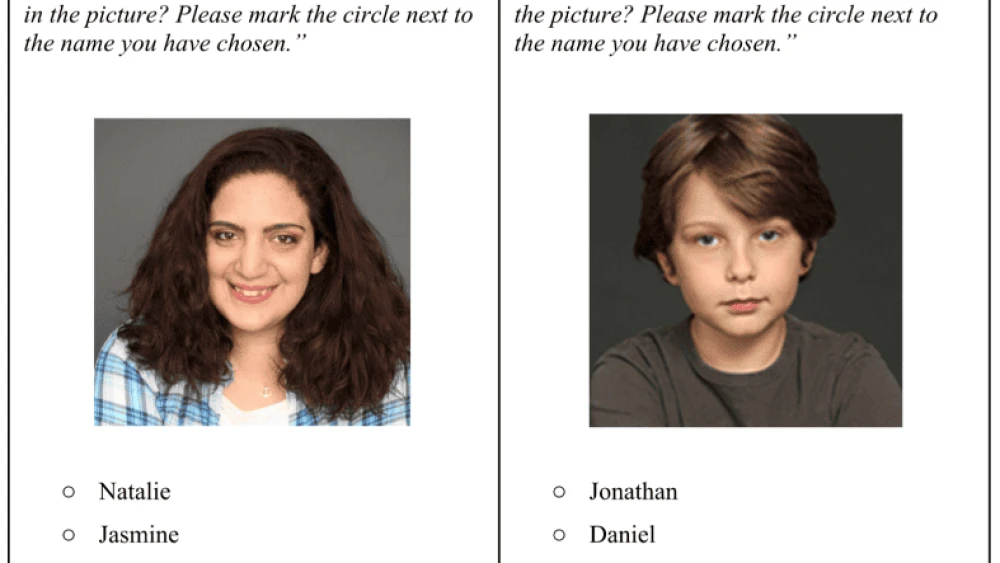
Examples of trials from the study, including an adult on the left and child on the right. Credit: Hebrew University of Jerusalem.

What’s in a name? Your facial appearance, according to a study from Hebrew University researchers published this month in the Proceedings of the National Academy of Sciences (PNAS), a peer-reviewed journal of the National Academy of Sciences.

Using human perception tests and machine learning, the scientists found that the faces of adults can be matched to their names more accurately than at chance levels. This was not the case when trying to match children to their names, suggesting that face-age congruence develops as one gets older.

The study was led by professor Ruth Mayo at the Hebrew University with Yonat Zwebner, Moses Miller, professor Jacob Goldenberg of Reichman University’s Arison School of Business and Noa Grobgeld from the Hebrew University.

“These results suggest that the congruence between facial appearance and names is not innate, but rather develops as individuals mature,” explained Prof. Mayo. “It appears that people may alter their appearance over time to conform to cultural expectations associated with their name.”

According to the machine-learning algorithms, adults with the same name shared similar facial features. In other words, the “self-fulfilling prophecy” highlights how social factors can shape our appearance.

There was never a question whether bar and bat mitzvahs were going to continue, says Rabbi Marla Hornsten at Temple Israel, despite the havoc that had teachers and children evacuate the building.
“We will not rest in the mission to stop the spread of radical Islam,” Texas Gov. Greg Abbott stated.
The panel conducts research on antisemitic activity and works with public and private entities on statewide initiatives on Holocaust and genocide education.
“If it’s something that families are attuned to, then I think it may be a good way to engage the kids on that level,” Rabbi Steven Burg, of Aish, told JNS.
“I was a little surprised at the U.K. to be honest with you,” U.S. President Donald Trump told reporters at the White House. “They should have acted a lot faster.”
“It is imperative that university administrators rise to the occasion to take a firm stand against antisemitism and racial violence,” Sen. Bill Cassidy wrote.