


As the importance of space assets becomes clearer than ever to militaries and governments worldwide, the Israel Air Force is creating its own “Space Administration.”
The role of the IAF’s Space Administration, which will initially be commanded by an officer with the rank of lieutenant colonel, will be to examine new ways for Israel to use space “in ways that cannot be detailed,” according to a Jan. 3 report by Israel Hayom.
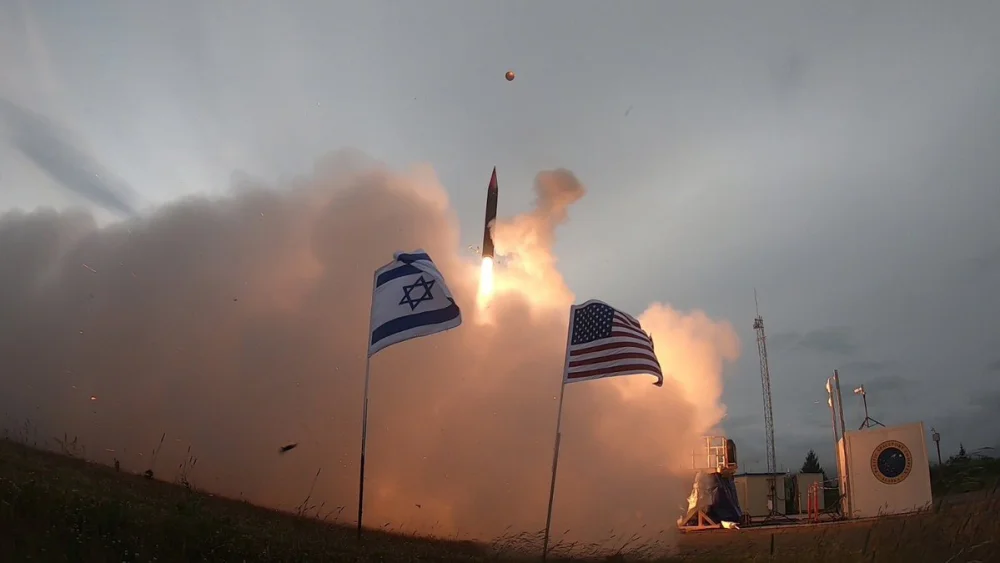
Although the IAF became officially known as the Israel Air and Space Force some 20 years ago, it has hitherto dealt very little with the space arena, with the exception of the Arrow 3 anti-ballistic missile interceptor, which leaves the atmosphere and navigates in space to take down long-range threats.
In general, international media reports have linked such air defense systems worldwide with a dual potential capability of intercepting ballistic missiles and targeting enemy satellites.
The ongoing Russian-Ukraine war has recently underlined the vital nature of space assets as well as the growing role of the private sector in providing services to militaries in this context.
Private satellite communications providers such as Elon Musk’s SpaceX provide services for Ukraine, and American imagery companies provide targeting information for the Ukrainian military.
The United States military has reportedly begun using commercial satellite imagery from private firm Maxar Technologies, as have U.S. allies.
Tal Inbar, a senior research fellow at the Missile Defense Advocacy Alliance, a nonprofit organization that promotes public support for missile defense systems in defense of the U.S. and its allies, told JNS on Tuesday, “The importance of the space field for the operations of every military is only becoming increasingly clear. Hence, we can expect and hope that the IAF too will utilize space as an element that uses space in a meaningful manner, and that it will be formulating activation concepts while also initiating research and development as well as manufacturing of Israeli space systems.”
Inbar noted that within the Israel Defense Force’s internal politics and budget allocation dynamics, the IAF may also have decided that it wants to take a slice from the space cake and develop real substance in this area, rather than leaving the space arena exclusively to Military Intelligence’s Unit 9990, which operates Israel’s spy satellites.
Many observers see the 1991 First Gulf War as the first major harbinger of the space military age, and since then, militaries have only grown more invested in such capabilities.
The Israeli Defense Ministry’s Directorate of Defense Research & Development has had its own space administration for some 40 years, which is mainly responsible for research and development of satellites.



