Newsletter
Newsletter Support JNS

IDF soldiers begin to vote at special army ballot boxes

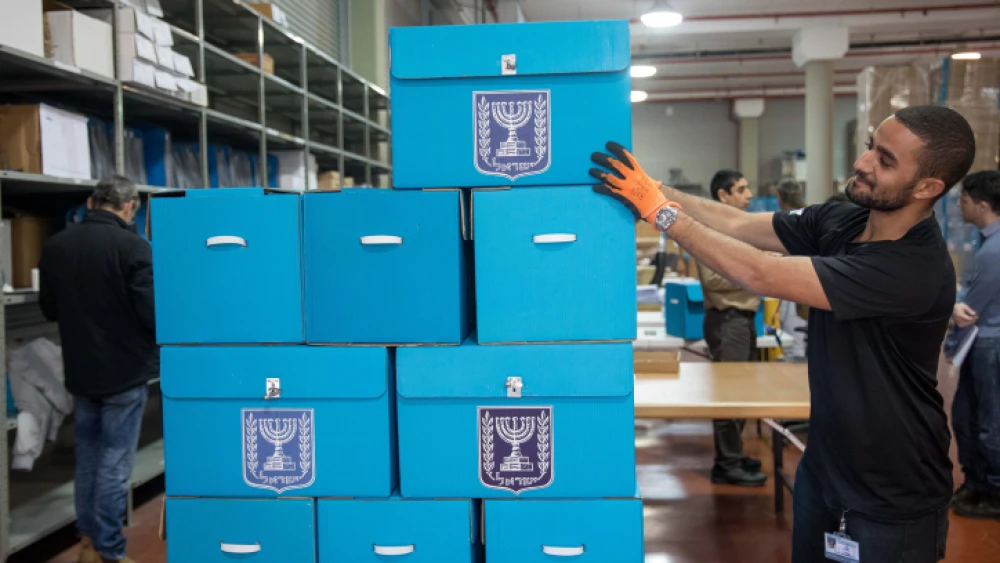
Voting has begun for Israeli military personnel, with 643 ballot boxes set up for Israel Defense Forces soldiers’ across the country, available 72 hours before national polls open on April 9.

Ballot boxes at a Central Elections Committee warehouse in Shoham, prior to being shipped to polling stations across Israel, March 25, 2019. Photo by Noam Revkin Fenton/Flash90.

Voting has begun for Israeli military personnel, with 643 ballot boxes set up for Israel Defense Forces’ soldiers across the country, available 72 hours before national polls open on Tuesday.

Voting kicked off late Saturday night and will take place until ballots close on April 9 to enable soldiers stationed away from voting centers, in addition to those embedded in the field on missions, to vote along with the general public.

Some 130 mobile polling stations have been deployed by the military to remote outposts and distant units.

“The Central Elections Committee and the IDF will ensure the elections are fair ... and the soldiers are able to decide who to vote for, like the rest of the Israeli public,” said head of the Central Elections Committee, Justice Hanan Melcer, during visits to IDF voting booths.

For many soldiers, this will be their first time voting in a national election.

“These attacks come amid a broader rise in violent extremism across Canada and other Western democracies—a toxic brew of anti-Zionist rhetoric, local criminal elements, Iranian-backed proxies and ISIS-inspired terrorism,” CIJA stated.
“Iran and Israel are the only two countries on this planet that have a biblical relationship,” the exiled Iranian Crown Prince Reza Pahlavi said.
“We discussed the friendship and relations between Israel and Bahrain, as well as the importance of the U.S.-led Abraham Accords,” Isaac Herzog said.
The cause of the blaze near the grave of Rabbi Shneur Zalman of Liadi was not immediately clear.
The Japanese Red Army member, who helped kill 26 people, lived in Lebanon since his release in a 1985 prisoner exchange.
The suspect’s writing about the deadly Samaria shooting prompted an investigation and the seizure of ammunition, cash and fireworks.