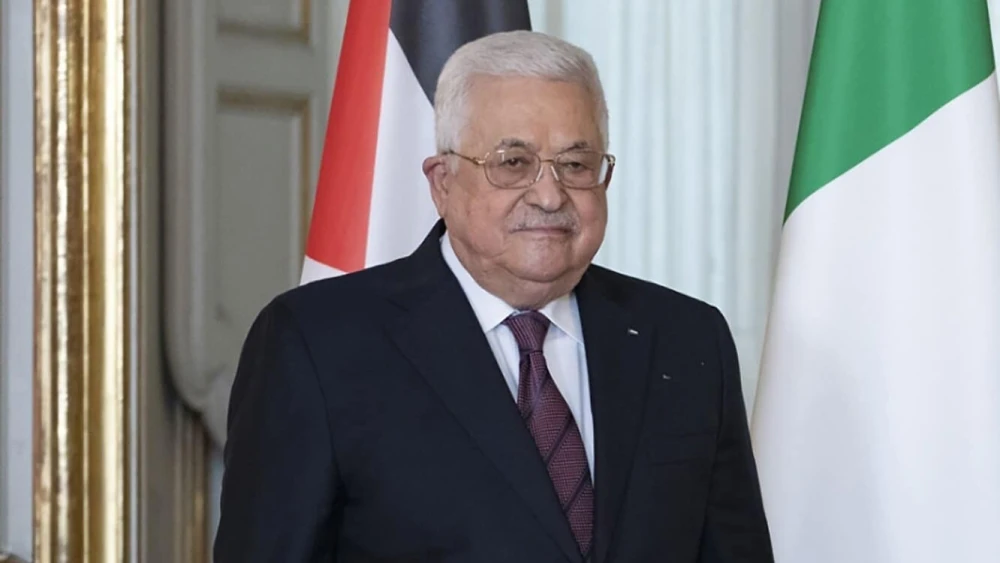
Palestinian Authority leader Mahmoud Abbas claimed last week that in the Quran, the Jewish Temple is described as being in Yemen.
“In the Noble Quran—and I believe that also in other divine books—it says that the [First and Second] Temples were in Yemen,” said Abbas on April 23 in a televised speech during the 32nd PLO Central Council meeting in Ramallah.
He made the remarks in the context of his claim that Israeli authorities were targeting Jerusalem’s Al-Aqsa Mosque, which is built on the Temple Mount, where the Jewish Temple used to stand.
“The Jews say, ‘This is ours, that was ours....’ No. That’s not what the Quran says,” said Abbas, according to a translation of his Arabic-language speech by the Middle East Media Research Institute (MEMRI.)
Scholars, including Nadav Shragai in his 2020 book “Al-Aqsa Terror: From Libel to Blood,” have identified false claims about the Quran’s localization of the Jewish Temple as a trend in a recent attempt at historical revision by Palestinian nationalists to deny Jewish ties to the place and strengthen Muslim or Arab ones.
“The attempts by Palestinian leaders like Yasser Arafat or Saeb Erekat to cast doubt on the Temple’s existence on the Mount or to distance it from that location by claiming that there was indeed a Temple, but in Nablus or Yemen, stem from one sole motive,” wrote Shragai: “The desire to expunge from the Temple Mount a competing Jewish historical narrative and a competing historical and religious awareness, since these could becloud their own historical and religious narrative on the Mount.”
Abbas’s predecessor, Yasser Arafat, also repeated this theory. On Sept. 25, 2003, Arafat told Arab leaders from northern Israel that no Jewish Temple had existed in the Land of Israel, but rather in Yemen. Arafat told his listeners that he had visited Yemen and seen with his own eyes the site upon which Solomon’s Temple once stood.
The previous year, another top PLO figure, Haj Zaki al-Ghul, stated that King Solomon had ruled over the Arabian Peninsula, and that it was there, not in Jerusalem, that he built his Temple.
Professor Yitzhak Reiter of the Jerusalem Institute for Policy Research, in a 2011 essay in The American Interest, traces the Yemen canard to Kamal Salibi, professor emeritus at the American University of Beirut and subsequently director of the Royal Institute for Interfaith Studies in Amman. In a 1985 book, Salibi claimed that biblical Jerusalem was located in the Arabian Nimas highlands, halfway from Mecca to Yemen.
The Quran does not name Jerusalem, but for centuries, Muslim scholars have acknowledged that the Jewish Temple stood there, including in the writings of Abu Jafar Muhammad bin Jarir al-Tabari, Muhammad al-Idrisi, who visited Jerusalem in the 12th century, theologian Taki ad-Din Ahmad ibn Taymiyyah (1263-1328) and 14th-century historian Abd al-Rahman ibn Khaldun, according to Shragai.
The current Muslim denial of this history, particularly since 1967, is a relatively recent political fabrication aimed at delegitimizing Jewish claims and justifying incitement and violence under the false claim that “Al-Aqsa is in danger,” he wrote.
In the same speech, Abbas also used sharp-worded language against Hamas, urging it to free the Israeli hostages it is holding.
“[Hamas says:] ‘We won’t release the American hostage.’ You sons of dogs, release the [hostages] and spare us this! Strip the [Israelis] of their excuses,” he exclaimed.
That part of his speech grabbed headlines worldwide, with some commentators presenting the statement as evidence that Abbas is a pragmatist working to de-escalate the war in Gaza. Others interpreted Abbas’s criticism of Hamas as posturing for Western audiences, meant to serve the Palestinian Authority’s agenda of taking over Gaza from its arch-rival Hamas under Israeli and Western auspices.