Newsletter
Newsletter Support JNS

Castro pledges to keep US embassy in Jerusalem

“I don’t believe that it would be productive to go backwards at this point,” said 2020 Democratic presidential candidate Julian Castro.

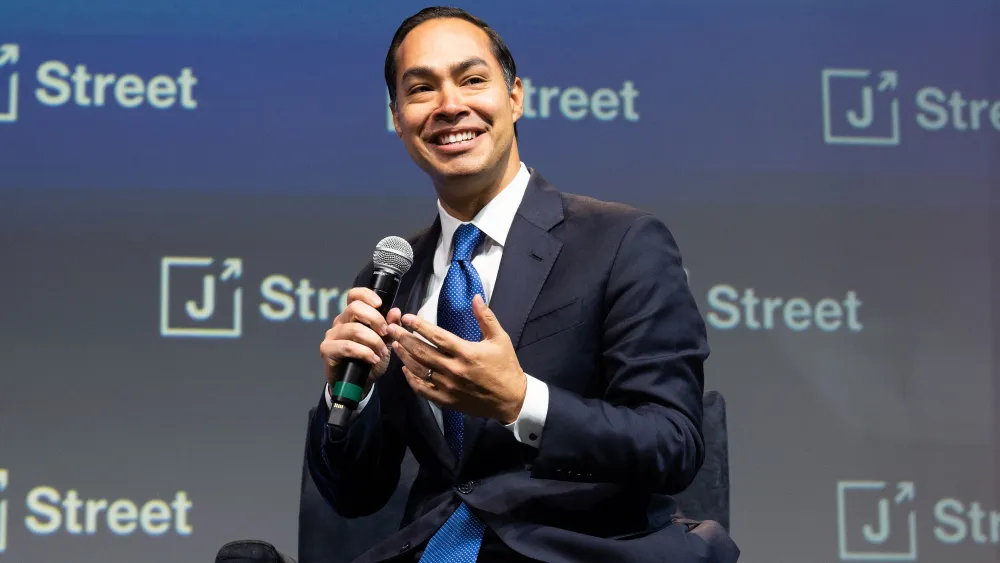
Former U.S. Housing and Urban Development Secretary Julian Castro, a 2020 Democratic presidential candidate, at the annual J Street Conference in Washington D.C., on Oct. 28, 2019. Credit: Michael Brochstein/Split Stone Media.

Julian Castro, former U.S. Housing and Urban Development Secretary and current Democratic presidential candidate, said on Thursday that if elected, he would keep the U.S. embassy in Israel in Jerusalem.

U.S. President Donald Trump relocated the embassy there from Tel Aviv in May 2018, just months after recognizing Jerusalem as Israel’s capital.

“The actions of this president when it comes to Israel and Palestinians in the Middle East has been counterproductive in helping ensure a two-state solution,” Castro told JNS on a conference call for members of the media. “I believe that he made a mistake in moving the embassy to Jerusalem without making that part of a larger, negotiated peace agreement and a two-state solution.”

“However,” said Castro, “I also don’t believe that it would be productive to go backwards at this point.”

He added, “I believe that we need to work to ensure that we’re both respecting the human rights of Palestinians and also working with Israel, our ally, as they forge a new government with a new opportunity to pursue a two-state solution.”

Other candidates who’ve pledged to keep the U.S. embassy in Jerusalem include former U.S. Vice President Joe Biden, South Bend Mayor Pete Buttigieg, Sen. Amy Klobuchar (D-Minn.), Sen. Cory Booker (D-N.J.), Sen. Michael Bennet (D-Colo.), and author and spiritual guru Marianne Williamson.

At the annual J Street conference in October, Castro expressed support for opening a U.S. consulate in eastern Jerusalem and “make clear that under a two-state approach, that would be the embassy to a Palestinian state.”

He also called for restoring U.S. assistance to the Palestinian Authority and the U.N. agencies supporting the Palestinians. If elected, he said that he would reopen the Palestine Liberation Organization mission in Washington, D.C., which the Trump administration shuttered in October 2018.

In a draft report delivered to the U.S. president, the commission also called for improved religious accommodations for U.S. service members.
Salah Salem Sarsour, accused of concealing Israeli military court convictions on immigration forms, argued his detention was part of a Trump admin effort to target the pro-Palestinian movement.
CENTCOM stated that the strikes targeted missile, drone and radar facilities after the Islamic Republic attacked a cargo ship in the Strait of Hormuz, calling the assault a violation of the ceasefire.
Now that the primaries are over, “we hope that everyone will come together and be united,” Christine Quinn, chair of the executive committee of the New York State Democratic Party, told JNS.
An Iranian official warned on Friday that the safety of ships passing through the Strait of Hormuz without Iran’s permission “cannot be guaranteed.”
“We have put the train back on the tracks and going in the right direction,” said Yechiel Leiter, Israeli ambassador in Washington. “Final destination? Peace between our two countries.”
Benny Gantz, JNS editor-in-chief Jonathan S. Tobin, Gilad Erdan, Mosab Hassan Yousef, Nissim Black and leading voices in security, diplomacy, media, law and Jewish communal affairs headline the summit’s third day in Jerusalem.