


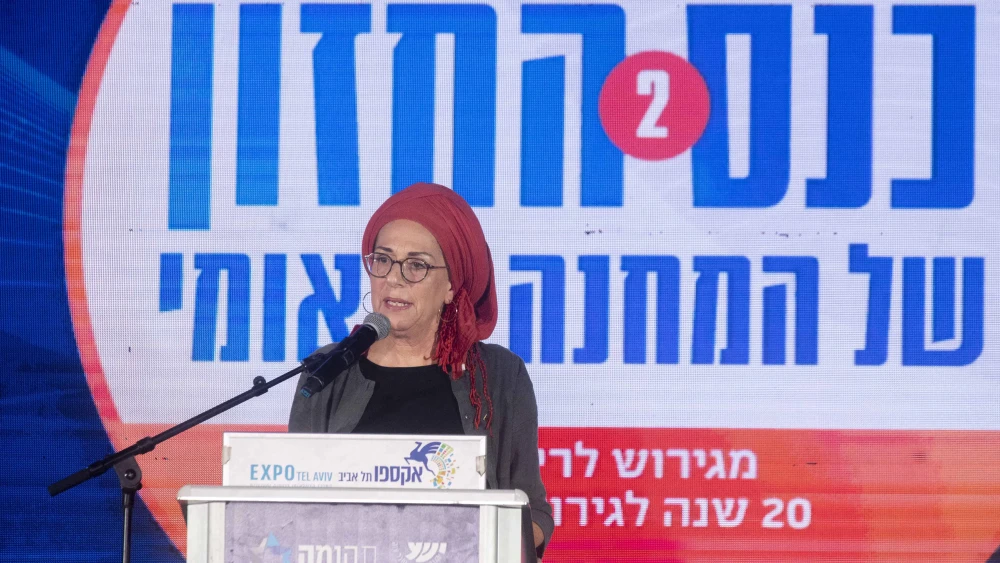
The fuel that Israel lets into the Gaza Strip likely powers the ventilation systems that bring air to the hostages in Hamas’s tunnels, Ditsa Or, the mother of one of those hostages, told JNS during an interview last week.
All the same, she wants Israel to stop supplying the fuel.
“Maybe it will force Hamas to take Avinatan and the other hostages up to the surface, making them easier to track down,” she said. “Maybe supplying the fuel only entrenches Hamas and furthers the hostages’ release.”
Her family has advocated firmer military action against Hamas, even as other families of hostages demand that the government give in to the terrorist group’s demands.
These competing approaches reflect a broader disagreement in Israeli society. After simmering for months, these tensions have been brought to the fore in recent weeks, as Israel simultaneously pursues talks with Hamas and a military operation in Gaza City.
Israel has allowed more humanitarian aid and fuel to enter Gaza last month following disputed reports of starvation in the area.
The fuel, said Ditsa Or, was an example of the uncertain impact surrounding any course of action vis-à-vis Hamas. A partial deal that would result in the liberation of only some hostages may doom the rest, she added.
Given these uncertainties, Israelis “need to stand firm and defeat their enemies while keeping up faith that doing this is also the most promising course of action for freeing the hostages,” she continued.
Avinatan Or, who recently turned 32, and the other 19 hostages presumed to still be alive in Gaza “entered a state of grave danger to their lives the minute they were abducted on Oct. 7, 2023,” she said. “No one has a path to freeing them that eliminates that danger. There are very dangerous implications to any course of action.”

In this reality, she added, “I can only try to take actions that I believe will safeguard his life, and at the same time not endanger others from our People. So that’s what I’m trying to do.”
Ditsa and her husband, Yaron, who have seven children and live in Shilo in Samaria, belong to a group of parents called the Tikva Forum, who believe military pressure on Hamas is the surest way to free their loved ones.
Another, larger group, the Hostages and Missing Families Forum, believes that the best way to get the hostages back is to give in to Hamas’s demands.
Hamas is reportedly offering to release some of the hostages in exchange for a 60-day ceasefire, a partial Israeli pullout from the Gaza Strip, the release of some 200 Palestinian prisoners from Israeli jails and a return to the U.N.-led humanitarian aid distribution process that it had controlled for years before the outbreak of war on Oct. 7, 2023.
Last week, hundreds of thousands of Israelis participated in a series of nationwide protests demanding that the government take the deal. Universities and many businesses declared a one-day strike in solidarity with the protests, which the Hostages and Missing Families Forum endorsed and helped organize.
To Ditsa Or, these were empty gestures.
“Besides making some of the participants feel good for a while, I don’t see what the strike and protests achieved. They showed Hamas that the government is under pressure. They disrupted the lives of many thousands of families, many of them with husbands serving in the reserves and mothers struggling to take care of children at the end of the summer school vacation. And they didn’t do a single thing toward getting Avinatan and the other hostages back home,” she said.
She has also been critical of the government. In a speech in Tel Aviv last month, she compared the government’s dual approach to the indecisiveness that the Prophet Elijah decried in the Book of Kings.
“Elijah saw the People of Israel as going back and forth from paganism to the belief in God. He told them to commit to one option, preferably the good one, but otherwise the bad one. This was preferable to their sitting on the fence,” she said.
Despite the differences of opinion and worldview that separate her from some of the other hostages’ parents, she feels emotionally connected to them, she emphasized. She regularly visits the Hostages and Missing Families Forum families at Tel Aviv’s Hostages Square, and has attended many events with the Forum parents.
“When we meet, we don’t talk geopolitics. We speak about what unites us, which is almost everything,” she said. “I’ve made it a mission to stay connected with them because we share the same fate, just like the rest of Israel.”
Neither she nor they “have the key out of the terrible labyrinth we find ourselves in. If we look around us, it’s an equation without a solution, a riddle without an answer.”
This is why “we need to look upwards. To God. To faith. That’s the missing dimension that we need to constantly remember as we look for a way out of this situation,” she said. “It’s our only way out.”


