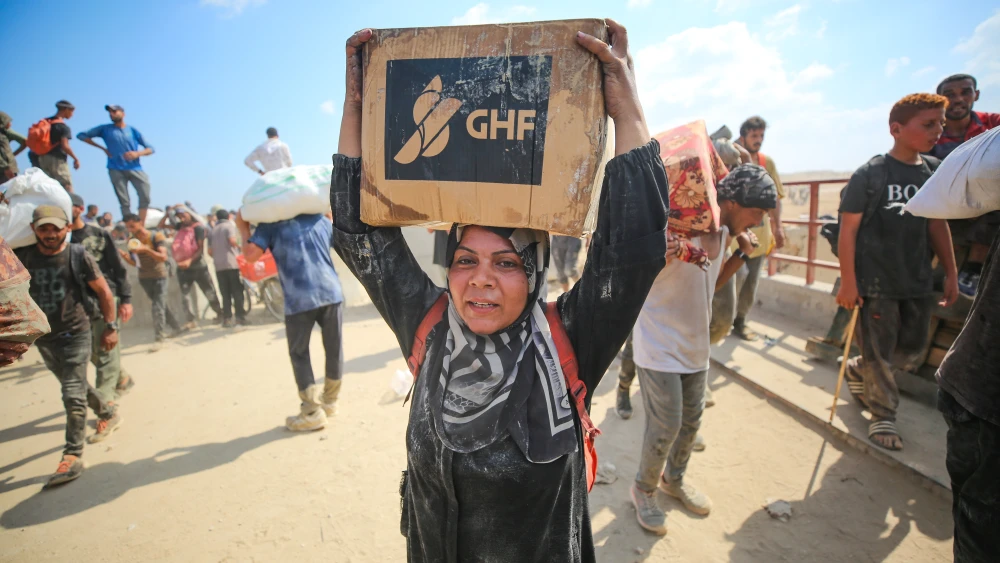
The Gaza Humanitarian Foundation announced on Monday that it is formally ending its emergency aid mission to the coastal enclave.
John Acree, the foundation’s executive director, said that creating the U.S.-led Civil-Military Coordination Center under the Trump administration’s 20-point Israel-Hamas ceasefire plan reduced the need for the foundation to continue operating.
“GHF’s goal was to meet an urgent need, prove that a new approach could succeed where others had failed and ultimately hand off that success to the broader international community,” Acree stated. “GHF believes that moment has now arrived.”
The foundation was created in February 2025 and claims that it has distributed 187 million meals to Gazans at a time when nearly 90% of aid from more established organizations, like the United Nations, was diverted by Hamas or looted. According to the foundation, “not a single GHF aid truck was looted” during its four-and-half months of aid delivery operations.
Throughout its existence, GHF faced criticism and questions about its independence and efficacy, including the extent to which it enjoyed the support of the U.S. and Israeli governments, Hamas’s killing of GHF’s local staff and reports of mass shootings at or near GHF sites.
Israel has denied claims that it was responsible for firing on Gazans seeking aid at GHF distribution centers.
The U.S. State Department thanked GHF for its efforts on Monday.
“GHF’s model, in which Hamas could no longer loot and profit from stealing aid, played a huge role in getting Hamas to the table and achieving a ceasefire,” wrote Tommy Pigott, the department’s deputy spokesman.
Acree said on Monday that the foundation’s model of aid distribution should be emulated in other parts of the world and in future Gaza aid plans.
“I am hopeful the Civil-Military Coordination Center and the international community writ large will learn from our success, understand the process we implemented and replicate it throughout Gaza in order that the safe delivery of food and other humanitarian aid will continue,” he said.
The group said that it will “maintain readiness to reconstitute if new humanitarian needs are identified and will not dissolve as a registered NGO.”