


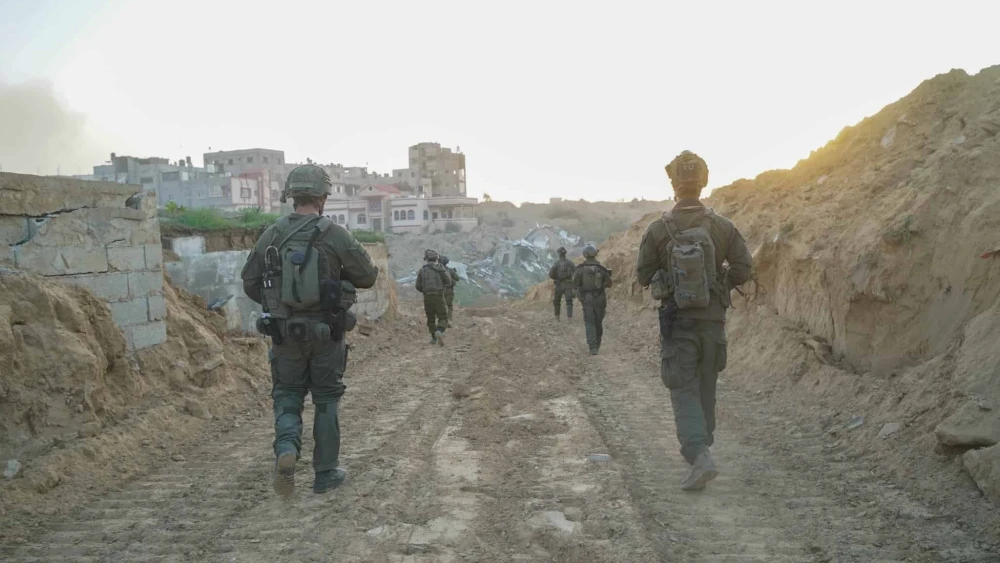
The Israeli military will reach Hamas’s leadership in the Gaza Strip “whether it takes a week or months,” Israel Defense Forces Chief of Staff Lt. Gen. Herzi Halevi vowed on Tuesday after visiting the Palestinian enclave.
The war against Hamas will “continue for many more months, and we will act in different ways—so that the achievement is preserved over time,” said Halevi. “There are no magic solutions, no shortcuts in the fundamental dismantling of a terror organization, but rather stubborn and resolute fighting, and we are very, very determined.”
“We eliminated many terrorists and commanders, some of whom surrendered to our forces, and we took hundreds captive. We destroyed underground infrastructure and many weapons,” Halevi said. “Now, we are focusing our efforts on the south of the Strip—Khan Yunis, the central camps and beyond, and we will continue both to maintain and deepen the achievement in the north of the Strip.”
Halevi added that Israel won’t permit a return to the pre-Oct. 7 security situation. “We will not allow such an event to recur,” he said.
Israeli Air Force airstrikes continue, according to Halevi. “A building falls when it is an enemy target. A building falls when it poses a danger to our forces,” he said.
Israeli ground forces operating in Gaza receive heavy fire support from the air, sea and land wherever and whenever they requested it, the IDF chief said. The military is learning and adapting its methods, as it learns about each area and its terrain, the enemy and its own needs, he added.
“We are intensifying the military pressure in different ways, with cunning,” Halevi said. “This pressure allows the realization of the war goals—the dismantling of Hamas and the return of the captives.”
Responding to a reporter’s question, Halevi stressed that Israel “has the armaments required to do what is needed in all arenas.”
“I will not specify numbers here. I do not think it is right for those around us to know what weapons the IDF manages—we should keep it to ourselves,” he said.
Earlier on Tuesday, Defense Minister Yoav Gallant briefed members of the Knesset Foreign Affairs and Defense Committee at the Defense Ministry in Tel Aviv.
“We are in a multi-front war. We are being attacked from seven different sectors—Gaza, Lebanon, Syria, Judea and Samaria, Iraq, Yemen and Iran,” he said. “We have responded and acted already in six of these sectors, and I say here in the most explicit way: Anyone who acts against us is a potential target, no one is immune.”
“The State of Israel will know what to do. The defense establishment is prepared,” he warned. “The results in Gaza everyone sees and understands, especially Hamas, Iran and Hezbollah.”
“I want to tell you that this is a long, hard war and there are prices—heavy prices—but its justification is the highest,” he added. “We were attacked brutally and barbarically in order to deter us from living here. We must make clear that anyone who makes such a move is decisively defeated. Whether it takes months or years, this matter must be finished.”
Also on Tuesday, the IDF announced that three more soldiers were killed in action in Gaza.
Maj. Shay Shamriz, 26, a company commander in the Nahal Brigade, and Capt. (res.) Shaul Greenglick, 26, an officer in the Nahal Brigade, were killed in northern Gaza. Master Sgt. Maor Lavi, 33, of the School for Infantry Corps Professions and Squad Commanders, was also killed in Gaza. The IDF did not specify where in the Strip.
Meanwhile, the IDF Givati Brigade’s Tsabar battalion, which fought to secure Kfar Aza during Hamas’s Oct. 7 massacre, is engaged in fierce battles in Daraj Tuffah in the northern Gaza Strip, the IDF said.
In one operation, the forces killed many terrorists in close-quarter combat. Soldiers found and destroyed 10 tunnel shafts. They also destroyed rocket launchers and located an explosive device, a box of grenades and uniforms worn by Hamas’s elite “Nukhba” terror squad.


