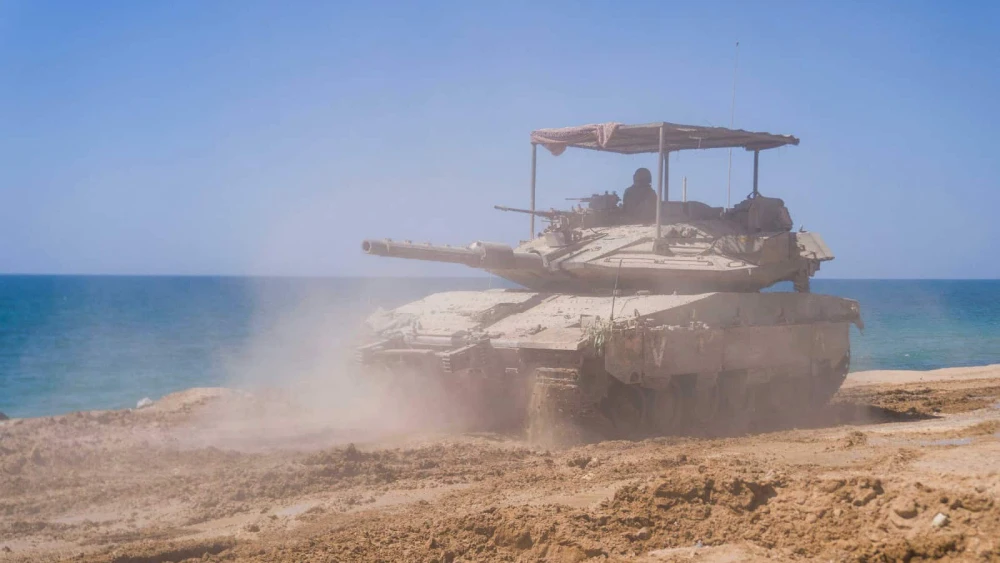
Around half of Hamas’s battalions in its last bastion of Rafah in southernmost Gaza have been dismantled during the current military operation there, the Israel Defense Forces said on Monday.
Furthermore, soldiers from the Armored Corps’ 162nd Division have killed at least 550 terrorists and destroyed some 200 tunnel shafts since tanks first rolled into Rafah in early May, taking control of the border crossing with Sinai and the eastern section of the city, before expanding activities to other areas, eventually securing the entire Gaza border with Egypt, known as the Philadelphi Corridor.
According to the IDF, many more terrorist operatives were killed in strikes on buildings and tunnels, while an unknown number of terrorists fled Rafah when the battle started.
Out of the four Hamas battalions in Rafah before the IDF ground incursion into the Gaza Strip, two—Yabna (south) and east Rafah—have been almost completely dismantled, while the other two—Tel Sultan (west) and Shaboura (north)—have been moderately broken down as the army continues to fight in these two neighborhoods.
Along the 8.7-mile Philadelphi Corridor, Israeli forces have located hundreds of rockets, including dozens of long-range rockets aimed at central Israel. The tunnels unearthed led to many underground routes, including at least 25 tunnels reaching the Egyptian border, some of which likely cross into Sinai and were used by Hamas to smuggle weapons. The IDF is further investigating these tunnels.

Israeli forces have gained operational control of the NPK neighborhood after intense fighting there over the past week, both above and below ground. It contained the headquarters of Hamas’s Rafah Brigade.
The 162nd “Steel Formation” Division, under the command of Brig. Gen. Itzik Cohen, has achieved operational control of 60-70% of Rafah, with full control expected in two weeks.
Also on Monday, air-raid sirens sounded in Kibbutz Kerem Shalom, a community near the southern Gaza Strip.
According to the IDF, more than a million noncombatants in the Rafah area fled the combat zone to Al-Muwasi, central Gaza and Khan Yunis.
Twenty-two soldiers from the 162nd Division have been killed during the Rafah operation, including eight early on Saturday morning when their “Namer” armored personnel carrier was destroyed during an operation in Tel Sultan.