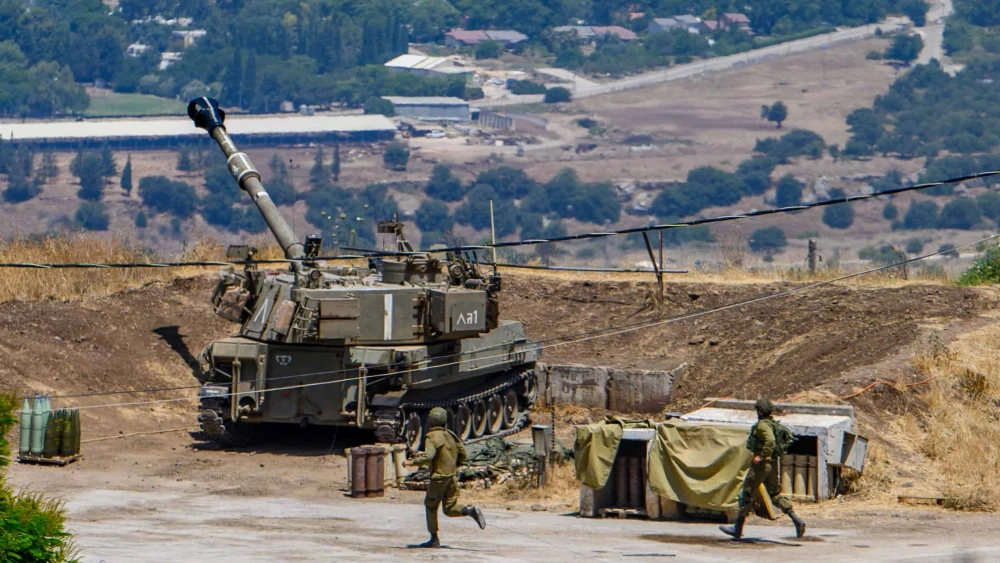
The Israel Defense Forces on Sunday hit targets in Southern Lebanon with artillery after Hezbollah terrorists there fired mortars at the Jewish state.
The military confirmed that there were no casualties in the Hezbollah attack.
The shells landed in the contested Mount Dov region close to the Blue Line, which demarcates the 120-kilometer (75-mile) border and was created in the year 2000 by U.N. cartographers to verify Israel’s withdrawal from Lebanon.
Hezbollah claimed responsibility for Sunday’s fire, saying it targeted three Israeli military sites in solidarity with the “Palestinian resistance.”
Footage shows mortars fired from Lebanon landing in the Mount Dov area pic.twitter.com/qoVK9aEw3X
— Emanuel (Mannie) Fabian (@manniefabian) October 8, 2023
In response, the IDF carried out a drone strike against “Hezbollah infrastructure,” with Israeli media reporting the targeting of a tent the Iran-backed terror group set up in Israeli territory in April.
The Hezbollah outpost was constructed north of the border fence but on the Israeli side of the U.N.-marked Blue Line. The position, across from an Israeli military base, was reportedly initially manned by three to eight armed terrorists.
Hezbollah does not recognize the Blue Line and disputes numerous points along the border.
תיעוד מתקיפת תשתיות חיזבאללה מוקדם יותר היום במרחב הר דב: pic.twitter.com/Myrb7r1pqZ
— צבא ההגנה לישראל (@idfonline) October 8, 2023
A U.N. peacekeeping force deployed along the border called on Sunday for “everyone to exercise restraint” and use the body’s “liaison and coordination mechanisms to de-escalate.”
UNIFIL added it is in contact with authorities on both sides of the border at all levels “to contain the situation and avoid a more serious escalation.”
Last month, the IDF bolstered its forces on the country’s northern border after a Lebanese “engineering vehicle” strayed a few meters into Israeli territory. In July, the IDF revealed that armed Hezbollah terrorists were spotted patrolling the border in clear violation of a legally binding U.N. resolution.
On March 15, a terrorist who infiltrated into Israel from Lebanon planted a roadside bomb in northern Israel that severely wounded a motorist. Shareef ad-Din, 21, from the Israeli Arab town of Salem, was caught in the blast when the device detonated behind a road barrier near the Megiddo Junction, some 18 miles southeast of Haifa.
Hezbollah said that Saturday’s devastating multi-pronged Hamas attack on Israel was in response to both the “continued occupation and a message to those seeking normalization with it.”
The United States has been working on a landmark peace deal between Israel and Saudi Arabia, which many believed could be signed in the coming months.
Hamas killed at least 700 Israelis on Saturday—the Jewish holiday of Simchat Torah—as it launched a massive offensive from the Gaza Strip, including firing more than 3,000 rockets and sending dozens of Palestinian terrorists to infiltrate the Jewish state.
In April, Hamas fired 34 rockets from southern Lebanon towards northern Israel in the biggest attack emanating from the Hezbollah-controlled country since the 2006 war.