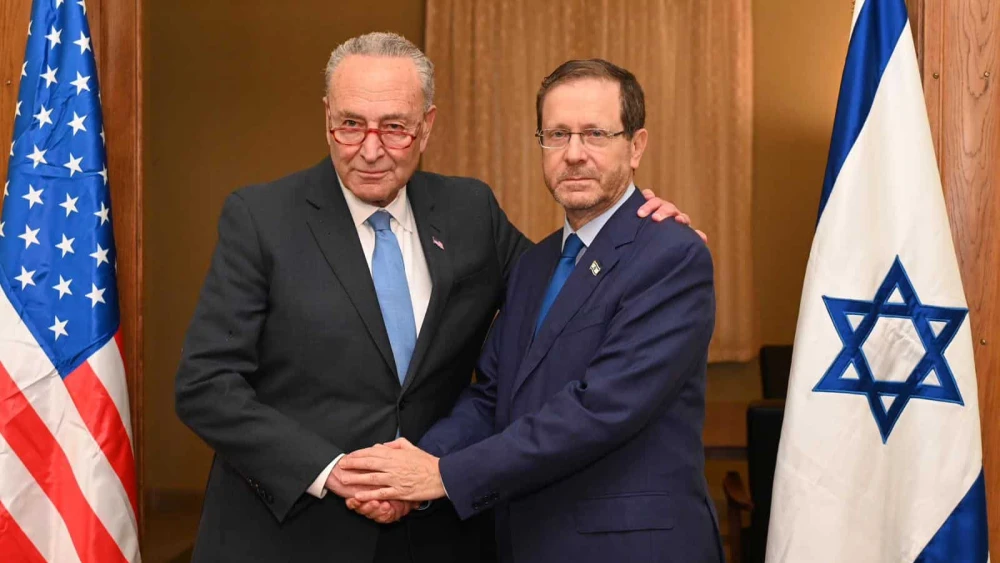

Dr. Abdul El-Sayed’s narrow victory in Michigan’s Democratic Senate primary was a clarifying moment. By endorsing the winner, Senate Minority Leader Chuck Schumer (D-N.Y.) abandoned all pretense of serving as a shomer, or “guardian,” of the beleaguered Jewish community. It is not just that Schumer indicated that he would endorse even an antisemite for political gain; it is that he did.
El-Sayed has not hidden his attitude toward Jews, which wallpapers slogans about Israel and Zionism over classical antisemitism. No one of intelligence could fail to see the similarities between his beliefs and those that overtook Germany less than a century ago.
He regards the Jews as a collective threat, stating without evidence that the Israeli government is “just as evil as Hamas,” the genocidal terrorists responsible for the worst anti-Jewish massacre since the Holocaust. El-Sayed claimed that rescuing hostages from torture and rape, and neutralizing those genocidal terrorists, constitutes “genocide.” Jewish lives, in other words, have no value in his view.
In a modern spin on the old “Chosen People” myth, he accuses Jews of racism, calling the only Middle Eastern country that gives both Jews and Arabs civil rights an “apartheid” state. And like his ideological forebears, he considers a boycott of Jews an appropriate “response.” Perhaps worst of all, El-Sayed used these depraved lies about Israel to justify violence against Jews in his home state. This is no different than the Nazis blaming Jews for the violence of Kristallnacht in 1938.
No one who values Western civilization or basic human decency would consider El-Sayed remotely fit to be a U.S. senator.
This brings us back to Schumer, who is placing political gain ahead of moral principle. During the primary, he backed the more moderate, pro-Israel candidate Rep. Haley Stevens. But once El-Sayed prevailed, Schumer immediately pivoted and was quite forthright about why. He issued a statement with Democratic Senatorial Campaign Committee chair Sen. Kirsten E. Gillibrand (D-N.Y.) that declared they were “united by a common purpose” with El-Sayed: “taking back the Senate.”
To Schumer, party cohesion and electoral math come first, while the character of the nominee takes a distant second. That is why he and Gillibrand both supported the now disgraced Senate candidate Graham Platner in Maine, despite his Nazi tattoo and a series of scandals, until a sexual assault accusation from a former Platner girlfriend sent them scurrying like rats abandoning a sinking ship.
For a lesson in moral courage, Schumer could learn from Boy George, who released a new song, “Od Nirkod” (“We Will Dance Again”), standing with the Jewish community at great professional and personal cost. In fact, he could study a political leader Schumer himself has accused of antisemitism in the past: U.S. President Donald Trump.
Trump has openly stated that El-Sayed hates Jews and Israel. Though entirely accurate, one could dismiss this as political posturing based upon party affiliation. This, however, would fail to recognize Trump’s penchant for repeatedly getting it right about hatred of Jews and Israel. He demonstrates this most clearly not when his targets are his political adversaries or adversarial college administrators, but his fellow Republicans.
Trump has distanced himself even from former allies over antisemitism, pushing back when they cross into anti-Jewish bias and conspiracy theories. He forcefully rejected former Georgia Rep. Marjorie Taylor Greene and actively campaigned against soon-to-be-former Rep. Thomas Massie (R-Ky.), both Republicans.
After podcaster Tucker Carlson’s interviews with a series of antisemitic bigots and his subsequent attacks on Trump’s policy on Israel and Iran, including claims that attacked Jewish organizations, Trump declared that Carlson “has lost his way,” is “not MAGA” and does not represent “America First.” Trump has said his movement has no room for antisemites.
This difference in attitude has an obvious practical impact upon the two parties. The most powerful Democratic leaders, including one who proudly trots out his personal Jewish identity whenever it suits him, treat fighting antisemitism and the demonization of the Jewish state as secondary to gaining power.
Leaders on the other side, including Trump, Senate Majority Leader John Thune (R-S.D.) and House Speaker Mike Johnson (R-La.), dismiss erstwhile allies and refuse to include them and their bigoted views for political profit.
This is what Jews in America need: not calculations of which candidate is electable in a purple state, but clarity on who will defend their security and legitimacy without apology.
El-Sayed’s primary victory, coupled with Schumer’s subsequent endorsement, demands a moral choice that transcends political inclinations. True friendship with the Jewish community is evaluated based on actions and adherence to principles, rather than on birth certificates or party affiliations. In this regard, the Democrats’ record is not even close to that of the Republicans.