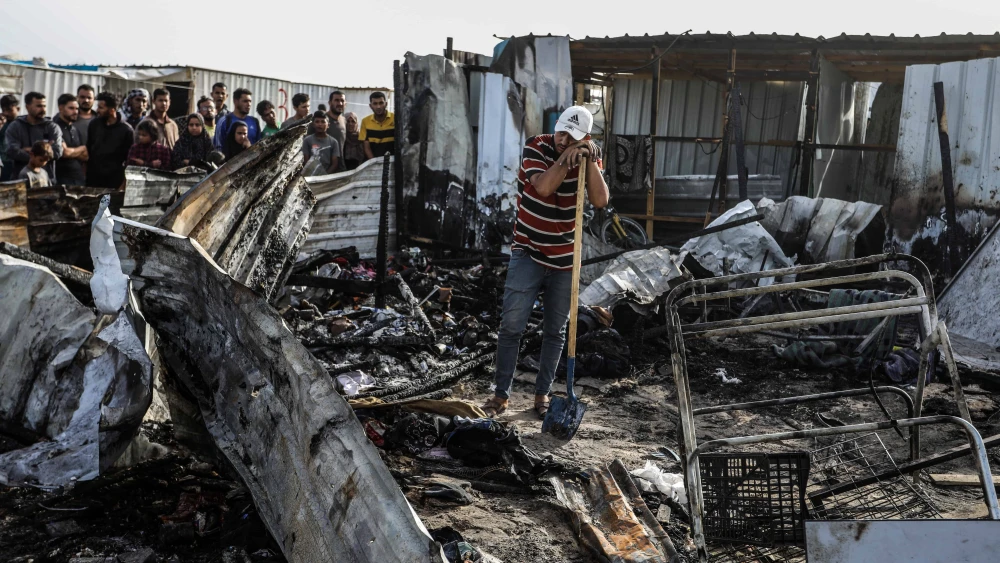
The Israeli military is investigating the possibility that the deadly fire that broke out in Rafah on Sunday night following an Israeli airstrike may have been caused by the secondary detonation of Hamas munitions, a military official said on Tuesday.
Two of the smallest type of munition that can be loaded onto fighter jets, each carrying 17 kilograms (37.5 pounds) of explosives, were used in the strike, the official said. This type of munition has been used hundreds of times by the IAF over the course of the war, he added.
“We are looking into the possibility that weapons stored in the compound next to our target may have ignited the fire,” the official said.
“It should be noted Hamas has been operating from this area since October 7,” he added, noting that a Hamas rocket launcher was located 47 meters away from the compound targeted on Sunday night.
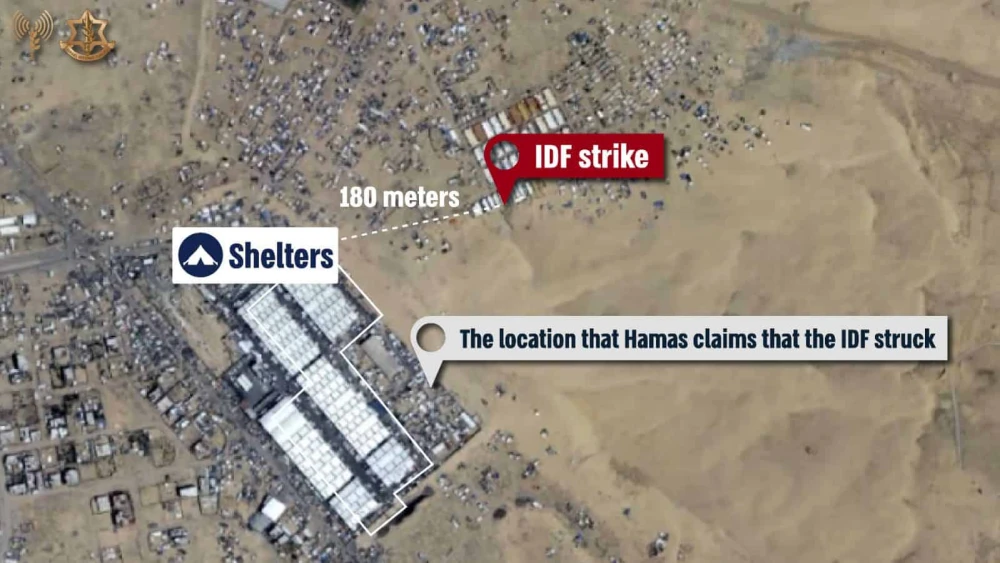
The attack, which targeted a structure in Tal as-Sultan in northwest Rafah, was based on intelligence indicating the presence there of Yassin Rabia, the commander of leadership in Judea and Samaria, and Khaled Nagar, a senior official in Hamas’s Judea and Samaria headquarters.
The military official emphasized on Tuesday that the strike occurred 1.5 kilometers away from the humanitarian evacuation zone established by the IDF.
Rabia managed the whole of Hamas’s terror activity in Judea and Samaria, transferring funds and planning attacks, as well as conducting attacks himself in 2001 and 2002 that killed IDF soldiers.
Nagar directed shootings and other attacks which led to the deaths of several Israeli civilians and soldiers, according to the military. Both were released in the 2011 Shalit prisoner exchange deal and were planning further attacks, the official added.
The IDF was also assessing footage of Sunday’s strike ostensibly captured by Gaza residents and posted to social media that “appears to show secondary explosions,” the official said.
The military also has intelligence reinforcing the suspicion that Hamas weapons were stored nearby and caught fire after the strike, he added.
The source stressed that the possibility that secondary explosions caused the fire remains a working assumption at this point and the investigation into the matter is ongoing.
The investigation is being conducted by the IDF General Staff fact-finding mechanism, which according to the military is an independent professional body.
However, he said that the weapon used in the strike was not capable of causing a fire of this kind, adding that the IDF has much experience in deploying this type of munition.
“Our war is against Hamas. It’s not against the people of Gaza,” said the official.
“This is a very tragic incident that occurred. We have to understand why it occurred. And we have to understand how we prevent this kind of incident from [occurring again],” he said.
On Tuesday afternoon, IDF Spokesperson Rear Adm. Daniel Hagari told reporters that “our munition alone could not have ignited a fire this size … We used the smallest munition that our jets can use.”
“The fire that broke out was unexpected and unintended. This was a devastating incident that we did not expect. We’re investigating what caused this fire,” Hagari said, stressing that the strike targeted a “closed” terrorist structure almost a mile from the Al-Mawasi Humanitarian zone.
The military spokesman continued, “There may have been weapons in the area. Our signals intelligence intercepted phone calls reinforcing this possibility that weapons stored in a nearby compound caught fire.”
He assured that the “investigation will be swift, comprehensive and transparent. Our war is against Hamas, not the people of Gaza. This is why we convey deep sorrow over this loss of life.”
Lastly, the IDF released an audio conversation between two Gaza describing the Rafah attack. pic.twitter.com/ip1AuARTdJ
— Joe Truzman (@JoeTruzman) May 28, 2024