


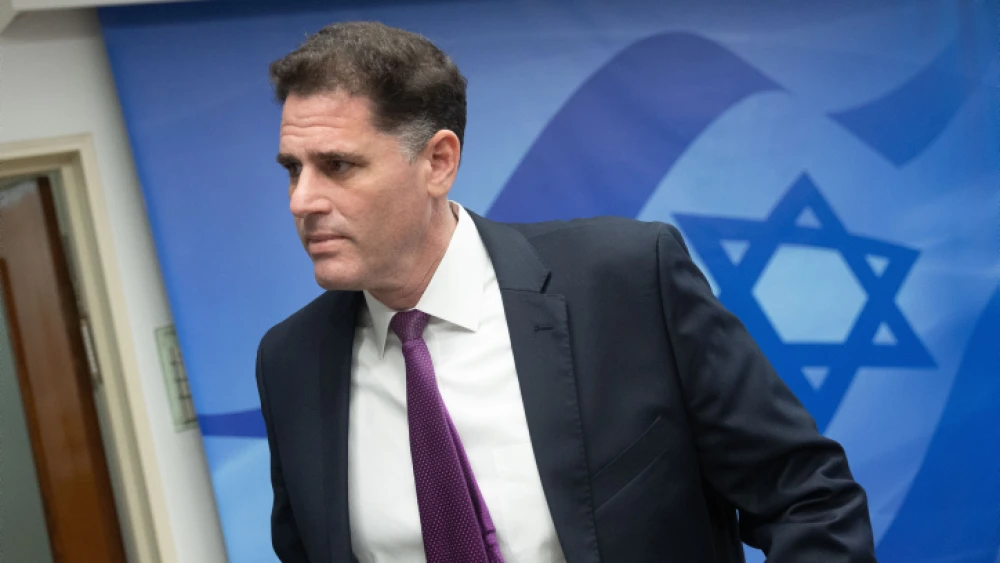
The Israeli Prime Minister’s Office clarified on Sunday that Israel has not agreed to any of its neighboring countries having a nuclear program, without distinguishing between military and civilian programs.
The clarification came after Israeli Strategic Affairs Minister Ron Dermer hinted during an interview with U.S. public broadcaster PBS that the Jewish state might be willing to accept Saudi Arabia starting a civilian nuclear program as part of a normalization agreement.
In the interview, which aired on Aug. 18, Dermer said, “You have countries in the region that can have civilian nuclear power. That’s a different story than a nuclear weapons program.”
Asked if Israel would agree to Riyadh having civilian nuclear capacity, including enrichment, in exchange for a peace deal, Dermer said that “like so many things, the devil is in the details, and we’re going to have to look at what ultimately is agreed upon.”
As a signatory to the Nuclear non-Proliferation Treaty, he continued, "[Saudi Arabia] could go to China or they can go to France tomorrow, and they could set up—ask them to set up a civil nuclear program and to allow for domestic enrichment.
“They could do that tomorrow if they wanted to. So the question that I asked myself is, if the U.S. is involved in this, what will that mean 10 years down the road, 20 years down the road, 30 years down the road, and what’s the alternative?”
With regard to the details of an agreement, said Dermer, “What are the safeguards? And what happens if they take another path, if they take a path with the Chinese or something else? We have to think through that whole thing.”
Conversely, he continued, “Let’s not underestimate the impact that an Israeli-Saudi peace agreement could have on the region and the world. I think, if Saudi—if you get a Saudi-Israeli peace, you’re going to have several other Arab countries, and Muslim countries are going to follow. And I think it’s the ultimate game-changer.”
He emphasized, however, that Israel would not accept any of its neighbors having a nuclear weapons program.
“You have countries in the region that can have civilian nuclear power. That’s a different story than a nuclear weapons program,” he said, adding, “We’re not going to agree to any nuclear weapons program with any of our neighbors.”
In its statement on Sunday, the PMO quoted Dermer as having stated during the PBS interview that “Israel did not agree to a nuclear program of any of its neighboring countries,” adding that “this was and remains Israel’s policy.” The statement did not address the fact that in the interview Dermer distinguished between civilian and military programs.
The PMO went on to state that “Prime Minister Benjamin Netanyahu brought four historic peace agreements that only strengthened the security and status of the State of Israel—and will continue to do so,” referring to the U.S.-brokered Abraham Accords that normalized relations with the United Arab Emirates, Bahrain, Morocco and Sudan.
Dermer last week met with U.S. Secretary of State Antony Blinken in Washington.
“The secretary reaffirmed the United States’ enduring friendship and steadfast commitment to Israel’s security,” Matthew Miller, the U.S. State Department spokesman, stated.
The two officials discussed “cooperation on regional challenges, including threats posed by Iran and its regional proxies in Lebanon and elsewhere. They also discussed ongoing efforts to further Israel’s full integration into the Middle East,” Miller added.
Blinken “emphasized the importance of Israel and the Palestinians taking affirmative steps to de-escalate tensions and bolster stability” in Judea and Samaria, per the department’s readout.
Dermer, the former Israeli ambassador to the United States and a close confidante of Netanyahu, was brought on as a minister in the current government primarily to handle normalization efforts and containment of Iran—two topics on which Dermer has been critical of Biden administration policies.


