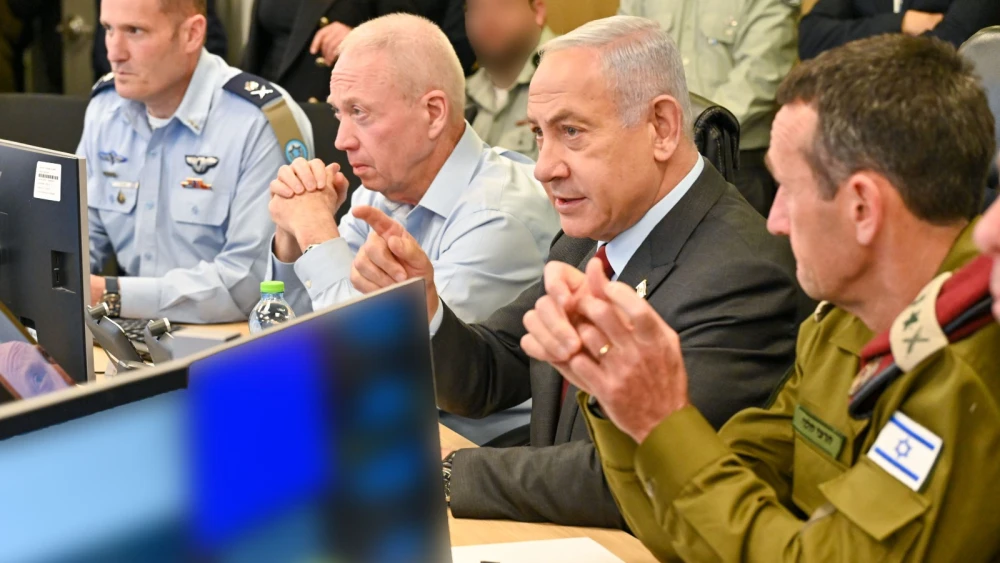
In a series of secret meetings, Israeli Prime Minister Benjamin Netanyahu instructed the heads of Israel’s security forces to significantly ramp up preparations for a strike on Iran’s nuclear installations, Israeli media reported on Tuesday.
The meetings, five in number, were attended by Defense Minister Yoav Gallant, IDF Chief of Staff Herzi Halevi, Mossad head David Barnea and other top officials, according to Channel 12.
Netanyahu reportedly relayed the conclusions drawn from the meetings to U.S. Secretary of State Antony Blinken and U.S. National Security Advisor Jake Sullivan during their recent visits to Israel. The prime minister likewise updated French President Emmanuel Macron during his trip earlier this month to Paris.
Netanyahu reportedly told Blinken, Sullivan and Macron that Israel would act militarily to stop Iran if need be.
The International Atomic Energy Agency said on Monday it was in talks with Iran after the nuclear watchdog’s inspectors last week detected uranium enriched to 84% purity in the Islamic Republic, just below the 90% level needed for nuclear weapons.
Earlier this month, the IAEA chastised Iran for modifying the connection between the two groups of advanced centrifuges at its Fordow plant. The change was discovered during an unannounced inspection on Jan. 21 at the Fordow Fuel Enrichment Plant (FFEP), a location built into a mountain where inspectors are beefing up checks after Iran said it would drastically increase enrichment.
In a confidential report to member states obtained by Reuters, the IAEA stated that “they were interconnected in a way that was substantially different from the mode of operation declared by Iran.”
A diplomat cited by Reuters in a separate report implied that the 84% enriched uranium was found at the same site as the reconfigured cascades, or clusters, of centrifuges.
In January, Israel and the U.S. held a five-day joint military exercise called “Juniper Oak,” which saw unprecedented levels of cooperation between the U.S. military’s Central Command (CENTCOM), which is responsible for the Middle East, and the Israel Defense Forces.
“Juniper Oak” tested Israeli and American readiness and boosted the operational connection between the two militaries so as to enable them to deal with “regional threats,” according to the IDF Spokesperson’s Unit, but the intended target audience for this message seems to have been Iran.