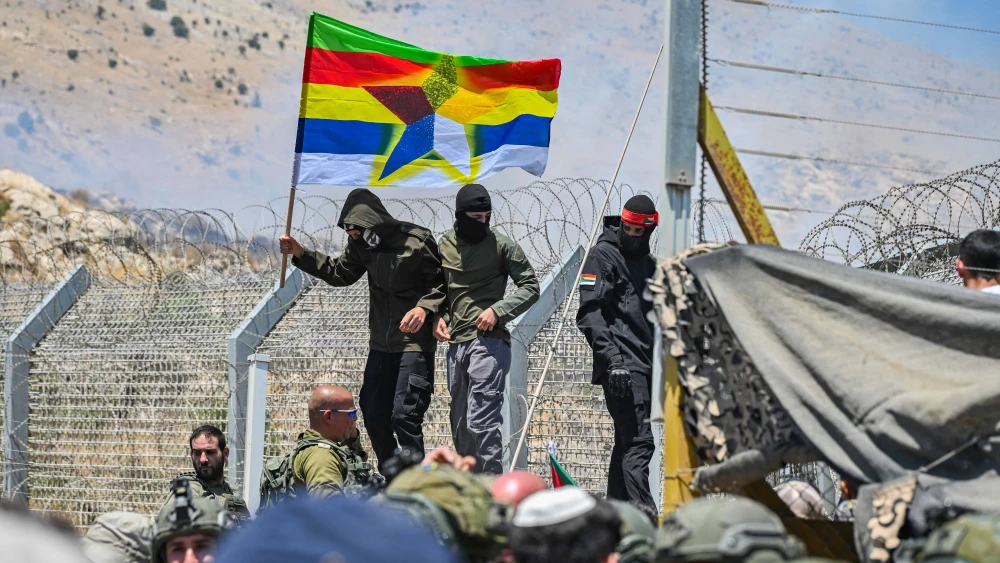
Israel has called on the United Nations Security Council to act against the Damascus regime for its role in atrocities being committed against Druze civilians in Syria’s Suweida province.
In a letter dated July 17, Israel’s Foreign Minister Gideon Sa’ar expressed “deep concern” over reports of brutal violence targeting the Druze community in southern Syria.
Sa’ar described acts of “killings and executions, defacement of bodies, public humiliation of captured civilians,” alongside widespread looting and desecration of religious sites.
“These heinous crimes terrorize the local community,” Sa’ar wrote to the Security Council president for July, Pakistani Ambassador Asim Iftikhar Ahmad. “In many cases, these acts are committed by the regime, its affiliated militias, or both.”
The foreign minister said the Syrian regime bears responsibility for the atrocities within its borders and must be held accountable by the international community.
Sa’ar warned that these attacks are not isolated incidents but part of a broader pattern of persecution of minorities by Sunni Arabs in Syria.
Minister of Foreign Affairs Gideon Sa'ar held a series of calls with his counterparts on the developments in Syria.
— Israel Foreign Ministry (@IsraelMFA) July 16, 2025
Minister Sa'ar spoke with European Union High Rep. for Foreign Affairs Kaja Kallas, German Foreign Minister Johann Wadephul, and Greek Foreign Minister Giorgos…
He cited massacres of the Alawite community in the northwest, ongoing aggression against Kurdish populations in the north and jihadist assaults on Christian institutions.
“The international community must not remain silent in the face of such targeted violence,” Sa’ar said. “Nor can it settle for empty condemnations.”
He urged the U.N. to deliver a firm and clear message to the Ahmed al-Sharaa regime, emphasizing that it “will be judged by its actions, not merely by its words.”
Sa’ar requested that his letter be distributed as an official document of the Security Council. He also sent a copy to U.N. Secretary-General António Guterres.
Israel’s call comes amid escalating tensions in Syria, where minority groups have faced violent repression and systemic persecution, often from both state forces and extremist groups.
On Friday, Sa’ar ordered the urgent transfer of humanitarian aid to the Druze in Suweida.
The aid, worth two million shekels ($600,000), will include food packages, medical equipment, first aid kits and medicine. The budget will come from the Ministry of Foreign Affairs.
The aid will be directed in a targeted manner to the areas in the Suweida province that were directly affected by the violent attacks against the Druze, the ministry said.
The ministry previously send aid to the Druze in Syria in March.
The 700,000 Druze in Syria, some 3.2% of the population, have faced increasing threats in recent months, particularly in the southern province of Suweida.
Despite the community’s historical neutrality in Syria’s long-running civil conflict, violence has surged in the area, raising fears of ethnic and sectarian cleansing.
Sa’ar’s letter reflects Israel’s broader diplomatic push to highlight the dangers posed by the al-Sharaa regime and its backers. He made clear that genuine regional stability is impossible without accountability for crimes against minorities.
“The world must act, before more innocent lives are lost,” Sa’ar said.
Meanwhile, Israel’s Ambassador to the U.N., Danny Danon, called out Guterres for his “shameful silence” over the Druze massacre in Syria.
UN Secretary-General @antonioguterres continues to expose his moral bankruptcy.
— Danny Danon 🇮🇱 דני דנון (@dannydanon) July 16, 2025
While members of the Druze community are being brutally slaughtered in Syria, he once again chooses silence.
Instead of calling for swift action in Syria, he chooses to vilify Israel—the only… pic.twitter.com/qDpufgN3P7