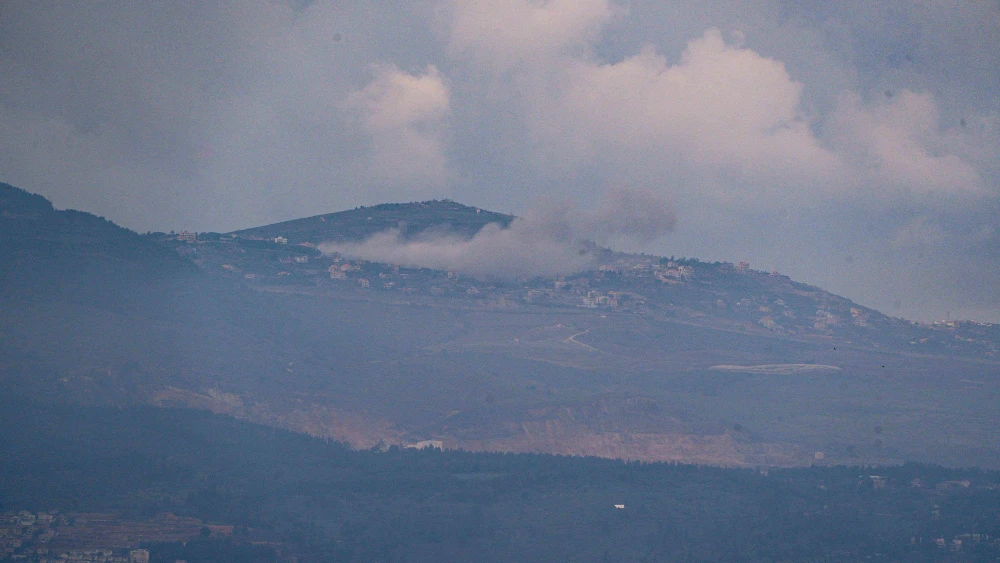
Israeli fighter jets struck several Hezbollah terrorist targets in Southern Lebanon on Tuesday morning.
Two launch posts were hit in the areas of Yaroun and Marwahin, where the previous day several Hezbollah terrorists were eliminated in an airstrike on “military” infrastructure, the IDF said.
Terrorist infrastructure was also targeted on Tuesday in the areas of Dhayra, Yaroun, Houla and Blida.
Three anti-tank missiles were fired from Lebanon at northern Israel on Tuesday, hitting an open area near Moshav Margaliot in the Eastern Galilee.
There were no reports of casualties or damage, according to the Israel Defense Forces and local authorities.
Also on Tuesday, air-raid sirens sounded in Arab al-Aramshe on the Lebanese border, with no initial reports of casualties or damage.
The IDF has struck more than 3,400 Hezbollah targets in Southern Lebanon and eliminated more than 200 Hezbollah operatives in Lebanon and Syria since the Iranian terrorist proxy joined the war in support of Hamas.
Hezbollah fired more than 2,000 rockets at Israel between Oct. 8 and Jan. 9. Additionally, the group has launched dozens of anti-tank missiles and drones at Israeli territory.
On Monday, a drone penetrated deep into Israeli territory, exploding in the Mount Arbel region of the Lower Galilee. In response, the IDF attacked Hezbollah’s weapons depots near Sidon, on the outskirts of the village of Al-Ghaziyeh, in what Lebanese channels described as a significant blast.
“IDF warplanes attacked two munitions warehouses of the terrorist organization Hezbollah, near the city of Sidon. The attack was carried out in response to the launch of the unmanned aircraft towards the Lower Galilee,” the IDF said.
מטוסי קרב של צה"ל תקפו לפני זמן קצר, סמוך לעיר צידון, שני מחסני אמצעי לחימה של ארגון הטרור חיזבאללה.
— צבא ההגנה לישראל (@idfonline) February 19, 2024
התקיפה בוצעה בתגובה לשיגור כלי הטיס הבלתי מאויש לעבר הגליל התחתון>> pic.twitter.com/aiL3eHaCuV
“After an investigation, it appears that it was an unmanned aerial vehicle launched by the terrorist organization Hezbollah from Lebanese territory, apparently earlier today. The circumstances of the incident are being investigated.”
The Hezbollah attacks have led to military and civilian deaths and widespread damage in the Upper Galilee.
Nearly 100,000 residents of northern Israel were displaced in the immediate aftermath of the Oct. 7 Hamas massacre of some 1,200 people near the Gaza border amid fears that Hezbollah’s Radwan fighters would attempt a similar invasion from Lebanon.
As of Jan. 9, Israel had killed 170 terrorists in Lebanon.