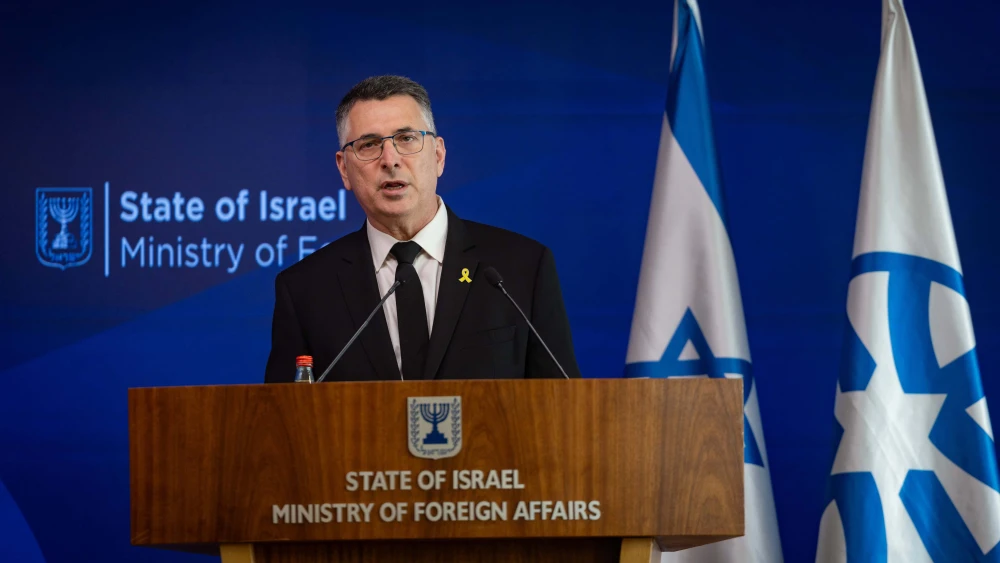
Foreign Minister Gideon Sa’ar held a series of urgent calls with counterparts overnight on Thursday, following Israel’s decision to attack Iran’s nuclear facilities.
One of the foreign minister’s first conversations was held early Friday morning with his German counterpart Johann Wadephul. Sa’ar informed his colleague of the unanimous Cabinet decision to remove the imminent threat of annihilation from the Israeli people and of the IDF’s subsequent actions.
“We made this decision at the last possible minute, after all other avenues had been exhausted,” he said. “The whole world saw and understood that the Iranians were not ready to stop, and we had to stop them. The latest IAEA report illustrated the serious Iranian violations.”
Sa’ar held a phone call with Italian Foreign Minister Antonio Tajani a short time ago.
As with Wadephul, Sa’ar informed Tajani of the Cabinet’s unanimous decision to take action against the Islamic regime. They also discussed the situation in Gaza, during which the Israeli minister expressed his hopes for a hostage deal, despite Hamas’s intransigence.
Sa’ar also spoke with the European Union’s high representative for foreign affairs, Kaja Kallas, updating her on the deliberations before the strike and the current IDF operation.
Israel’s foreign minister emphasized the breadth of Iran’s long-range ballistic missile project, saying that the rate of production of its missiles was “unimaginable” and threatened to make it the world’s premier manufacturer.
Sa’ar maintained that the missile program constituted a dramatic threat to a small country such as Israel, and reiterated points of view from conversations with European leaders about Tehran’s ability to intimidate Europe.
The Foreign Ministry has shifted to emergency operations, activating a situation room to coordinate with Israeli diplomatic missions worldwide.
Dozens of Israeli jets attacked dozens of targets, including military and nuclear sites, in Iran in a “preemptive, precise, combined offensive” strike early in the morning on Friday, the Israel Defense Forces stated.
Israeli Prime Minister Benjamin Netanyahu said that the operation, dubbed “Rising Lion,” will go on “for as many days as it takes to remove this threat.” He added that it will “roll back the Iranian threat to Israel’s very survival.”
“We struck at the heart of Iran’s nuclear enrichment program. We struck at the heart of Iran’s nuclear weaponization program. We targeted Iran’s main enrichment facility in Natanz,” Netanyahu said. “We targeted Iran’s leading nuclear scientists working on the Iranian bomb. We also struck at the heart of Iran’s ballistic missile program.”