Newsletter
Newsletter Support JNS

Israeli government agrees on increased defense budget for 2022

The understandings include the allocation of $230 million for the home front; the treatment and recognition of wounded IDF veterans; and funding for a scholarship program for those who completed military or national service.

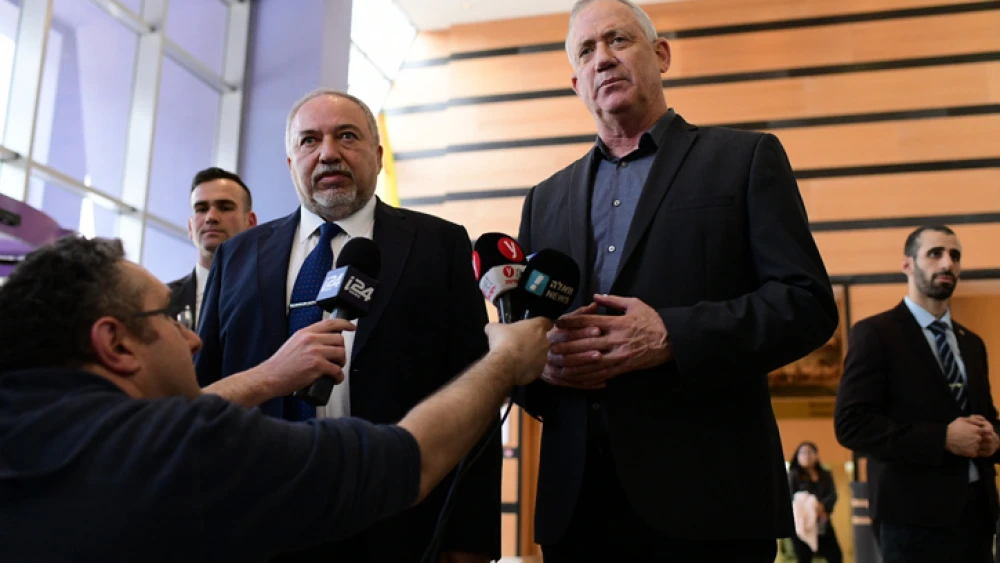
Israeli Finance Minister Avigdor Lieberman (left) and Defense Minister Benny Gantz in Ramat Gan on March 9, 2020. At the time, Lieberman was a member of Knesset and Gantz was head of the opposition. Photo by Tomer Neuberg/Flash90.

Israeli Prime Minister Naftali Bennett, Finance Minister Avigdor Lieberman and Defense Minister Benny Gantz have agreed on a defense budget to be passed as part of the state budget for 2022: 58 billion shekels ($17.8 billion).

The ministers agreed that the defense budget would enable the Israeli military to equip and strengthen itself in light of current threats, with an emphasis on acquisitions from defense firms based in the Israeli periphery.

The understandings also included an allocation of 750 million shekels ($230 million) for the home front; promotion of reforms in the treatment and recognition of wounded Israel Defense Forces veterans; and full funding for a scholarship program for veterans of IDF service and national service. A decision was also taken to decide on the length of compulsory IDF service, based on a balanced framework that the Defense Ministry has laid out. “The prime minister, finance minister and defense minister welcome the agreement and call on all ministers and ministries to reach understandings as soon as possible, so the state budget can be approved in an orderly manner in the Cabinet and the Knesset,” according to an official statement.

Meanwhile, according to reports on Tuesday, Lieberman wanted the defense establishment to invest more resources in the IDF’s ground forces, particularly long-range, precise ground missiles, and thinks that the defense apparatus spends liberally on the Israeli Air Force at the expense of the military’s ground forces.

This report first appeared in Israel Hayom.

Melat Kiros, who said that Oct. 7 was the “inevitable consequence of apartheid,” unseated 15-term incumbent Rep. Diana DeGette in the Democratic primary to represent Denver in Congress.
Abdulkadir Al-Jelani, 58, is due in court on July 1 and faces charges of making the threats and three counts of assault with a weapon.
The designations include Hezbollah-linked institutions that “threaten regional stability, international security, mutual interests and global trade,” the U.S. Treasury Department stated.
Gerard Filitti, of the Lawfare Project, told JNS that “lax immigration policy” has always been the main driver of importing “terrorist ideology” into the United States.
“The teachers we have, we don’t respect and support in the way that they deserve,” Paul Bernstein told JNS. “If we’re successful and we grow enrollment, that problem only gets bigger.”
“The message being sent is that you can get away with attacking someone in broad daylight because you disagree with their opinions, especially if it involves feelings about Israel,” Joshua Burt, of the Anti-Defamation League, told JNS.