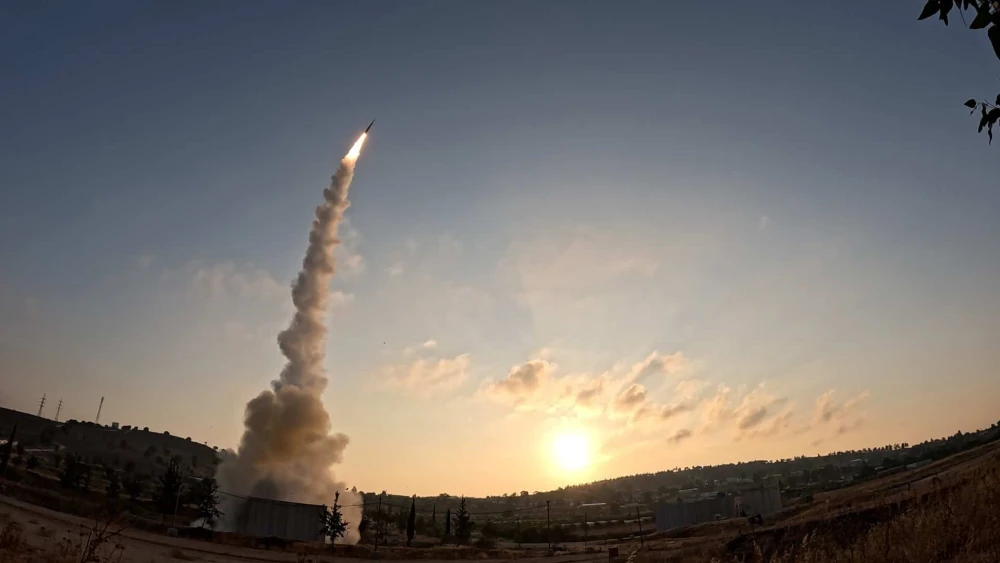
During “Operation Rising Lion,” Israel’s missile defense architecture prevented more than $15 billion in property damage while safeguarding countless lives from ballistic missile and unmanned aerial vehicle (UAV) attacks, said IDF Brig. Gen. (ret.) Daniel Gold on Tuesday.
Gold, who heads the Directorate of Defense Research & Development (DDR&D) in the Israeli Defense Ministry, released the ministry’s assessment of advanced systems’ performance during the 12-day Israel-Iran war.
Israeli-developed weapon systems “proved instrumental” in the strike on Iran’s nuclear and ballistic missile facilities, “delivering tactical surprise and air superiority over Iran,” according to the ministry.
Some 86% of the ballistic missiles launched from Iran toward Israeli territory were successfully intercepted, according to IMOD.
Enhanced versions of the Arrow system, designed to intercept newer, longer-range threats, were integrated into Israel’s missile-defense system over recent months, with the most recent version installed just one week before the operation.
Iron Dome and David’s Sling upgrades (an Iron Dome test against drone swarms was conducted in March), together with the IDF’s multi-layered air defense response, achieved an over-99% interception rate for Iranian drones, according to the Defense Ministry.
“Air-defense systems prevented damage potential seven times greater than the actual damage sustained,” said the ministry.
On the offensive side, Israeli drones achieved “unprecedented reach,” logging thousands of flight hours and conducting over 500 strikes and interdictions within Iran.
Space-based intelligence produced more than 12,000 satellite images of Iranian territory, amounting to tens of millions of square kilometers in both day and night-time surveillance.
UAV operations minimized risk to combat pilots while hunting Iranian missile launchers, saving numerous lives and preventing extensive damage to the State of Israel.
“Combined with the Swords of Iron War, UAV missions accounted for 60% of total Air Force flight hours and 50% of all IDF strike operations,” according to the ministry.
Throughout the operation to establish air superiority over Tehran, the Israeli Air Force deployed various armaments developed over the years by the DDR&D and defense industries, which “proved decisive in achieving tactical surprise and securing air dominance over Iran,” the statement continued.
Several weapon systems were deployed for the first time in the preemptive strikes against Iran’s nuclear facilities and ballistic-missile infrastructure. These systems were developed over decades and designed specifically for those missions, according to the ministry.