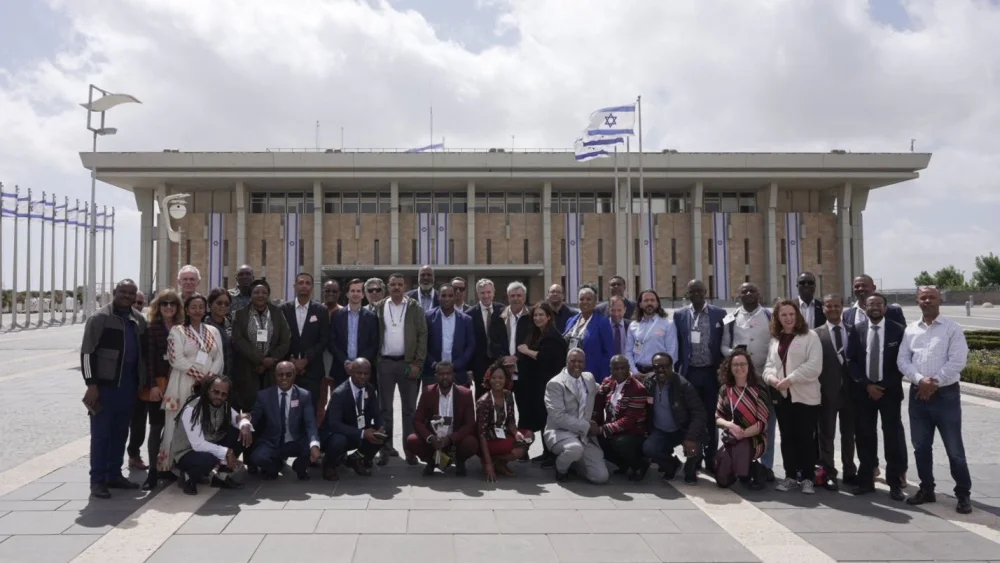
Representatives from nearly 30 African and Middle Eastern countries were in Jerusalem this week for a conference, including from states that don’t maintain diplomatic relations with Israel.
They participated in the three-day summit at the invitation of the Jerusalem Center for Public Affairs.
Titled “Trusted Regional Partnerships at a Time of Shifting Alliances,” the guests participated in panel discussions Monday through Wednesday on increasing cooperation between the Jewish state and Middle Eastern and African nations in the areas of national security, counterterrorism, food and water security and the environment. They also discussed expanding the Abraham Accords.
Saudi Arabia has been mentioned as a possible candidate to join the circle of Arab Muslim countries normalizing relations with Israel; Saudi journalist Abdel Aziz al-Khamis said at the conference that Riyadh wants a larger role in safeguarding Muslim sites in Jerusalem as a condition for normalization.
“Settlement of the Al-Aqsa issue is a key condition for the establishment of relations between Israel and Saudi Arabia,” al-Khamis said, referring to the mosque on the Temple Mount.
“When we come to talk about peace between Israel and Saudi Arabia, a new approach and a fresh way of thinking must be taken, but in any case, east Jerusalem and the holy places will be at the heart of the agenda from the Saudi side,” he emphasized.
The Jordanian Waqf Islamic trust currently oversees Muslim holy sites in Jerusalem, a status quo in place since Israel liberated the Old City in 1967 and that was reaffirmed in the 1994 Jordan-Israel peace treaty.
Al-Khamis also touched on the importance of the Saudis joining the Abraham Accords for other countries to be added to the historic agreement.
“Saudi Arabia is the most important hub of the region. If it joins the Abraham Accords, all the Gulf states will join. They’ll see Israel as a friend and it will be easier for them to cooperate. Without Saudi Arabia, the Abraham Accords won’t go any further,” he said.
In addition to the panel discussions, the participants received a recorded video message from Israeli President Isaac Herzog and visited the Knesset where they met with Speaker Amir Ohana, among others. They also met with National Security Council chief Tzachi Hanegbi.
In addition to Israel, representatives participated from Bahrain, Chad, Djibouti, Egypt, Ethiopia, Ghana, Iran, Jordan, Kurdistan via Sweden, Kenya, Kosovo, Liberia, Malawi, Mauritania, Morocco, Namibia, Nigeria, Saudi Arabia, Somalia, Somaliland, South Africa, South Sudan, Tunisia, Turkey, Uganda, the United Arab Emirates and the United States.
“This is an unprecedented, historic meeting of representatives of countries that, in the current climate, were not supposed to come to Israel and discuss strengthening Israel’s ties with Africa and bolstering the Abraham Accords,” said Dan Diker, president of the Jerusalem Center for Public Affairs.