
Every life has a beginning. Mine began in Bombay.
Long before it became Mumbai, Bombay was a magnet for dreamers, merchants, industrialists and builders drawn by the promise of opportunity.
Among the most influential were the Sassoons, a Jewish mercantile family whose philanthropy and commercial enterprises helped shape nineteenth-century Bombay. Later, there were the Tatas, whose industries helped power India’s economic awakening.
Their legacies remain etched into the city’s institutions, skyline and spirit. For generations, Bombay served as India’s gateway to the world, attracting those bold enough to think beyond the limits of their time.
Bombay, later Mumbai, never stopped producing visionaries. As India entered a new era of economic liberalization and global ambition, another family emerged from the city with a vision equal to the moment.
If the Sassoons helped connect Bombay to global commerce and the Tatas helped build industrial India, the Ambanis would come to symbolize a new chapter in the nation’s rise, one defined by scale, infrastructure, energy, technology, connectivity and aspiration.
The story of the Ambanis is not simply the story of a family that accumulated wealth. It is the story of three generations who expanded the possibilities of what India could become.
If Mumbai provided the stage, Dhirubhai Ambani supplied the vision. Arriving from Yemen with modest means but boundless ambition, he saw possibilities where others saw limitations. At a time when India’s economy was constrained by regulation, scarcity, and bureaucracy, Dhirubhai dared to imagine that an Indian company could compete at world scale.
He was not content merely to participate in India’s economy. He sought to transform it. The enterprise he founded would grow into one of the most consequential business organizations in modern India, though his greatest contribution would prove to be something far more enduring than any factory, refinery or balance sheet.
Every great transformation begins with a dream. Visionaries see possibilities where others see obstacles and continue long after conventional wisdom tells them to stop.
Through Reliance Industries Limited, Dhirubhai helped millions of Indians believe that world-class institutions could be built at home and compete globally. He democratized ownership, invited ordinary Indians to participate in the nation’s growth story and challenged a generation to think beyond its perceived limits.
Dhirubhai did more than build a company. He expanded the boundaries of what Indians believed was possible.
If Dhirubhai taught India to dream bigger, his son, Mukesh Ambani, spent the next two decades demonstrating how large those dreams could become. Under his leadership, Reliance evolved from a successful industrial enterprise into one of the world’s most expansive business ecosystems, spanning energy, petrochemicals, retail, telecommunications, media and digital services.
Dhirubhai did more than build a company. He expanded the boundaries of what Indians believed was possible.
Yet scale was never pursued for its own sake. Mukesh understood that in a nation of more than a billion people, meaningful transformation required thinking beyond conventional limits. His vision was not merely to build businesses but to create platforms capable of serving hundreds of millions, helping power India’s rise.
Great institutions are never built by one visionary alone. Alongside the Ambani family stood a trusted cadre of leaders, including the Meswani brothers, whose contributions helped transform Reliance’s petrochemicals and manufacturing operations into world-scale enterprises and establish the industrial foundation that fueled the company’s expansion into new sectors.
Together, they built far more than a corporation. Massive refineries, integrated petrochemical complexes, nationwide retail networks and digital platforms serving hundreds of millions reflected a simple philosophy: think beyond the present and build for the long term.
In many ways, Reliance became a mirror of modern India itself. As India grew in confidence, scale and ambition, so did Reliance. Over time, the story of one became inseparable from the story of the other.
The Ambanis understood that great institutions are built not only through industry and commerce, but through aspiration, culture, and shared experiences. Few examples illustrate this better than the Mumbai Indians cricket franchise.
What began as a franchise in the Indian Premier League evolved into one of the most successful and recognizable brands in global cricket, extending its reach beyond India through teams in New York, the United Arab Emirates and South Africa.
While public attention naturally gravitates toward the Ambani family and its most visible leaders, trusted figures behind the scenes, including Nikhil Meswani, have played important roles in helping build and strengthen the broader Mumbai Indians ecosystem. Like Reliance itself, the franchise reflects a philosophy of long-term investment and enduring value.
The Ambanis were never just about building companies, cricket teams or balance sheets. They were building belief.
Yet every great institution eventually faces the same question: Can the vision of one generation be successfully passed to the next? For the House of Ambani, that question now rests with a new generation preparing to write its own chapter in one of the most remarkable stories in modern business history.
History ultimately remembers those who expand what a nation believes is possible.
Every great family enterprise eventually reaches a defining moment: the transition from visionary founder to steward, and from steward to successor.
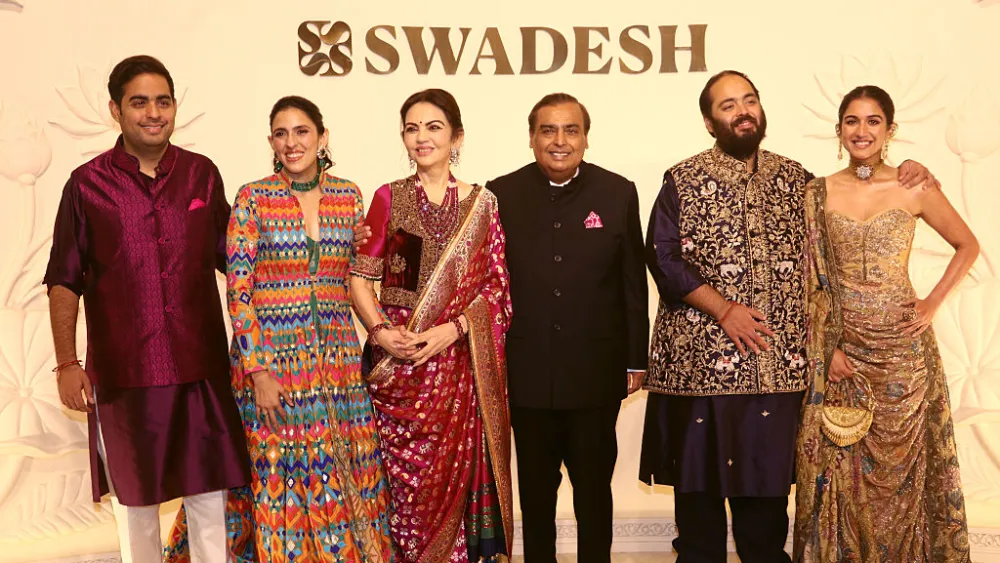
For the Ambanis, that moment is now unfolding. Akash Ambani, Isha Ambani and Anant Ambani are inheriting far more than one of India’s largest companies. They are inheriting a living institution that touches nearly every aspect of Indian life, from energy and retail to technology, digital connectivity, entertainment and sport.
The challenge before them is not simply to preserve what previous generations built, but to determine what Reliance becomes in a rapidly changing world.
History rarely remembers those who merely inherit success. It remembers those who build upon it. Dhirubhai dared to imagine a bigger India. Mukesh transformed that vision into an enterprise of unprecedented scale. The next generation now carries the responsibility of taking that legacy to an even higher level.
If the first chapter of the Ambani story was about aspiration and the second about execution, the third may ultimately be about global leadership. The question is no longer whether the House of Ambani can build great enterprises. It is whether the next generation can help define India’s century.
That question leads to the ultimate measure of any great family legacy: not what it owns, but what it leaves behind.
From the bustling trading houses of Bombay to the digital platforms of modern Mumbai, the story of the Ambanis traces the evolution of India itself. Few families have left such a broad imprint on a nation’s journey from developing economy to global power. The true measure of the Ambani legacy, however, won’t be found in market capitalization, refinery output, retail revenues, subscriber counts or personal wealth. History ultimately remembers those who expand what a nation believes is possible.
From the Sassoons’ Bombay to the Tatas’ industrial India to the Ambanis’ Mumbai, the city has long attracted families whose ambitions reached beyond commerce and into the future of a nation.
Whether India’s 21st century becomes its defining century remains to be seen. But when that story is written, the House of Ambani will almost certainly occupy one of its most important chapters.
Their greatest legacy may not be the enterprises they created, but the confidence they instilled in a nation learning to believe in its own future.