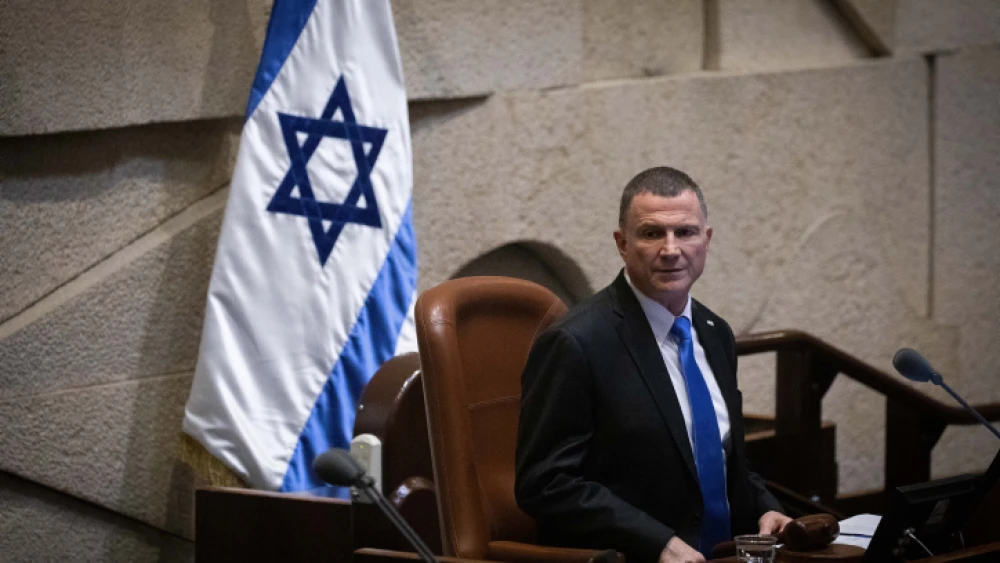
Longtime Knesset Speaker Yuli Edelstein resigned his post on Wednesday rather than implement a ruling by Israel’s High Court that the parliament must hold a vote to appoint a new speaker.
Addressing the Knesset in announcing his resignation, the Likud Party member stated, “The Supreme Court of Justice decided that the Knesset Speaker must hold a vote this week to choose a new Knesset Speaker. The Supreme Court’s decision is not based on how the law is worded, but on a one-sided and extremist interpretation.”
The ruling was handed down following a petition by the Blue and White Party demanding that Edelstein be forced to call a vote, even though it has yet to form a formal parliamentary majority. However, while the 62 Knesset members, including the 15 members of the Joint Arab List, who oppose Israeli Prime Minister Netanyahu’s continued premiership are currently unable to form a coalition, they would have voted against Edelstein, a strong Netanyahu ally, in the vote for a new speaker.
In Israel’s 72-year history, a Knesset Speaker has never been appointed before the formation of a majority parliamentary coalition, and Knesset bylaws do not demand it. The Knesset Speaker is responsible for implementing all Knesset protocols and bringing votes to the plenum.
“The Supreme Court’s decision contradicts the Knesset protocol,” said Edelstein. “The Supreme Court’s decision destroys the Knesset’s work. The Supreme Court’s decision is gross and audacious interference on the part of the judicial authority in the affairs of the elected legislative authority. The Supreme Court’s decision harms, in an unprecedented fashion, the sovereignty of the nation and the sovereignty of the Knesset. The Supreme Court’s decision undermines the basis of Israeli democracy.”
Edelstein, a former refusenik who spent years in a Russian prison before being allowed to immigrate to Israel, told the parliament: “Knesset members, as someone who has paid a heavy personal price, of years in prison and slave-like labor, for the right to live as a citizen in the State of Israel, there is no need for explanations regarding how much I love the State of Israel and the nation of Israel. And so, as a democratic individual, as a Jewish Zionist, as someone who has fought against evil powers, and as the speaker of this place, I will not allow Israel to deteriorate to anarchy. I will not play a part in a civil war.”
Calling for a unity government, he added, “Knesset members, citizens of Israel, right now our nation needs unity, needs a unity government. In these days, when there is a plague that is endangering us from the outside, and divisions which tear us apart from the inside, we must all act with integrity, we must all strive to be better. We must all unite. Therefore, for the sake of the State of Israel, and in order to renew the national spirit in Israel, I hereby resign from my position as Knesset Speaker. We will pray, and we will work, for better days.”
A new vote for speaker will now be held next week.