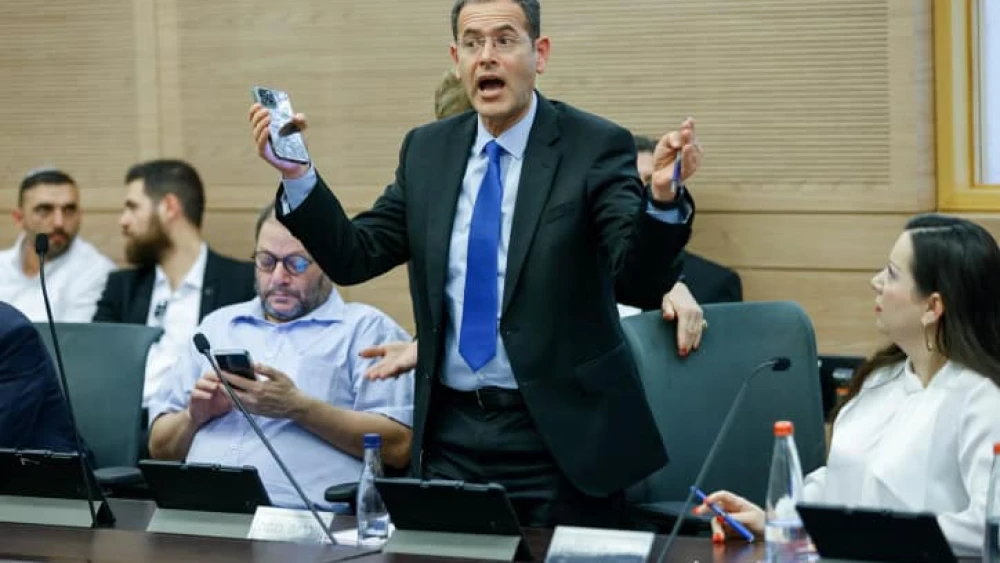
Two Likud Knesset members and a Likud minister are threatening to dodge party discipline on the haredi enlistment issue.
Knesset members Dan Illouz and Moshe Saada, and Economy Minister Nir Barkat, sent a letter to Israeli Prime Minister Benjamin Netanyahu, who heads Likud, stating, “If the current draft recruitment bill for ultra-Orthodox yeshivah students is brought to a vote, we will oppose it.”
“We know that this bill needs to be improved; also, the Supreme Court will disqualify it,” Saada told JNS. The draft law specifies that only about 2,000 ultra-Orthodox men will be recruited in the first stage.
There are 63,000 haredi men eligible for the draft.
Israel’s Supreme Court, sitting as the High Court of Justice, is currently hearing a case in which the petitioners argue that the state must start recruiting ultra-Orthodox yeshivah students because the law exempting them from mandatory service expired last year. The government representative requested that the court reject the petitions and instead allow the Knesset to continue the legislative process toward a solution.
Saada continued, “We need a law that is more realistic and more equal that also solves the heavy burden placed on so many [who serve in the IDF]. It is impossible to continue like this. We need a change in the way of thinking.”
The three Likud dissenters have a simple solution: Instead of specifying how many ultra-Orthodox should be recruited, they are in favor of a cap on how many won’t be recruited.
“We believe that only a limited number of yeshivah students should be recognized every year as eligible for exemption from military service,” Illouz told JNS.
“Define those who shouldn’t be drafted, then all the others must be drafted. If those eligible evade the draft, then there should be repercussions against them personally. Under the proposed government law, the repercussions aren’t against them, but rather against their yeshivahs.”
Their plan also envisages benefits for those who do serve in the military. “We have submitted a draft bill that proposes, “You serve, you get—you don’t serve, you don’t get.” We intend to give priority to those who enlist, in projects such as discounts in buying homes,” Saada said.
“If you were to conduct a secret vote in the Likud Party on our proposal, the result would be 90% in favor. I think the entire Likud Party understands, every sane Zionist person understands, that this is what needs to be done now. We are in an existential war and to win it we need a large army. In the past, the concept was a small, smart army—this has changed,” said Saada.
The ultra-Orthodox parties
The current government enlistment bill reflects Netanyahu’s attempt to find an agreed formula with the ultra-Orthodox parties (Shas and United Torah Judaism), which threatened to quit the government if the mass of haredi yeshivah students were recruited. So, the question is, why should they agree to the bill suggested by the Likud dissenters?
Ilouz said, “We believe that there is a possibility to find a tenable solution that will initiate a historical process of the ultra-Orthodox joining the army. I think that now is also the time when haredi society itself is ready for that. I’m in very close contact with a lot of haredi elected officials and with people in the community itself and I think there is an understanding that those who don’t actually study [Torah] need to serve.
“If I weren’t a member of Knesset, who is not allowed to do army reserve duty, I would be together with my comrades serving in the reserves,” added Illouz.
The big question is how far will the dissenting MKs go, especially since the recruitment bill is a life-and-death issue for the coalition.
“Will you go ahead even if it leads to the downfall of the government?” JNS asked the dissenters.
“If there are no soldiers, it will lead to the downfall of the nation,” replied Saada.
“It’s not a game. We are at war, and reservists do periods of 150 days in Gaza, return home, and then go for another round. I think this is our ethical and moral duty. Even if not everyone is saying it out loud, it is clear to everyone in the Likud Party that this is what should be,” he said.
Illouz added, “I said very, very clearly that if the bill that’s currently presented is brought to a vote without significant changes, I don’t see myself voting for such a law because I won’t be able to look at all the reserve soldiers fighting right now in Gaza or on the northern border in the eyes.
“And we hope that the haredi parties will be able to be more flexible for us to get to some solution,” he said.
Amichai Stein is the diplomatic correspondent for Kan 11, IPBC.