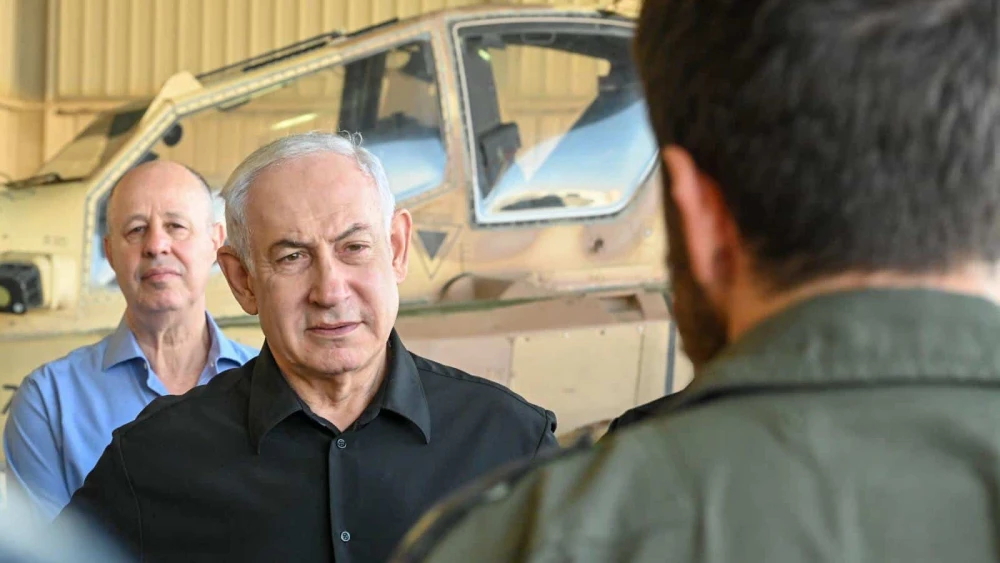
Prime Minister Benjamin Netanyahu held a discussion on Thursday to evaluate the Israeli military’s preparedness for the possibility of a third attack on Iran.
Also on the agenda: a more aggressive U.S. policy expected from the incoming Trump administration regarding Iran.
Israeli Strategic Affairs Minister Ron Dermer, after a Nov. 10 meeting with Donald Trump, reportedly left with the impression that the president-elect would support an Israeli Air Force strike on Iran’s nuclear facilities, or possibly send in a U.S. strike, according to news site Axios, citing unnamed sources.
On Tuesday, Trump, replying to a question from reporters about a U.S. strike on Iran, said, “It’s a military strategy and I’m not answering a question on our military strategy. Only a stupid person would answer.”
Iran fears a direct Israeli attack against its strategic sites in the near future, having interpreted Israel’s ceasefire with Hezbollah as intended to free up IDF assets to concentrate on the Islamic Republic directly, Channel 12 reported on Dec. 22.
It is not clear whether Iran’s weakened position after the fall of the Assad regime in Syria will push it into diplomatic talks to de-escalate matters or drive it to pursue a nuclear bomb with greater energy, as the country’s leaders have sent mixed messages.
Ali Abdolalizadeh, an aid to Iranian President Masoud Pezeshkian, said on Dec. 31, “We must negotiate with Mr. Trump. The country’s issues cannot be left unresolved, and the entire establishment has also reached the conclusion that direct negotiations are necessary,” Iran International reported.
However, others in the Islamic Republic are calling to ramp up its nuclear program. U.S. National Security Advisor Jake Sullivan warned on Dec. 22 that voices in Iran are saying publicly that it should construct a nuclear bomb.
“If you’re Iran right now and you’re looking around at the fact that your conventional capability has been reduced, your proxies have been reduced, your main client state has been eliminated, Assad has fallen, it’s no wonder there are voices saying: ‘Hey, maybe we need to go for a nuclear weapon right now,’” Sullivan told reporters.
In Israel, senior officials have called to again attack Iran.
On Dec. 22, Ynet reported that Mossad Director David Barnea advocated for such a strike in response to attacks on Israel by the Houthis, a Yemen-based proxy of Tehran. “Go for the head, Iran,” Barnea argued, officials said.
Israeli support for a harsh response against Iran cuts across political lines. Benny Gantz, leader of the opposition National Unity Party, told JNS on Dec. 23 that Israel should take “all the necessary means” to defend itself against the Iranian threat.
Israel struck Iran twice last year, on Oct. 26 and April 19, both times in retaliation for Iranian attacks. Iran’s initial attack on April 13 marked the first time the Islamic Republic had struck Israeli territory directly.
Israel’s second attack was more devastating than the first in April. It targeted 20 sites in Iran in multiple waves, destroying Iran’s remaining Russian-built, S-300 surface-to-air missile defense systems.
Israel’s strikes left Iran vulnerable to future attacks, Fox News reported at the time, quoting Biden administration adviser Amos Hochstein, who said, “Iran is essentially naked.”
Analysts told JNS last month that Iran’s Islamic dictatorship is ripe for regime change and an Israeli military strike could help push it over the edge.
“This is a golden opportunity,” Janatan Sayeh, a research analyst with the Washington-based Foundation for Defense of Democracies (FDD), told JNS, outlining the possibility of a one-two punch, with the U.S. imposing economic sanctions and Israel delivering military blows.