


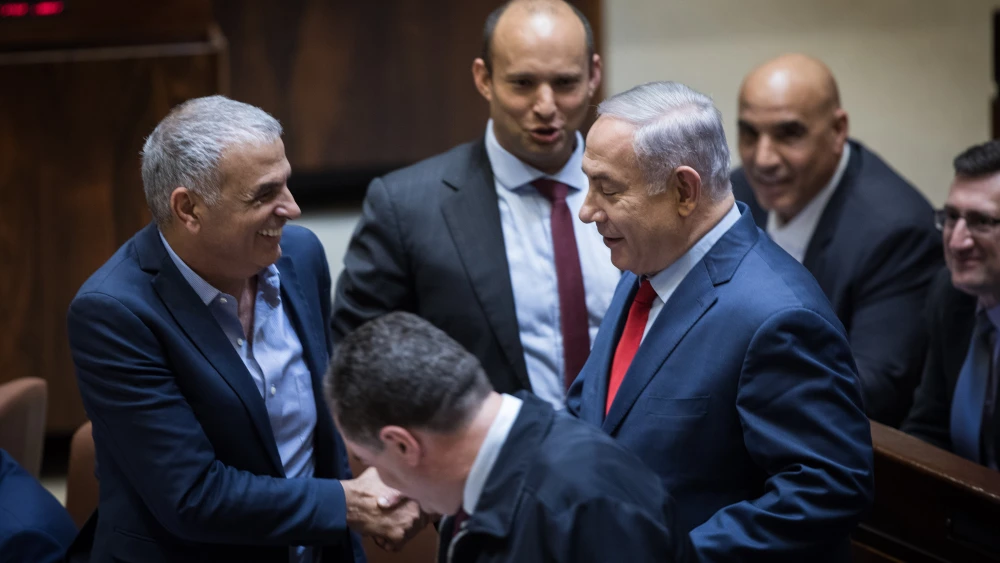
Israeli Prime Minister Benjamin Netanyahu and his Likud party are meeting with coalition partners in a last-ditch attempt to stabilize the government and avoid early elections. The coalition government currently contains a razor-thin majority of 61 out of 120 Knesset members, following the resignation of Defense Minister Avigdor Lieberman and his six-member Yisrael Beytenu Party’s decision to leave the government last week.
Lieberman resigned his senior government post after Netanyahu and Israel’s security cabinet agreed to a controversial ceasefire with Hamas, after more than 400 missiles were fired on Israeli population centers from Gaza. Announcing his resignation, Lieberman said the ceasefire, “cannot be interpreted in any way other than a surrender to terror.”
Following Lieberman’s resignation, Jewish Home Party leader and Minister of Education Naftali Bennett demanded that Netanyahu give him the defense post in Lieberman’s absence, threatening that the right-wing Jewish Home would similarly leave the coalition if Bennett did not receive the prestigious portfolio.
Netanyahu, hesitant to accept Bennett’s public ultimatum, announced that coalition partner and Finance Minister Moshe Kahlon of the Kulanu Party objected to Bennett serving as Defense Minister. Kahlon rebuffed Netanyahu’s claim in a television interview Saturday night stating, “I did not place an ultimatum on Bennett’s appointment as defense minister. These spins don’t work on me. I have not been a member of the Likud for a long time and I do not work for them.”
Rather, Kahlon suggested that the nation should go to early elections to get a new mandate for economic issues. “I will not abandon the economy for another two months in office,” said Kahlon.
Kahlon similarly disagreed with Lieberman’s and Bennett’s assessment that the government reacted too weakly to Hamas’s military escalation, stating, “The government did not give in to Hamas. I sat in cabinet discussions that lasted deep into the night. We made very difficult decisions and approved very bold actions. The IDF is doing daring work.”
Following Kahlon’s statements, Netanyahu is reconsidering offering Bennett the defense portfolio in order to stabilize the government and avoid early elections.
The current government has served for nearly four years, with regular elections scheduled for November 2019.
Ahead of the recent Gaza flare-up, the idea of early elections had already been floated by members of the government, as well as by members of the opposition. If the coalition partners agree to dissolve the current government, early elections would likely be held in late February or March.


