
Providing the F-35 fighter jet to Turkey is not only a profound betrayal of Israel—America’s strongest democratic ally in the Middle East—and the indigenous peoples of the Middle East, the Red Sea and the Horn of Africa; it betrays the ideals of liberty and resistance to tyranny upon which the American Republic was founded.
As an Eritrean and a member of the Tigrinya nation—an ancient Judeo-Christian civilization with a unique, non-tribal social structure in the Red Sea—I view this development with deep historical clarity. In the sixth century, our ancestors fought alongside the Roman Empire to secure Red Sea trade routes in South Arabia (modern-day Yemen and Saudi Arabia) and to repel Persian expansion. Later, in the 16th century, we stood against the Ottoman Empire’s invasion alongside allies such as Portugal. Having endured these struggles, I know what it means when expansionist Iran and Turkey seek to revive their ancient Persian and Ottoman empires.
Growing up in a Tigrinya society scarred by Ottoman atrocities, I view an F-35-armed Turkey under an Islamist leader with imperial ambitions with profound skepticism. The Ottomans armed and deployed proxy forces from what is now Somalia to wage a campaign of destruction. Ahmed Ibrahim al-Ghazi, known locally as “Ahmed Gragn” (“Ahmed the Left-Handed”), led the invasion under the banner of the Adal Sultanate, equipped with Ottoman muskets and supported by Turkish warriors. His forces operated much like modern jihadist organizations such as ISIS and Al-Qaeda.
Under the leadership of Bahri Negassi Isaac, the Tigrinya nation fought bravely, but was overwhelmed by Ottoman gunpowder. In 1529, he appealed to Portugal for military assistance. Lisbon responded by sending 400 musketeers under Cristóvão da Gama, son of the legendary explorer Vasco da Gama. Together, they defeated Ottoman-backed forces in four major battles.
Yet the Ottomans ultimately seized our coastline, severing the Tigrinya from traditional allies in Portugal, Byzantium and India. This condemned our nation to centuries of economic decline, stagnation and strategic isolation, the scars of which remain today.
For more than three centuries, Ottoman forces controlled our coastal regions, destroying churches and holy texts, demolishing places of worship, enslaving our people and inflicting widespread violence. Thousands of Tigrinya men were killed. In an extraordinary act of defiance, Tigrinya women tattooed Christian symbols on their foreheads to resist forced marriages and preserve their identity, knowing such resistance could bring severe punishment. Many paid the ultimate price. The full extent of this historical trauma remains largely unrecognized internationally.
The Ottoman Empire functioned as an Islamic Caliphate, merging political and religious authority. This fusion of imperial ambition with Islamist ideology resulted in the persecution, displacement and destruction of indigenous minorities. One of the darkest legacies of Ottoman rule in Eritrea was the mass enslavement of the Tigrinya people. The Massawa-Hirgigo region on the Red Sea coast became a hub of the slave trade.
The Portuguese observer Bernardo Pereira documented how boats carrying captured Tigrinya slaves departed from Zeila toward Mecca. Men, women and children were sold and transported to Turkey, Arabia, India, Cairo and Constantinople, with many forced to renounce their faith under threat of death. It is widely believed that Abraha—later renamed Ibrahim, the great-grandfather of Russian poet Alexander Pushkin—was taken as a child from this Eritrean coastal region and sold into Ottoman slavery.
Turkey under President Recep Tayyip Erdoğan, rooted in political Islam and aligned with Muslim Brotherhood-influenced movements, is reviving a Neo-Ottoman agenda. Ankara is expanding its influence through military bases and interventions across Syria, Iraq, Somalia, Sudan and Libya. Turkey is currently hosting elements of the Eritrean Muslim Brotherhood opposition, sheltering and preparing Islamist networks for an inevitable political transition in Eritrea. By providing F-35 fighter jets, the United States risks empowering an expansionist agenda that threatens the remaining ancient civilizations of the region, including my own, the Tigrinya nation.
Erdoğan’s repeated threats to eliminate Israel and its warnings toward allies such as Greece represent the opening of a broader effort to establish Turkish regional hegemony. Israel is the primary target not because it is weak, but because it is the strongest barrier to these ambitions—a nation at the forefront of defending its own freedom and that of other indigenous peoples across the region.
During his visit to Turkey, U.S. President Donald Trump claimed that Erdoğan told him Turkey would have joined Iran against Israel if not for their personal friendship. Whether a boast or a warning, the implication is extraordinary: A NATO leader was prepared to align with Iran, America’s chief regional adversary. This represents a form of coercive diplomacy—leveraging strategic uncertainty to pressure Washington. The message is clear: “Give us the F-35s, or we will forge alliances that undermine your strategic interests.”
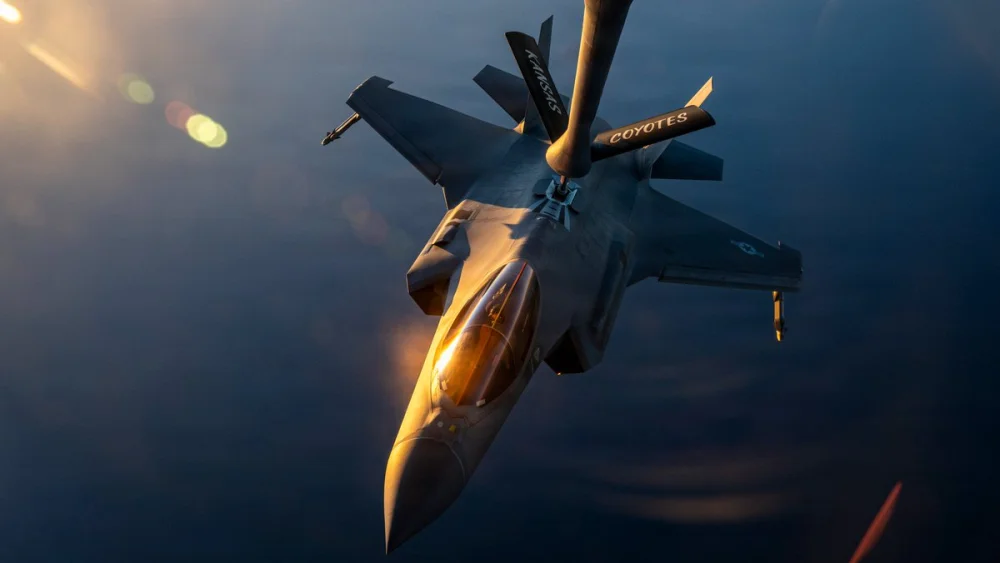
The F-35 does not merely modernize Turkey’s air force; it supercharges Ankara’s Neo-Ottoman ambitions. By combining stealth, advanced sensors and electronic warfare capabilities, the F-35 would give Erdoğan and his government an unprecedented instrument of power projection. We survived because Rome stood with us. We survived because Portugal stood with us. If America arms the heir to the empire that persecuted our people, history will remember not only Turkey’s ambition but Washington’s decision to enable it.
Nothing justifies handing America’s most sensitive fifth-generation military technology to an increasingly authoritarian, expansionist Islamist regime. Neither Turkey’s strategic position, nor its role in countering Russia or the presence of Incirlik Air Base, justifies transferring America’s most advanced fighter aircraft to a regime whose ambitions threaten America, its allies and the indigenous peoples of the Middle East, the Red Sea and the Horn of Africa.
The Jewish state is not Erdoğan’s final target. With military footprints across Somalia, Syria, Libya and Sudan, Ankara is positioning itself to dominate the Red Sea corridor and the Mediterranean. Washington must recognize these neo-Ottoman ambitions and strengthen its support for Israel. Arming Turkey with F-35s is more than a strategic blunder. It is a betrayal of the American ideals of liberty and resistance to tyranny.