Newsletter
Newsletter Support JNS

Netanyahu meets leaders of Caribbean Island states

The leaders discussed the public health and water management challenges that their nations face, and ways Israel can offer assistance.

Netanyahu Caribbean
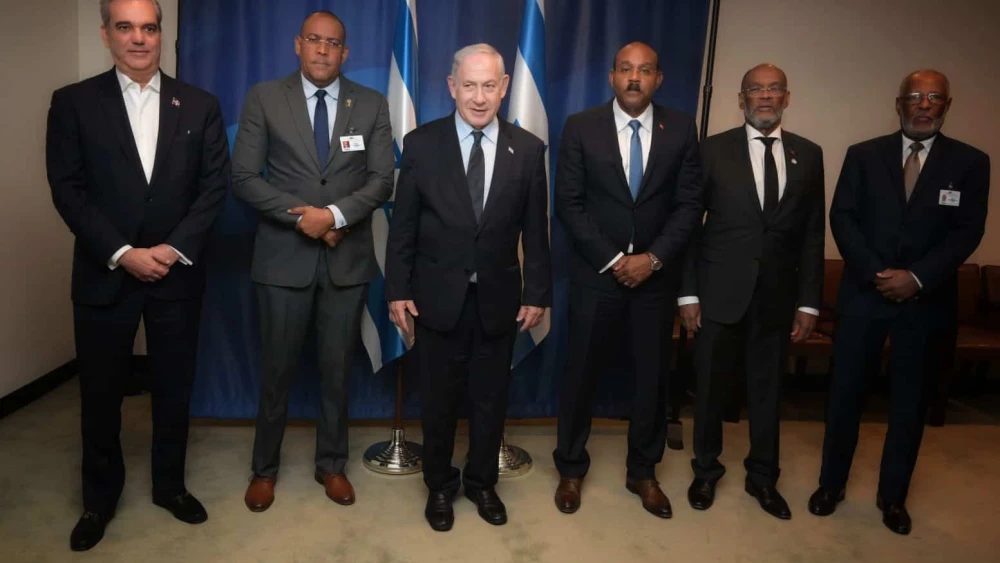
Israeli Prime Minister Benjamin Netanyahu (third from left) meets with five heads of Caribbean Island states on the sidelines of the U.N. General Assembly in New York City on Sept. 21, 2023. Credit: Avi Ohayon/GPO.

Israeli Prime Minister Benjamin Netanyahu met on Thursday on the sidelines of the U.N. General Assembly in New York City with the leaders of five Caribbean Island states.

Those present included Dominican Republic President Luis Abinader; Prime Minister of Antigua and Barbuda Gaston Browne; Haitian Prime Minister Ariel Henry; St. Kitts and Nevis Prime Minister Terrance Drew; and Barbados Foreign Minister Kerrie Symmonds, according to a statement from Netanyahu’s office.

After the leaders discussed the public health and water-management challenges that their nations face, Netanyahu said that Israeli experts would visit the Caribbean and offer assistance.

Later this year, the Israeli embassy in Panama plans to offer a course titled “Intensive vegetable production in arid and semi-arid conditions.”

In March, the Israeli and Dominican Republic baseball teams signed a Memorandum of Understanding at the World Baseball Classic in Miami. And in January, Latin American legislators signed a resolution to adopt the International Holocaust Remembrance Alliance’s (IHRA) working definition of antisemitism.

“These attacks come amid a broader rise in violent extremism across Canada and other Western democracies—a toxic brew of anti-Zionist rhetoric, local criminal elements, Iranian-backed proxies and ISIS-inspired terrorism,” CIJA stated.
“Iran and Israel are the only two countries on this planet that have a biblical relationship,” the exiled Iranian Crown Prince Reza Pahlavi said.
“We discussed the friendship and relations between Israel and Bahrain, as well as the importance of the U.S.-led Abraham Accords,” Isaac Herzog said.
The cause of the blaze near the grave of Rabbi Shneur Zalman of Liadi was not immediately clear.
The Japanese Red Army member, who helped kill 26 people, lived in Lebanon since his release in a 1985 prisoner exchange.
The suspect’s writing about the deadly Samaria shooting prompted an investigation and the seizure of ammunition, cash and fireworks.