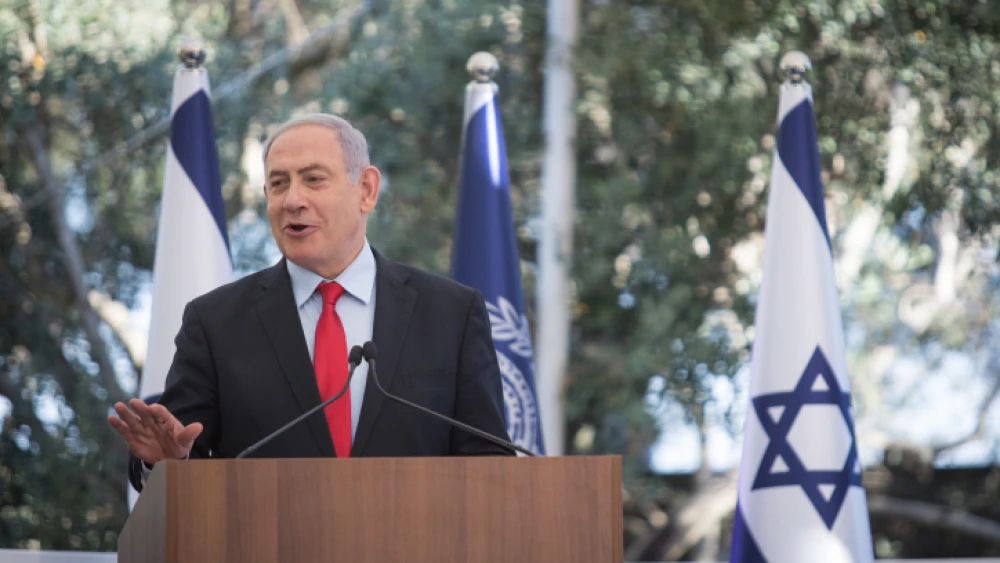
At the end of the week, Benjamin Netanyahu will mark a personal achievement and become the longest-sitting Israeli prime minister after the country’s first leader and founding father David Ben-Gurion.
“We have turned Israel into a rising global power,” Netanyahu said in a special interview with Israeli daily Israel Hayom.
“We’ve discovered that we can leverage the Jewish people’s basic characteristics into extraordinary strengths. This nation has extraordinary abilities in the economy, in defense and security, and in statesmanship. We have proven that Israel could be transformed from a small country in the corner of the Middle East into a major force on the global stage.”
Asked how, from a historical standpoint, he would answer those who once said that Israel was a disrupting force in the Middle East, Netanyahu said “they also used to say that all of the region’s problems were the result of the Palestinian issue. No one today dares to argue this seriously.
“Even our sworn enemies are embarrassed to say it because the struggle here is between the Middle Ages and modernism; between the tyranny of radical Islam and the forces of freedom. It is the simplest fight—stand up against the Islamic fundamentalism that wants to take over the Middle East.”
Over the years, Netanyahu has often spoken about the Iranian threat, Tehran’s dangerous rhetoric, and about the threat the Islamic republic’s nuclear program poses to Israel and the entire world.
Asked whether he believed the West’s goal should be toppling the Iranian regime or, alternatively, to negotiate a better nuclear agreement, the prime minister said, “I won’t mourn the end of the Iranian regime, but there can also be a change within the regime.”
After winning the April 9 elections, Netanyahu had hoped to form a stable government that could live out its four-year term, but after he failed to form a coalition, another election was called, this time for Sept. 17.
“This election is about who will be the next prime minister—me, with my proven abilities, or [Blue and White Party leader] Benny Gantz, who is totally inexperienced,” he said.
“To lead Israel, you have to be able to play in the global arena, and if he can’t act vis-à-vis the United States and the other various forces on the international stage, Israel won’t be able to continue to progress on its current path,” he said.
This article first appeared in Israel Hayom. The full interview with Prime Minister Benjamin Netanyahu will be published by Israel Hayom on Friday.