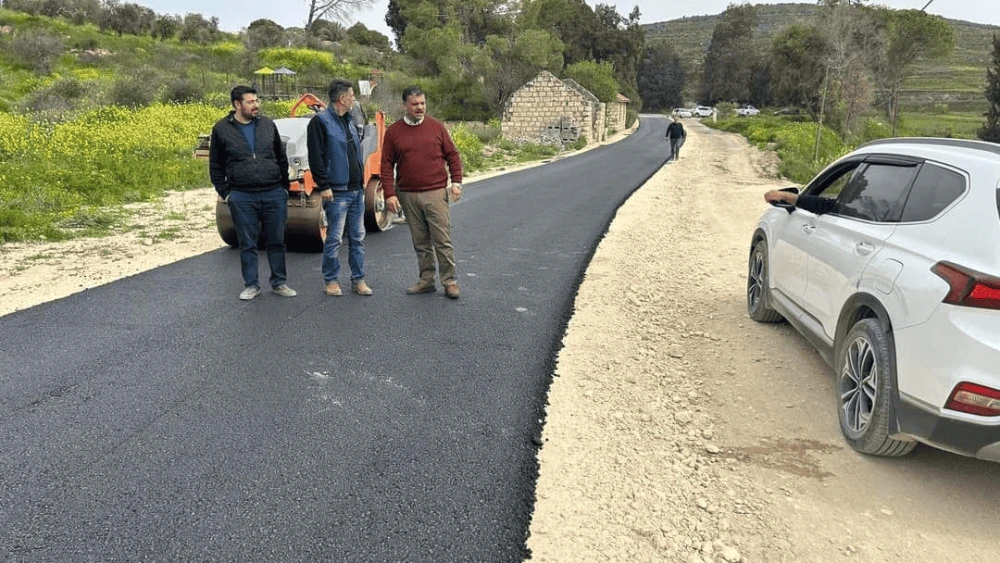
Palestinian construction workers have constructed an illegal road through the ancient village of Sebastia, near Nablus (Shechem) in Samaria, causing damage to an Israeli heritage site, Israeli NGO Regavim reported on Wednesday.
Shomron (Samaria) was the capital of the Kingdom of Israel during the 9th and 8th centuries BCE. Herod the Great renamed it “Sebastia” in honor of Emperor Augustus, translating the Latin epithet augustus to the Greek sebastos, meaning “venerable,” according to Josephus.
The site has significance in modern Israeli history as well—in the 1970s, Jewish resettlement activists moved into Sebastia’s abandoned train station, marking the first Jewish return to northern Samaria in 2,000 years.
“This road actually goes through the train station, which is an Israeli historical site. The very famous beginning of the whole settlement movement really started with Sebastia and the train station,” Naomi Linder Kahn, who leads Regavim’s International Division, told JNS.
The movement claimed that the “destructive project” in Sebastia was part of a concerted effort by the Western-backed Palestinian Authority to erase the Jewish connection to the entire Land of Israel.
“The entire area is under constant attack by the P.A. Parts of the archaeological site further up the road have been destroyed—parts of the area were paved over for a parking lot, parts for a soccer field, and there is an official P.A. visitor center there,” said Linder Khan.
The ancient village is a “hot spot for Palestinian Authority historical revisionism,” she added.
Since the Oslo Accords were signed in the 1990s, the archaeological site has been in Area C of Judea and Samaria, under full Israeli control, and the adjacent present-day Arab village of Sebastia has been in Area B, under Israeli security control and P.A. civilian jurisdiction.
In May 2023, the Israeli Cabinet approved a nearly $9 million budget for the restoration and development of Sebastia. The funds were allocated to the establishment of a visitors’ center, the paving of a new access road and increasing law enforcement to prevent vandalism.
Yet Linder Khan charged that, even in the parts of the site under full Israeli security control, “the Palestinians behave as if it isn’t, and the Israelis kind of go along with it. What the government should be doing is allowing a Jewish presence there. As soon as there isn’t one, this is what happens.”
Also on Wednesday, Israel’s Ynet news outlet reported that Palestinians had flattened Umm ar-Rihan, a historic site from the Second Temple period located in Area C near the security barrier in northern Samaria.
The destruction was clearly visible in drone photos, which showed a new parking lot built on top of the ancient Jewish settlement.
The Archaeology Unit of Israel’s Civil Administration identified the perpetrator, who was arrested along with other accomplices. The main suspect is expected to be formally charged in the coming days.
“Since the start of the Gaza war, we have been seeing increasing attempts to destroy Jewish heritage sites throughout Judea and Samaria, and it’s our duty to continue to fight for our history even while fighting for our home,” commented Heritage Minister Amichai Eliyahu.