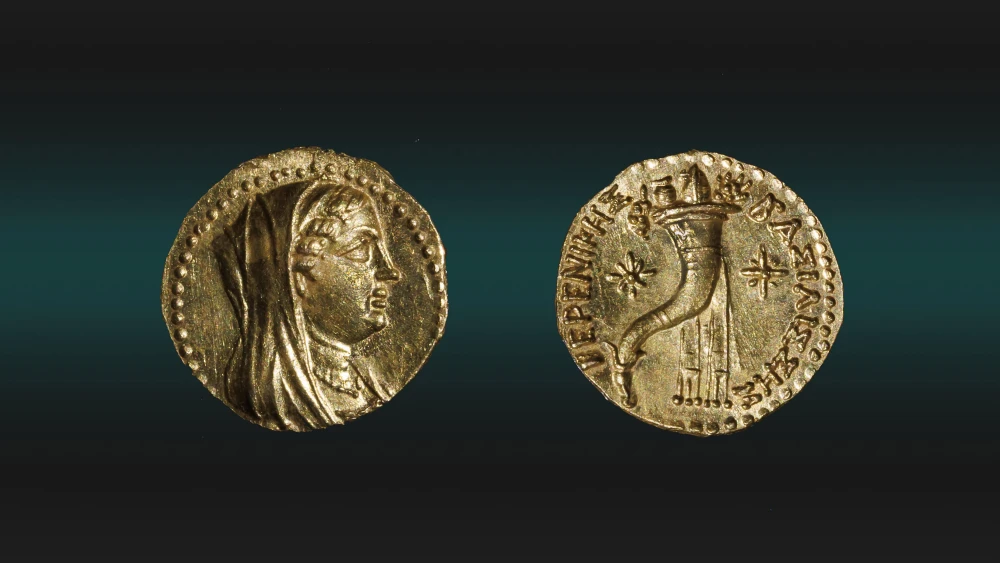
A gold coin dating back about 2,200 years has been uncovered just outside the walled Old City of Jerusalem, shedding new light on the development of the city after the destruction of the first ancient Jewish Temple, the Israel Antiquities Authority announced on Wednesday.
The small denomination quarter-drachma, made of pure gold (99.3%), and dated to 246–241 BCE, was minted for Queen Berenice II during the reign of her husband, Ptolemy III, the state-run archaeological body said.
The coin, which was found last year during soil sifting next to a dig at the parking lot opposite the history-rich City of David, is one of only 20 such coins known to exist, and the first discovered outside of Egypt and in an archaeological excavation.
“I was sifting the excavation soil when suddenly I saw something shiny,” recounted Rivka Langler, an excavator at the site.
“I’ve been excavating in the City of David for two years, and this is the first time I’ve found gold! I always saw other excavators discovering special finds, and I kept waiting for my moment—and now it finally arrived!”
The coin depicts Berenice as a Hellenistic queen, wearing a diadem and veil, with a necklace around her neck. The reverse shows a cornucopia, an ancient symbol of prosperity and fertility, flanked by two stars. A surrounding Greek inscription reads “of Queen Berenice.”
“As far as we know the coin is the only one of its kind ever discovered outside Egypt, which was the center of Ptolemaic rule,” said Robert Kool, Head of the Numismatics Department at the Israel Antiquities Authority, and Haim Gitler, Chief Curator of Archaeology and Curator of Numismatics at the Israel Museum. “Only about 20 such coins are known, and this is the first ever uncovered in a controlled archaeological excavation, making it a find of extraordinary scientific importance.”
The discovery sheds new light on the status of Jerusalem and its development even after the destruction of the first Jewish Temple by the Babylonians in 586 BCE.
“Until now, the prevailing scholarly view was that post-586 BCE Jerusalem was a small, marginal, economically weak town,” noted Yiftah Shalev, director of the excavation. “The coin—alongside additional finds from the mid-3rd century BCE—begins to shed new light on this: Jerusalem in the centuries after the destruction of the First Temple was not desolate and isolated, but rather a city in the process of renewal, reestablishing ties with the dominant political, economic, and cultural centers of the period.”
The coin will be displayed to the public in September during the annual City of David Research Conference.