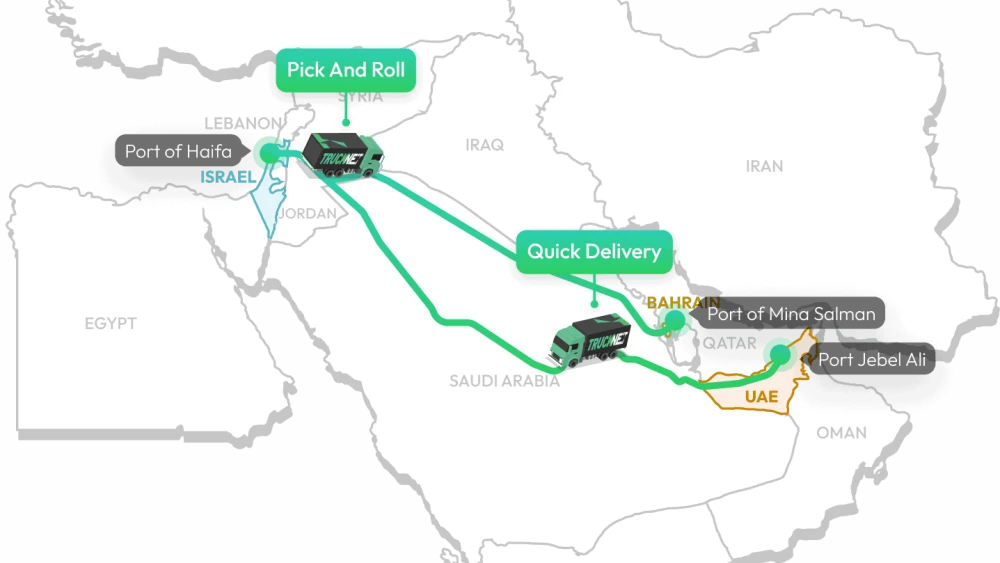
A land corridor for the delivery of cargo from the Gulf States to Israel through Saudi Arabia and Jordan and back is up and running, with operations increasing during the Israel-Hamas war as alternate sea routes have come under attack, Israeli officials said Wednesday.
The corridor, which uses state-of-the-art Israeli technology to facilitate service, has gathered steam as Iranian-backed Houthi rebels from Yemen stepped up attacks on international vessels in the Red Sea.
The U.S.-backed project, which got underway earlier this year, is a testament to the strength of the 2020 Abraham Accords, which saw Israel make peace with four Arab countries, led by the UAE and Bahrain.
After a slow start due to diplomatic sensitivities, the land route grew exponentially in the wake of the Houthi attacks, said Hanan Fridman, founder and president of Trucknet, an Eilat-based Israeli start-up which provides logistics technology for the Arab companies that make the journey.
He told JNS that in the wake of the repeated Houthi attacks there has been a “sharp demand” for the land cargo service.
Cutting time and expense
Even before the outbreak of the war ignited by Hamas’s Oct. 7 attack on Israel, the “Land Connectivity by Trucks” project enabled the transport of cargo between the Gulf of Dubai and Israel’s Haifa Port while significantly cutting costs and time, said Fridman. A 14-day journey by sea at the time was reduced to just four days by land, he added.
The transportation project was launched without publicity even as U.S.-brokered talks were still underway with Saudi Arabia towards the normalization of relations between Riyadh and Jerusalem. A landmark peace accord between Israel and Saudi Arabia, widely expected to occur early next year, is believed to have been one of the major reasons for the Hamas attack.
A month before Oct. 7, the Israeli company, which serves as a “matchmaker” between cargo companies and carrier companies, signed an agreement with the UAE and Bahrain in Manama.
“We had no idea that there would be a war but we envisioned enhancing the land route,” said Fridman.
Breakout
After the war broke out, the land option suddenly became even more useful as the Houthis began attacking the sea route, forcing Israeli vessels to reroute via Africa, resulting in both additional delays and higher transportation costs.
“Because of the Houthis, the prices of transport by sea shot up significantly,” he said.
Fridman declined to specify how many trucks were now running the land route daily, but noted that the maximum capacity is 300 trucks a day.
The overland crossing, which received the approval of the Israeli Defense Ministry and government, provides a faster alternative to the Suez Canal and sidesteps the security problems involved in maritime transport, at a competitive price, the company said in a statement.
A veritable ‘New Middle East’
“The Abraham Accords really created a new Middle East,” said Fridman. “Turning the Haifa port into a gateway of connectivity for goods to and from the East is a major boon for the Israeli economy.”
A separate long-term plan discussed before the war and still on the books would see the creation of a rail link between Israel and the Gulf states through Saudi Arabia that would be part of a train project linking Israel, the Gulf, Europe and the East.