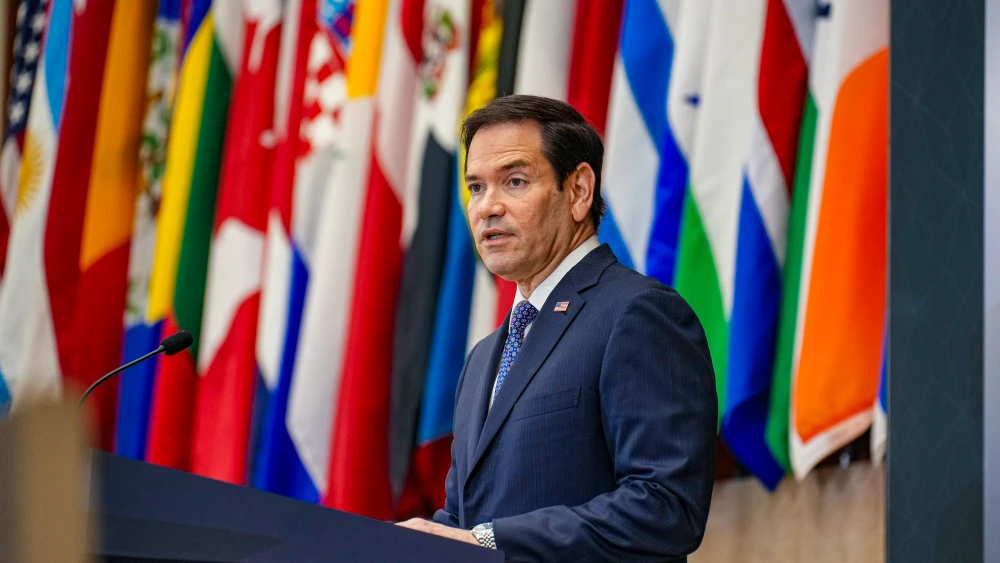
U.S. Secretary of State Marco Rubio said on Thursday that after decades of focusing primarily on Islamist extremism, Washington’s “counterterrorism doctrine has had a blind spot” when it comes to left-wing political terrorism.
Rubio made the remarks while opening the U.S. State Department’s Ministerial on the Resurgence of Political Terrorism, attended by representatives from more than 60 countries. The Trump administration has said the conference is intended to strengthen international cooperation against what it describes as a growing transnational threat from far-left extremist groups.
“For 25 years, the term counterterrorism—at least in the West—has meant, first and foremost, the fight against radical Islamist extremism. And there’s a very poignant reason for that,” Rubio said, citing the Sept. 11 attacks in the United States and additional bus and train bombings in Europe.
“The entire architecture of Western counterterrorism was rebuilt from the studs around the singular traumatic event. That made sense at the time,” he said, adding that coordinated international efforts have sharply reduced the threat of jihadist attacks on the U.S. homeland.
Rubio argued, however, that extreme violence from the far left has been brushed off as a serious threat and “dismissed as a partisan fiction” built on the “unspoken understanding” among think tanks and others that “only one kind of political violence was a true threat to the system.
“A bomb planted by a neo-Nazi group was a nefarious and murderous act of evil. It is,” Rubio said. “But a bomb planted by a Marxist revolutionary—well, that’s just merely a tragic excess of idealism.”
As part of the administration’s response, the State Department announced a new visa restriction policy targeting members of what it called “Far-Left Terrorist” groups and affiliated networks.
According to Rubio, the restrictions apply to foreign nationals who have supported or incited terrorism, engaged in violent criminal activity or economic sabotage or financed, recruited or provided logistical support for violent acts. He said the policy is intended to disrupt the international financing and coordination of such groups.