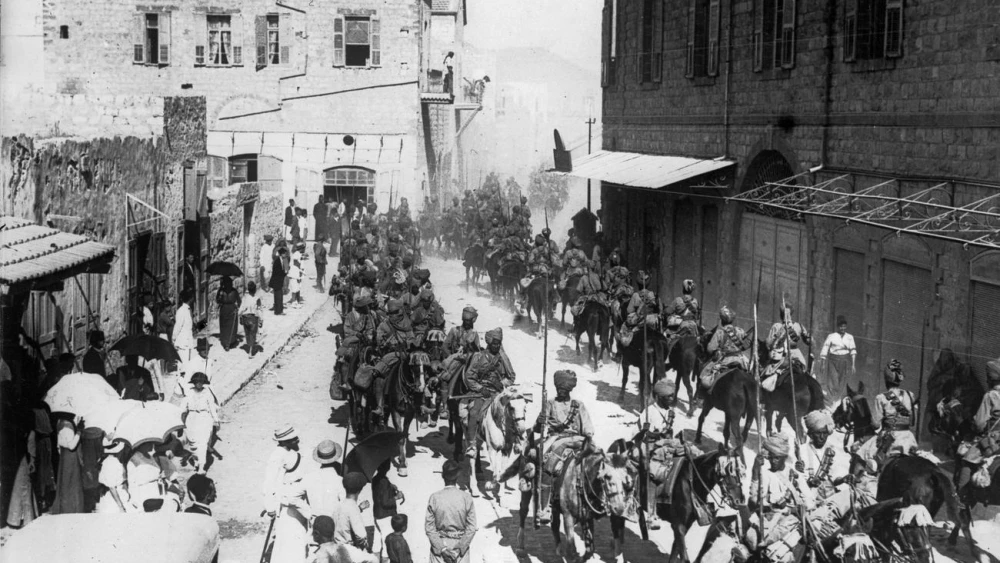

As World War I neared its end, Indian cavalrymen surged up the slopes of Mount Carmel and carved their place in history. Charging Ottoman and German positions with lances lowered and horses at full gallop, they liberated Haifa in a single afternoon.
It was one of the last great cavalry charges ever fought and one of the most successful. Where armored cars and British units had failed, Indian horsemen succeeded with speed, audacity and courage. Their victory was so decisive that it reshaped the final days of the campaign in the north.
Despite official commemorations, the story has slipped quietly out of public memory. Haifa honors the Indian regiments with monuments and street names, yet few Israelis know that their city was freed in September 1918 by cavalry from Jodhpur and Mysore. And few Indians know that their soldiers once liberated a Jewish city overlooking the Mediterranean.
It is a reminder that the India-Israel relationship did not begin in the 1990s. It began on the battlefield, long before modern diplomacy, when two ancient cultures found themselves unexpectedly aligned against a common enemy.
The battle that saved a spiritual leader in Haifa now forms an unexpected bridge between India, Israel and the Bahá’í faith.
The liberation was led by the Jodhpur Lancers, elite Rajput horsemen raised by the Maharajas of Jodhpur. Their charge through the narrow defile into the city—under machine‑gun fire and against fortified positions—remains one of the most daring feats of the First World War. The Mysore Lancers enabled the assault by seizing the artillery on Mount Carmel and neutralizing the enemy headquarters in the German Colony, ensuring that the Jodhpur charge could advance without being cut down from above.
The scale of the cavalry commitment is often overlooked. The Jodhpur Lancers rode into battle with roughly 300 horses, nearly half-committed to the frontal charge. The Mysore Lancers fielded another 250 horses on the slopes above the city. In total, more than 600 horses of the Fifteenth Imperial Service Cavalry Brigade were deployed in the Haifa sector. The Jodhpur charge alone cost around 60 horses, a loss that reflects the ferocity of the machine‑gun fire they faced.
Yet the Lancers did not break formation. They pressed on until the city was taken, demonstrating discipline and resolve that astonished even their British commanders.

Although the liberation of Haifa is remembered as one of the most daring cavalry actions of World War I, it unfolded in the shadow of a larger strategic collapse.
Days earlier, the Ottoman army had been decisively broken at the Battle of Megiddo, sending its northern units into retreat. By the time the Jodhpur and Mysore Lancers reached Mount Carmel, Haifa had become a rear‑guard position, held by remnants of Ottoman and German forces attempting to slow the Allied advance. Recognizing this context does not lessen the Lancers’ achievement; it underscores how their speed and audacity prevented the retreating enemy from regrouping or turning Haifa into a renewed defensive stronghold.
Rear‑guard actions can be unpredictable, and Haifa still bristled with danger. Artillery on Mount Carmel, machine‑gun nests in the German Colony and fortified positions had already repelled earlier attempts to take the city. The Mysore Lancers neutralized the guns above, clearing the way for the Jodhpur charge to break through the defile and sweep into Haifa.
Their discipline and resolve ensured not only the swift capture of the city but the protection of ‘Abdu’l‑Bahá, the spiritual head of the Bahá’í faith, whose life had been threatened in the months prior.
In this way, the Lancers transformed what could have been a routine clearing operation into a moment of lasting military and moral significance, one that continues to echo in the India-Israel partnership today.
Few Indians know that their soldiers once liberated a Jewish city overlooking the Mediterranean.
A lesser‑known dimension of the battle adds a striking human and civilizational arc to the story. In the months before the assault, Ottoman commander Jamal Pasha threatened to execute ‘Abdu’l‑Bahá on the slopes of Mount Carmel. British intelligence took the threat seriously and alerted London, prompting Lord Balfour to instruct Gen. Edmund Allenby to ensure his protection when the British advanced on Haifa.
Thus, on Sept. 23, 1918, one of the objectives of the Jodhpur Lancers was to secure his safety. Their rapid victory forced Jamal Pasha to flee, lifting the threat, and Allenby cabled London with a message that echoed around the world: “Inform the world that Abdu’l‑Bahá is alive.” The humanitarian rescue adds a layer to the Lancers’ achievement, showing that their charge carried not only military significance but moral weight.
This connection still echoes today. The Bahá’í World Center—crowned by the golden‑domed Shrine of the Báb—stands on Mount Carmel overlooking the very ground where the Indian cavalry charged. And in a striking parallel, India is home to the world’s largest Bahá’í community and the famed Lotus Temple in New Delhi. The battle that saved a spiritual leader in Haifa now forms an unexpected bridge between India, Israel and the Bahá’í faith: a civilizational thread woven quietly into the fabric of both nations.

Israel has never forgotten the Indian soldiers who liberated Haifa. Nearly 900 Indian troops who served in the First World War in the Middle East lie buried in Haifa, Jerusalem and Ramle. Their graves are maintained with dignity by the Commonwealth War Graves Commission, and Israelis visit them with reverence. Streets in Haifa bear the names of the Indian regiments, monuments stand in their honor, and schoolchildren learn the story.
The centenary commemorations in 2018 brought Indian cavalrymen back to Israel, riding once more in tribute to the Lancers who freed the city a century earlier.
Among the Rajput families who served in the Lancers, the Jodha family is remembered with respect for its long tradition of service—a commitment that stretches back more than a century, rooted in the martial traditions of Marwar and carried forward through generations who served in the Jodhpur Lancers, the Indian Army and their predecessors. Lt. Col. Aman Singh Jodha, who rose from humble beginnings to lead the Lancers, embodied the regiment’s spirit at its finest.
His grandson, Brig. Mahendra Singh Jodha—a third-generation Indian Army officer and military historian—has devoted years of research to preserving this legacy and bringing the story of the Lancers to the wider world.

Their family’s service, like that of many who rode at Haifa, is a reminder that the liberation of the city was not an abstract event but the work of real soldiers, real families and real sacrifices. The Jodhpur and Mysore Lancers carried traditions older than most modern armies, and their courage shaped the destiny of a land far from their own.
The Battle of Haifa is a testament to courage, loyalty and the enduring power of civilizational friendship. It is a story that belongs to both India and Israel, one that continues to shape their partnership today.
The memory of the charge, carried by the descendants of the Lancers and preserved by the people of Israel, remains a symbol of what two ancient cultures can achieve when a joint purpose meets on the field of history.
More on this subject: India and Israel: The rediscovered alliance
The Copper Plates: A 1,000‑year charter that anchored the Jews of Cochin