


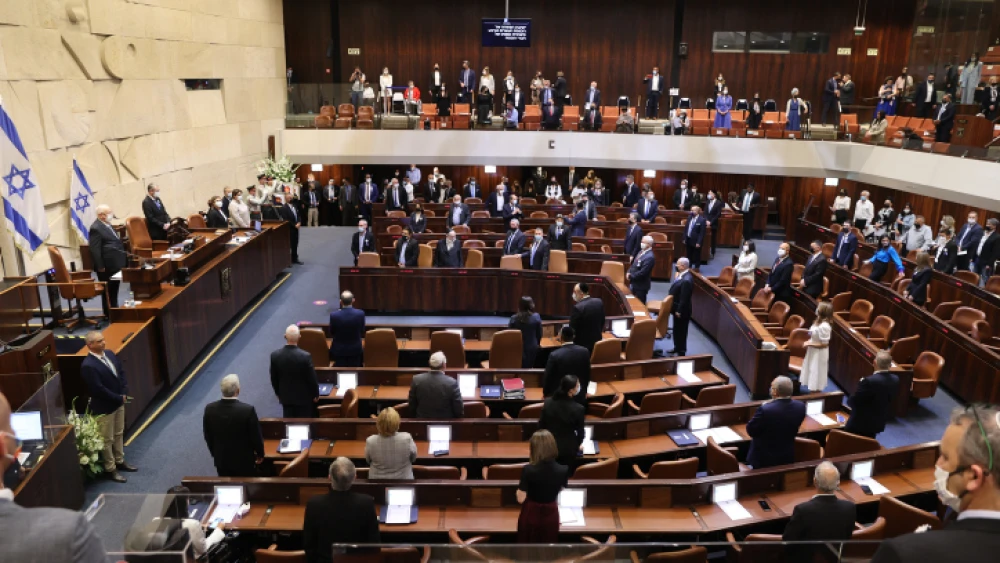
Israel’s 24th Knesset was sworn in on Tuesday with less than the customary fanfare due to coronavirus restrictions on the number of attendees and the political crisis that is threatening to lead to a fifth round of elections.
Most of the 120 Knesset members, both veterans and newcomers—sporting the traditional flower pinned to their lapels—confirmed their oaths of office from their plenum seats: “I pledge myself to bear allegiance to the State of Israel and faithfully to discharge my mandate in the Knesset.”
The MKs from the Joint Arab List altered the words of the oath, each standing when his or her name was called to state: “I pledge to fight the [Israeli] occupation, racism and apartheid.”
Knesset Speaker Yariv Levin disqualified their vows, which—if not altered in a subsequent private swearing-in session—will lead to their being denied some of their rights as members of the legislative body.
Mansour Abbas, the leader of the Ra’am Party—who has been dubbed a “kingmaker” for the four seats he garnered in the March 23 elections that could make or break the formation of a coalition—was absent from the proceedings. According to Kan News Radio, he was in the hospital being treated for kidney stones.
Also absent was United Torah Judaism MK Meir Porush, who was out of the country attending his granddaughter’s wedding. Both he and Abbas are slated to undergo their swearing-in sometime next week.
Upon his arrival on the red carpet outside the Knesset building in Jerusalem, Israeli President Reuven Rivlin was greeted by Levin, who days earlier had accused him of attempting to help oust Prime Minister Benjamin Netanyahu.
In his address to the plenum ahead of the swearing-in of each MK, Rivlin said, in part: “The disagreements that divide our society are genuine differences. ... But there are times when we are obliged to resolve even wrenching, tough, painful disagreements. The seats on which you are sitting ... are rare and valuable. The power you have ... is enormous. The Israeli people looks to you and expects each one of you to show leadership ... that is faithful to the people and their values, but that also knows how to mark boundaries and show the way; leadership that is confident in its path, but that sees ideological rivals not as the enemy ... but as potential partners.”
Earlier on Tuesday, Rivlin gave Netanyahu the mandate to form the country’s next government, albeit with what he said were “moral and ethical” reservations stemming from the prime minister’s corruption trial, the evidentiary phase of which began on Monday.



