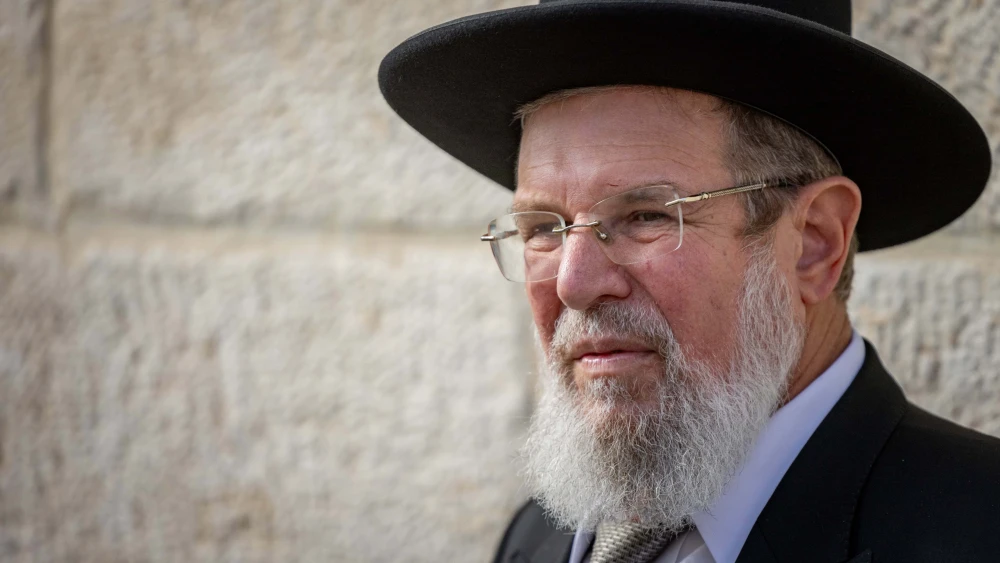
Rabbi Kalman Ber from Netanya was elected Israel’s Ashkenazi chief rabbi on Thursday, defeating Rabbi Micha Halevi in a run-off vote.
A moderate rabbi with links to the Religious Zionism movement, Ber won the second round of voting 77-58 over hardliner Halevi after the previous election late last month ended in a tie, local media reported.
Ber, who until now served as the rabbi of Netanya, enjoyed the backing of the ultra-Orthodox Degel HaTorah Party. He was also supported by those who campaigned against Halevi, who once promised not to run.
Halevi received support from Israeli Finance Minister Bezalel Smotrich’s Religious Zionism Party and Shas, the Sephardi ultra-Orthodox party.
The second round was held at the Chief Rabbinate in Jerusalem under the auspices of Yehuda Cohen, the organization’s director general.
Meir Porush, the minister of Jerusalem affairs and Jewish heritage, said in a statement following Thursday’s vote that “the election of the Gaon Rabbi Kalman Ber—may he live many long and good days—to the position of chief rabbi is important and significant news for Israel’s tradition.”
Porush said Ber received support from “all denominations and circles and will unite all of Israel during this difficult period.”
Rabbi David Yosef was elected in the first round on Sept. 30 to succeed his brother as the Jewish state’s Sephardic chief rabbi. Yosef, 67, whose late father, Ovadia Yosef, joined Shas and became its spiritual leader after serving as Sephardic chief rabbi for 11 years, won 72 votes out of 140.
The vote, which was initially expected to take place in the spring, was repeatedly delayed because of a dispute involving the Chief Rabbinate, the religious services ministry and Jerusalem’s High Court of Justice.
The impasse was broken following a court ruling that effectively lifted justice’s previous requirement that women be considered to serve under the title of “rabbi” on the Rabbinate’s electing assembly.