


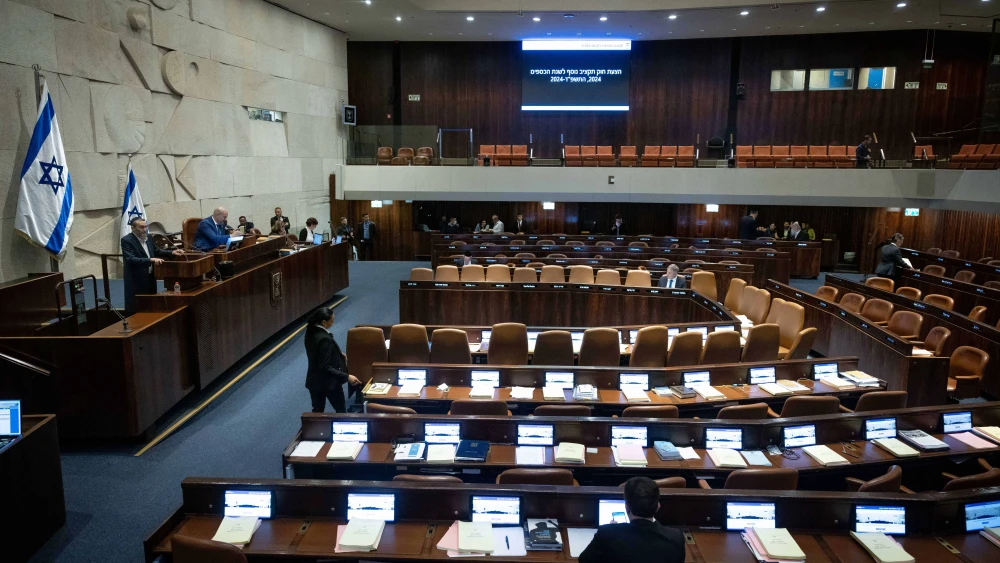
The Knesset plenum voted 61 to 41 on Wednesday to pass a law allowing the deportation of terrorists’ families. It applies to first-degree family members, including parents, siblings and spouses.
The law empowers Israel’s interior minister to eject from Israel those family members who can be proven to have known of attacks beforehand but who did nothing to warn the authorities.
It also allows the minister to deport family members who expressed support for or incited acts of terrorism.
As the law’s explanatory section notes, since Hamas’s Oct. 7, 2023, massacre, cases of incitement by those holding Israeli citizenship or permanent residency have risen, and the law is intended to serve as a deterrent.
Maurice Hirsch, director of the Initiative for Palestinian Authority Accountability and Reform at the Jerusalem Center for Security and Foreign Affairs, told JNS that the law’s passage provides “another important provision to combat terror.”
Hirsch, who helped draft the bill, served as the director of the Military Prosecution for Judea and Samaria and as head of the Advisory Committee to the interior minister for subjects related to the Law of Citizenship, including the cancellation of citizenship.
“The days in which the terrorists wantonly murder people and by their actions enrich their families and raise their social status within their communities are over,” Hirsch said.
“With the passage of the law, the terrorists and their families are put on notice that the State of Israel will no longer tolerate the widespread support for terror, and that their actions are going to have potentially harsh consequences,” he added.
Terrorists want to “enjoy the fruits” of their violence, he noted.
They receive stipends from the Palestinian Authority’s “Martyrs Fund,” which pays terrorists and their families monthly salaries for carrying out attacks. Arab citizens of Israel who engage in terrorism also receive these payments.
Terrorists’ families also enjoy higher status in Palestinian society, which glorifies terrorism, said Hirsch.
“In most societies, people involved in terrorism are spewed out and condemned. In Palestinian society, it’s a mark of honor, of success, that you are the family member of a terrorist,” he told JNS.
The bill strikes at the heart of these incentives, he added.
“If the family is deported, it can’t enjoy the benefits or the glory,” he said.
Deportation isn’t permanent under the law. For those holding Israeli citizenship, it’s seven to 15 years, while for those with permanent resident status it’s 10 to 20 years.
The law takes into account the 1961 Convention on the Reduction of Statelessness, which seeks to prevent people being stripped of citizenship. Even though the convention has a provision for canceling the citizenship of those who engaged in acts of disloyalty to the state, the law allows the deported individuals to retain citizenship.
The law was put forward by Knesset members Hanoch Milwidsky and Eliyahu Revivo of the Likud, and Almog Cohen of Otzma Yehudit, among others.
Oded Forer of Yisrael Beiteinu, an opposition party, also supported the bill.
However, it didn’t enjoy as much support as anticipated. Almog said at an Oct. 29 Knesset House Committee meeting that he expected the bill to garner the support of more than 80 of the 120 MKs.
The reason had nothing to do with the law itself, but rather a decision by the opposition parties on Wednesday to cease all cooperation with the government following the firing of Defense Minister Yoav Gallant on Tuesday.
The opposition declared that in protest, it would oppose all bills presented by the coalition, even those related to the war effort or benefits for IDF reservists.
Yisrael Beiteinu almost immediately broke with this decision, however. It did not vote against but instead abstained on the deportation law. One of its members, the aforementioned Forer, did vote in favor.



