Newsletter
Newsletter Support JNS

At UN, Netanyahu reveals hidden Iranian nuclear site, secret Lebanon missiles

The Israeli prime minister said a warehouse includes technology for Iran’s nuclear initiative, remarking that the Islamic Republic “took this radioactive material and spread it around Tehran like Nutella.”

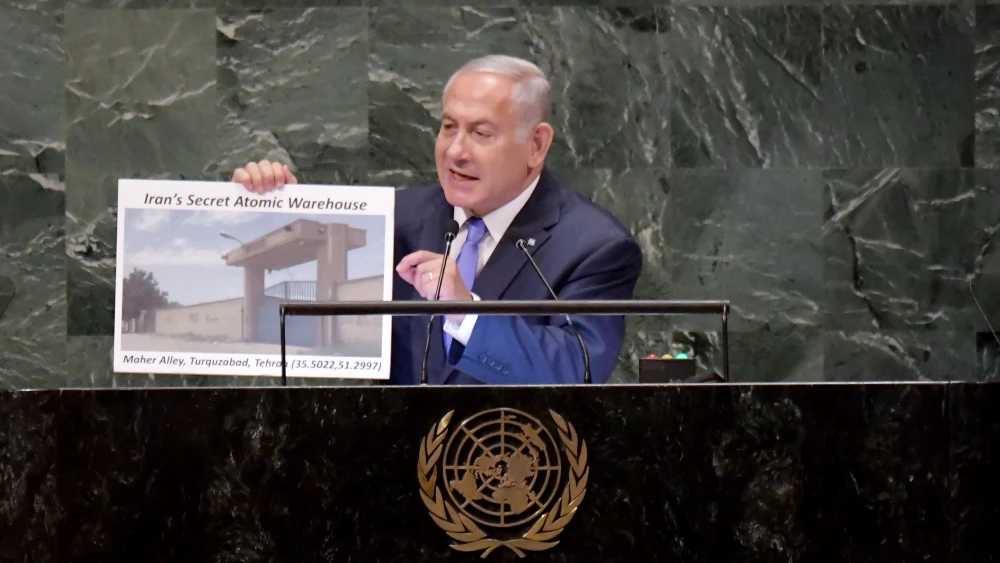
Israeli Prime Minister Benjamin Netanyahu addresses the U.N. General Assembly in New York, visual in hand, revealing a hidden Iranian nuclear facility and secret missiles in Lebanon’s capital, on Sept. 27, 2018. Photo by Avi Ohayon/GPO.

In his address at the U.N. General Assembly’s 73rd session on Thursday, Israeli Prime Minister Benjamin Netanyahu, visual in hand, revealed a hidden Iranian nuclear facility and secret missiles in Lebanon’s capital.

Netanyahu said the Iranian warehouse includes technology for Iran’s nuclear initiative, remarking that the Islamic Republic “took this radioactive material and spread it around Tehran like Nutella.”

Netanyahu said the regime removed 33 pounds of radioactive material from the facility, which contained up to 600,000 pounds of nuclear material, last month. The Israeli prime minister asked the International Atomic Energy Agency to inspect the facility.

“I have a message for tyrants of Tehran—Israel knows what you’re doing,” Netanyahu said. He added that Israel will continuously counter Iran and “also in Syria and also in Iraq.”

“Hezbollah is using the innocent people of Beirut as human shields,” said Netanyahu, holding up a photo of a missile site beneath a soccer stadium. “Israel also knows what you are doing.”

Netanyahu’s remarks come a day after meeting with U.S. President Donald Trump on the sidelines at the U.N. event, with the Israeli leader saying afterwards that he was “very pleased” with the outcome. They discussed peace negotiations with the Palestinians and the situation in Syria, among other regional issues.

“My sense is that John wanted to retire with the confidence that, in the absence of the first generation of Catholic and Jewish leaders who lay the foundation of friendship, these relations would grow and thrive,” the scholar Malka Simkovich told JNS.
“Before the war, the public was divided,” the premier said. “I think that has changed.”
Prosecutors say defendants linked to the IRGC planned assassinations and arson against the Federal Republic’s top Jewish leader, a pro-Israel activist and Jewish businesses.
A change in Austrian law could allow survivors who remained in the country after World War II while searching for relatives or awaiting visas to receive long-denied benefits.
The facility, mainly used by budget airlines, had been shut for four months due to reduced traffic during the war with Iran.
“Peace is tied to freeing Lebanon from the de facto Iranian occupation,” said Gideon Sa’ar.
Benny Gantz, JNS editor-in-chief Jonathan S. Tobin, Gilad Erdan, Mosab Hassan Yousef, Nissim Black and leading voices in security, diplomacy, media, law and Jewish communal affairs headline the summit’s third day in Jerusalem.