Newsletter
Newsletter Support JNS

Israeli ambassador: Hatred that spurred Holocaust is not gone

“We have seen it all before,” envoy Daniel Meron says at U.N. ceremony in Geneva where Argentina was handed the chairmanship of the International Holocaust Remembrance Alliance.

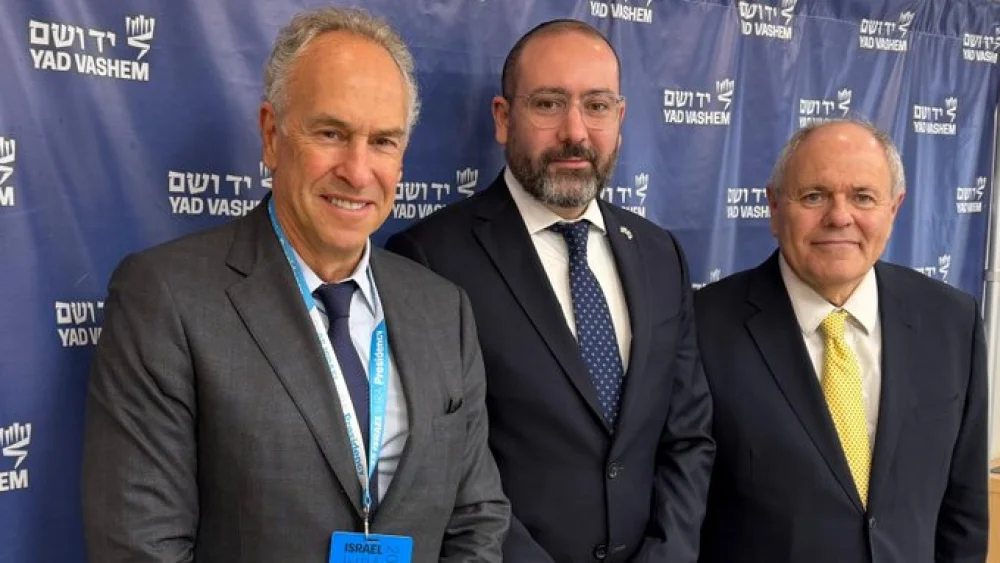
From left, Marcelo Mindlin, now head of the International Holocaust Remembrance Alliance, Argentine Ambassador to Israel Rabbi Shimon Axel Wahnish and Dani Dayan, then president of the IHRA, Dec. 17, 2025. Credit: Rabbi Wahnish/X.
From left, Marcelo Mindlin, now head of the International Holocaust Remembrance Alliance, Argentine Ambassador to Israel Rabbi Shimon Axel Wahnish and Dani Dayan, then president of the IHRA, at Yad Vashem in Jerusalem, Dec. 17, 2025. Credit: Rabbi Wahnish/X.

Israel officially handed over to Argentina the rotating chairmanship of the International Holocaust Remembrance Alliance (IHRA) on Wednesday, amid the worst burst of global antisemitism since the Holocaust.

The symbolic ceremony held at the United Nations in Geneva took place two months after Argentina, on March 18, became the first South American country to assume leadership of the organization, which seeks to promote Holocaust education and awareness worldwide.

IHRA Chair Marcelo Mindlin, president of the Holocaust Museum of Argentina since 2016, will hold the post for one year.

Israel’s ambassador to the U.N. in Geneva noted that the hatred which spurred the Holocaust is not gone, but is lurking underneath the surface, including in ways where it is trivialized or distorted to apply to today’s conflicts.

“These actions, hiding under the guise of pretend righteousness, just repeat the same old tropes that have always existed,” Ambassador Daniel Meron said. “We have seen it all before.”

Ambassador Carlos Foradori, Argentina's representative to the International Organizations in Geneva, and Israeli Ambassador Daniel Meron in Geneva on May 13, 2026. Credit: Permanent Mission of Israel to the U.N. in Geneva.
Ambassador Carlos Foradori, Argentina’s representative to the International Organizations in Geneva, and Israeli Ambassador Daniel Meron in Geneva on May 13, 2026. Credit: Permanent Mission of Israel to the U.N. in Geneva.

Ambassador Fabiana Loguzzo, Argentina’s special representative for the fight against antisemitism and co-chair of the country’s presidency of the International Holocaust Remembrance Alliance, spoke about her nation’s motto for its leadership role in the organization—"Expanding the frontiers of memory"—highlighting the commitment to shedding light on archival documents and stories of the Holocaust.

Argentina has undergone a 180-degree shift from serving as a safe haven for Nazis after the Holocaust to becoming, under President Javier Milei, one of the staunchest supporters of Israel in the world.

An intergovernmental organization made up of more than 40 countries, the IHRA is most commonly known for its working definition of antisemitism, adopted a decade ago, which has become the gold standard for the oldest hate and has since been adopted by more than 1,200 entities worldwide, including the U.S. State Department.

“At a time of rising and normalization of antisemitism, including Holocaust distortion, inversion and denial, the IHRA’s leadership is vital,” Michal Cotler-Wunsh, CEO of the International Legal Forum and Israel’s former special envoy for combating antisemitism, told JNS on Thursday. “For ‘Never Again’ to mean anything, it is imperative to identify and combat all strains of antisemitism as defined by the IHRA in a long, democratic process.”

France is scheduled to assume the presidency of the organization next year.

Etgar Lefkovits, an award-winning international journalist, is an Israel correspondent and a feature news writer for JNS. A native of Chicago, he has two decades of experience in journalism, having served as Jerusalem correspondent in one of the world’s most demanding positions. He is currently based in Tel Aviv.
The designations include Hezbollah-linked institutions that “threaten regional stability, international security, mutual interests and global trade,” the U.S. Treasury Department stated.
Gerard Filitti, of the Lawfare Project, told JNS that “lax immigration policy” has always been the main driver of importing “terrorist ideology” into the United States.
“The teachers we have, we don’t respect and support in the way that they deserve,” Paul Bernstein told JNS. “If we’re successful and we grow enrollment, that problem only gets bigger.”
“The message being sent is that you can get away with attacking someone in broad daylight because you disagree with their opinions, especially if it involves feelings about Israel,” Joshua Burt, of the Anti-Defamation League, told JNS.
“Not identifying Hamas as a terrorist organization is, I think, a failure, Marc Miller told the Canadian Press. “And not clearly stating that, for example, Hamas intended to kill Jews is, I think, an unfortunate error in curation and should be rectified.”
“This is life for Jews under the leadership of Mayor Zohran Mamdani,” advocacy group StopAntisemitism wrote.