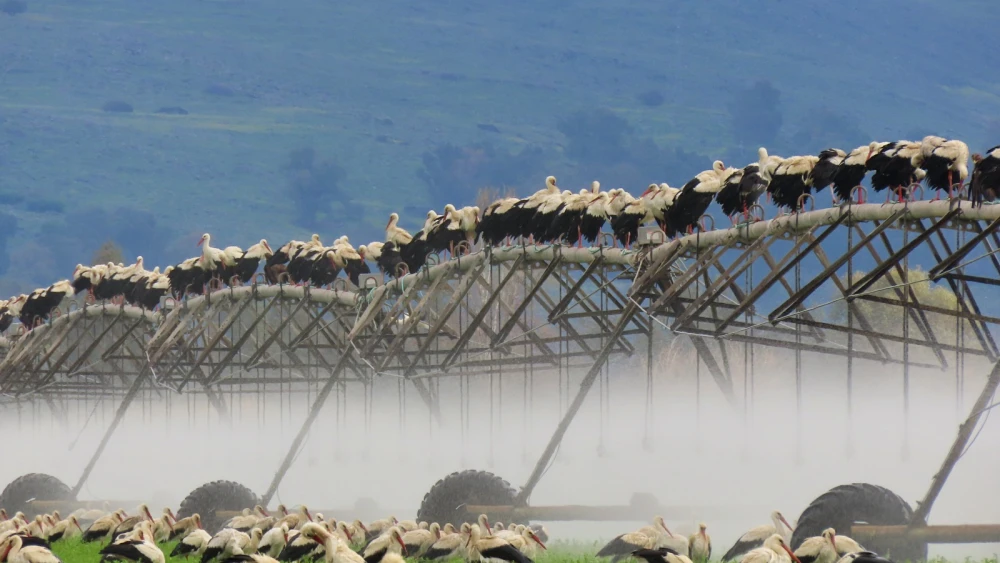
As the spring migration season reaches its peak, thousands of white storks (Ciconia ciconia) have been seen over the past month at Israel’s Hula Lake Park in the Galilee Panhandle on their journey from Africa to Europe and Asia.
The Hula Lake Park, which provides an abundance of food and perching places, is a popular rest-stop for storks, as more than half a million of them pass over Israel twice a year during the migration seasons, Keren Kayemeth LeIsrael-Jewish National Fund (KKL-JNF)—which runs the park—said in a statement on Wednesday.
Storks fly during daylight hours, and at night they stop to rest in trees. At Hula Lake Park, they can often be seen perched on irrigation systems in agricultural fields.
Feeding mainly on rodents, amphibians, reptiles and large insects, the storks play an important role in natural biological pest control, contributing to a balanced and environmentally friendly ecosystem. As a result, they are especially beneficial to agriculture, according to KKL-JNF.
Since storks rely on rising warm air (thermals) to be able to soar over long distances, they avoid flying over the open ocean, where thermals do not form, preferring to fly through intercontinental land channels such as Israel.
“The white stork is the species that, for many generations, symbolized migration and longing for the Land of Israel for Jews from Ethiopia to Poland. Today, we bear the responsibility to ensure that Israel, as a central stopover on the migration route of storks and other bird species, continues to support the miracle of migration that takes place before our eyes twice each year,” Yaron Charka, KKL-JNF’s chief ornithologist, said in a statement.