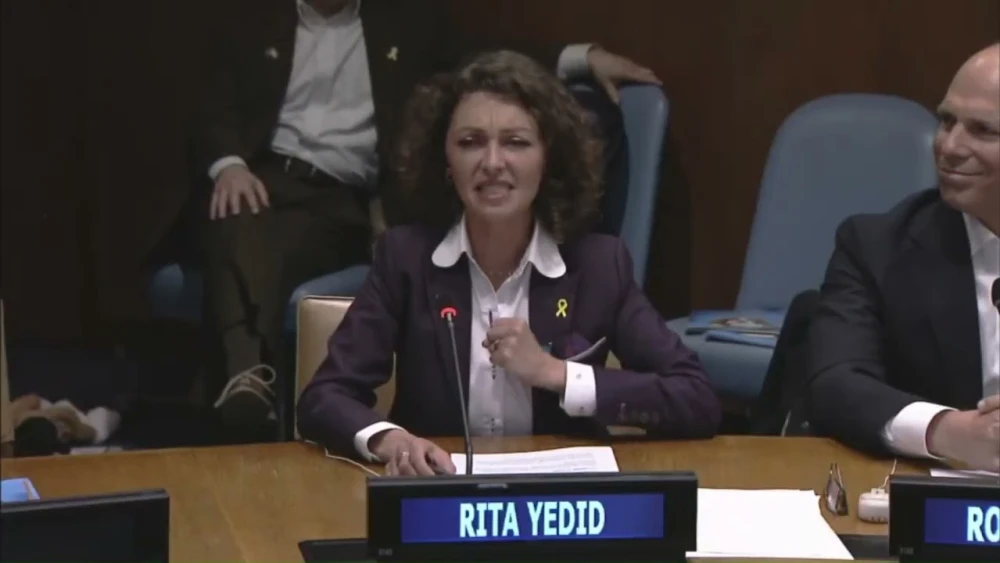
“All I wanted was to dance. I went dancing and almost didn’t come home to my son,” Rita Yedid told JNS on Monday.
On Oct. 7, 2023, as Hamas terrorists stormed the Supernova music festival near Kibbutz Re’im on the Gaza border, Yedid hid in a ticket-booth caravan with her sister Eden, her husband. Guy, and three other partygoers.
Guy was shot and wounded while shielding her from Hamas gunfire. Around 11:30 a.m., a terrorist looked through the caravan window, threatened the group and stole their phones and money. All six were rescued later that day by Israeli soldiers.
Almost 400 people were murdered and scores were kidnapped during the massacre.
“RITA,” a film documenting Yedid’s first visit back to the festival site and her healing process, premiered at the Tel Aviv Cinematheque on Wednesday.
Directed by Asaf Sudry and Tali Shemesh, it follows Yedid on her deeply personal healing journey.
“Every day, we can be hit by a car in the street or be struck by lightning. It doesn’t have to happen in a terror attack like Nova. I want people to see that there is a chance, even if it is small, that we can take the worst things that happen to us in life and turn them into an opportunity,” Yedid said.
“We can stand up and be resilient, find strength and a sense of mission. It does not happen in one moment. Therapy is very helpful in that process. I hope people will watch this film and feel that they can do it themselves, and believe they can overcome whatever they are going through in their own lives,” she added.
Yedid’s film begins with her returning to the Supernova site while recounting her story. She admitted she was extremely nervous about returning to the scene of the horror. “I didn’t know what it would do to me, just like I was sure I would never go dancing again.”
Once she realized returning could aid her healing, Yedid visited the site for the first time six months after the massacre, and recalled feeling anger that the area had been cleaned up.
When she returned, the site was still largely bare, and it took Yedid time to relocate the parking area, the festival grounds, the location of her tent.
“I am so grateful for what the site is today. It has become more of a memorial site, with signs and explanations. No one can forget it or clean it up,” she said.
In the film, Yedid asks forgiveness from the victims murdered at Nova. She told JNS she hopes the project will help ensure they are remembered.
At one point in the film, the cameraman focuses on a photograph of Jake Marlowe, who was murdered at Nova. “We called his parents, who are from London. It made them very happy. They were very thankful that his face is in the movie and that his name appears at the end as a tribute,” she said. His parents are family friends of the film’s co-executive producer, Raquela Cohen.
“For me, parents who lost their loved ones are the hardest people to meet face to face. I made a movie about resilience, but they no longer have their children. It is basically about living while balancing sorrow and growth,” she added.
Dancing again, Yedid said, was central to her recovery. It was one of the biggest tools that allowed her to release the stress from her body, as well as the anger and stiffness.
“It’s something I love to do. I thought I would never be able to listen to that music again, because so many people died. Dancing became another form of therapy for me,” she said.
Footage from her healing process, originally filmed at the request of SafeHeart, a nonprofit mental-health organization established to support survivors of the massacre, was incorporated into the movie.
With the film, Yedid said she hopes to inspire change and take part in events and discussions aimed at preventing similar tragedies in the future.
“At first, I looked at this film as something I could send out because I am now a mother of two, and it’s not practical to fly all over the world and speak about the massacre. Suddenly, I had an impactful movie. It shows me how to make lemonade from the lemons life gives you,” she said.