


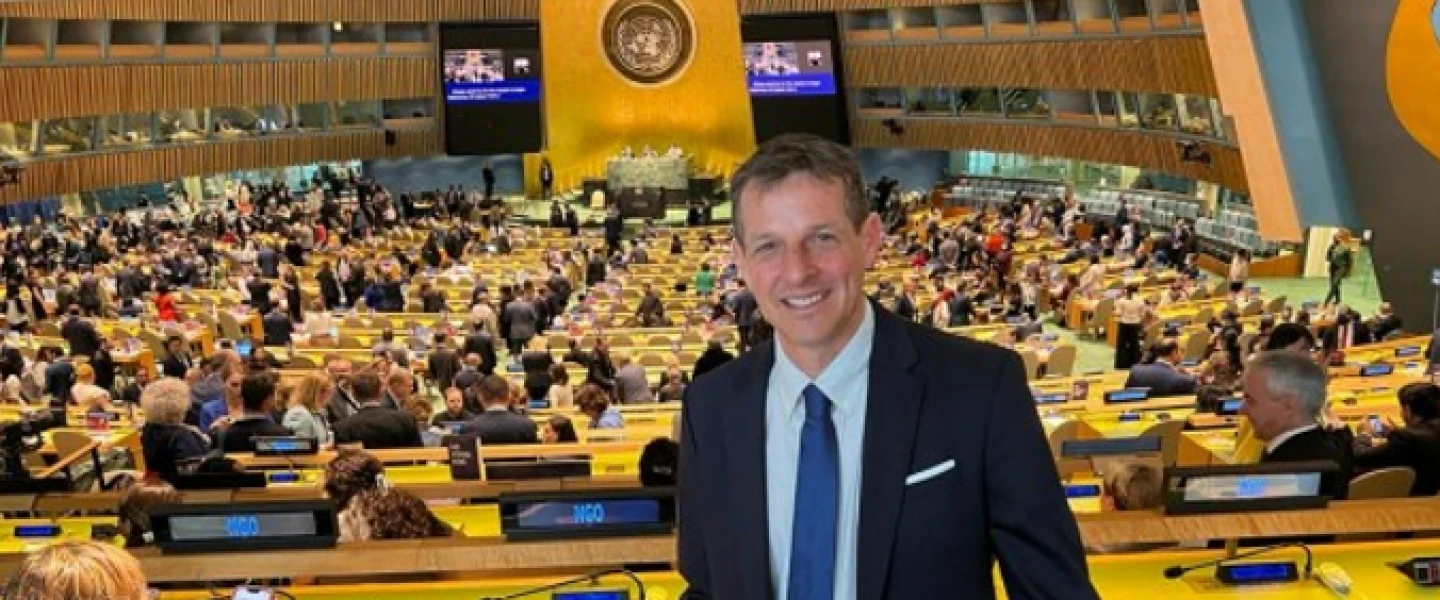
When Ahmir Lerner addressed the United Nations General Assembly on June 11, he was there to discuss a subject that rarely captures global headlines: protecting the rights of people with disabilities during times of crisis.
Yet the message delivered by the chief executive officer of Ra’anana-based Beit Issie Shapiro, one of Israel’s leading disability-rights organizations, reached far beyond the annual Conference of States Parties to the Convention on the Rights of Persons with Disabilities.
Addressing diplomats and delegates gathered at U.N. headquarters in New York, Lerner called on world leaders to demonstrate moral clarity at a time when international institutions face growing challenges from conflict, polarization and misinformation.
“Have the courage to speak clearly. Have the courage to reject false equivalence. Have the courage to defend truth—even when it is uncomfortable, even when it is unpopular,” Lerner told the assembly. “Because without that—everything we say here about equal rights becomes empty.”
For an Israeli representative speaking at the United Nations amid heightened scrutiny of the Jewish state, the remarks carried particular significance.
An Israeli voice at the United Nations
The conference brought together representatives of governments, civil-society organizations and advocates from around the world to discuss advancing the rights and inclusion of people with disabilities.
For Beit Issie Shapiro, however, participation represented more than attendance at another international gathering.
The organization viewed its presence as an opportunity to ensure that Israel remained part of important global conversations at a time when many Israelis have become increasingly frustrated with international institutions.
“Our work transcends politics; our mission serves humanity on a global scale,” Lerner told delegates. “By withdrawing from U.N.-based forums, we would silence one of Israel’s most positive voices on the global stage. Our continued presence gives us a voice to challenge misrepresentations and advocate for fairness.”
Founded more than four decades ago, Beit Issie Shapiro has become a recognized leader in disability inclusion, rehabilitation, innovation and advocacy. Since 2012, it has held Special Consultative Status with the United Nations Economic and Social Council (ECOSOC), enabling it to participate in U.N. conferences, submit policy recommendations and contribute to international initiatives affecting people with disabilities.
That status provided the platform for Lerner’s address to the General Assembly.
Lessons from crisis and resilience
While his speech focused on universal themes, it also drew on Israel’s experience maintaining services for vulnerable populations during periods of war and emergency.
As part of the conference, Beit Issie Shapiro partnered with Israel’s Permanent Mission to the United Nations and Israel’s Commission for Equal Rights of Persons with Disabilities to host a side event titled, “Preparedness, Protection and Response for Persons with Disabilities in Times of Emergency.”
The discussion examined lessons learned from ensuring continuity of care and support for people with disabilities during crises and how those lessons can help shape preparedness efforts worldwide.
Representing Israeli civil society, Lerner shared practical insights from maintaining rehabilitation services, therapies and support programs despite repeated disruptions and security threats.
“Preparedness is not only about infrastructure,” he said. “It is about proactive outreach, trained people, and systems that can function under disruption. The question is not whether another crisis will come, but whether next time, our systems will be ready to include those who need them most.”
According to Lerner, inclusion cannot be treated as an afterthought when emergencies occur. Effective emergency planning requires accessible communications, trained personnel, resilient support systems and strong community networks long before a crisis begins.
‘The kind of hasbara people wanted to hear’
Although attendance at the side event was smaller than in some previous years, Lerner’s General Assembly appearance generated significant interest afterward.
Speaking with JNS, he said many attendees initially viewed him simply as the head of an international disability organization rather than through the prism of Israeli politics.
“People did not realize I was Israeli at first. I was speaking as an NGO,” he said.
Lerner noted that no delegates left during his remarks and that audience members applauded when he finished.
“There was no standing ovation,” he said with a smile, “but there was clapping.”
The strongest reactions came after the speech.
According to Lerner, supporters, donors and colleagues contacted him to express pride that an Israeli voice had spoken so candidly within the halls of the United Nations.
One participant from Belgium requested the full text of the speech almost immediately after it concluded.
“The main response was a sense of pride,” Lerner told JNS. “People said this was the kind of hasbara [public diplomacy] they wanted to hear. They felt it was brave to say these things within the U.N., which many view as anti-Israel. They said these are things all of us feel and that no one is saying the way they should.”
The volume of responses, he added, exceeded his expectations.
A career of service
Born in the United States to Israeli parents, Lerner immigrated to Israel as a child and later served as a navigator in the Israeli Air Force.
He subsequently spent 22 years in the Prime Minister’s Office, holding senior positions in logistics and security, before moving into the social sector. Prior to joining Beit Issie Shapiro, he held leadership roles at Education Cities and the Mandel School for Educational Leadership.
Lerner earned degrees in economics and banking from the London School of Economics and an MBA from Reichman University, formerly the Interdisciplinary Center Herzliya.
Despite growing criticism of international institutions in some quarters, he believes engagement remains essential.
For Beit Issie Shapiro, maintaining a presence at the United Nations is not merely about representing Israel. It is about ensuring that practical lessons learned in one country can benefit vulnerable populations around the world.
At a conference dedicated to advancing the rights of people with disabilities, the organization’s message was clear: inclusion must be built into emergency planning from the outset, not added later as an afterthought.
And in a forum where political divisions often dominate discussion, Lerner used his three minutes before the General Assembly to advocate for something more fundamental.
“The courage,” he said, “to speak clearly—and to defend the truth.”
