
During an Israeli election campaign, every political commentator rushes to crown the latest headline-grabber as “the issue that will decide the race.” Yet today, the real issue shaping the contours of the next Israeli government is buzzing, almost inaudibly, below the public’s radar.
The Arab parties have announced their “red line” for any future partnership, a demand on which they will not compromise: the immediate repeal of the “Yishur Kav” reform, a project already underway to recalibrate the situation on the ground in the Negev.
What is this plan, why has it become such a burning issue in this election cycle, and what does it mean for the future of the Negev Desert?
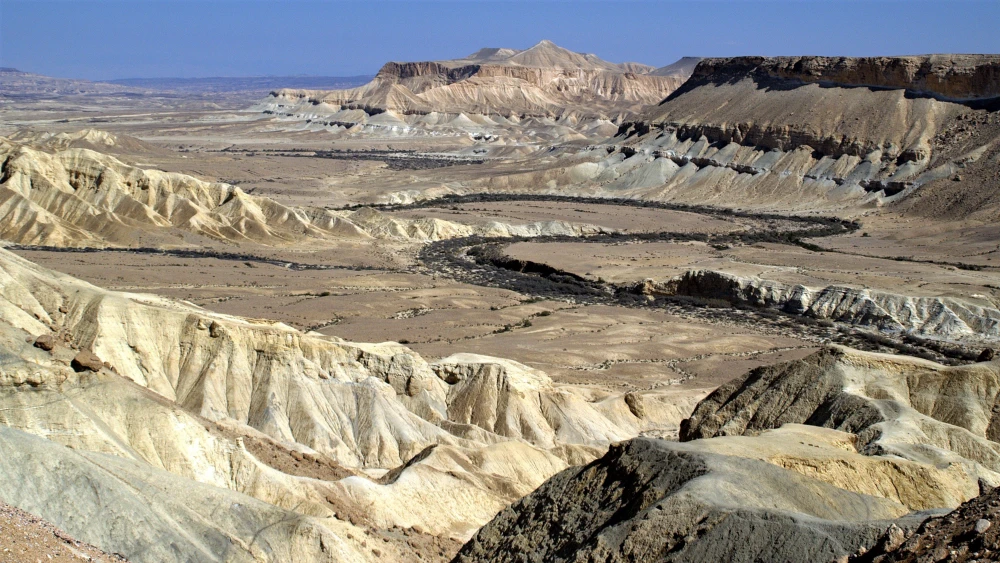
The best way to understand the plan and the crucial change it portends is to visit the overlook point above the town of Laqiya. The State of Israel planned and developed Laqiya to accommodate tens of thousands of Bedouin residents, yet in practice it is mostly small clusters of homes surrounded by vast empty expanses.
Why do hundreds of residential and commercial plots, developed and prepared for immediate absorption of Bedouin families at a cost of millions of shekels in public funds, remain vacant, while sprawling, illegal Bedouin squatter camps surrounding Laqiya continue to expand?
The answer consists of two misleadingly simple words: ownership claims. A small segment of Israel’s Bedouin population claims ownership of approximately a million dunams of land in the Negev, based on nothing more than folk customs. To date, every ownership claim adjudicated in court has been rejected, and the “claimed land” has been registered as state property for the simple reason that the claimants never owned it under any recognized system of law, including British or Ottoman law.
Surely, you may say, if this is the case, there should be no problem at all. All the land subject to ownership claims should, by now—some 40 years after the registry process began—be registered as state property, and the problem will be solved. In any case, the State of Israel grants plots of land to every Bedouin claimant (free of charge), so why not resolve the issue and move on toward normalcy in the Negev?
Any future government that yields to political pressure will set the Negev back by decades.
The problem is that the Negev is not in Europe; it’s in the Middle East. A court ruling is not the whole story. Not by a long shot. The Negev may technically be ruled by Israeli law, but the Bedouin sector rules itself by a parallel legal system: Bedouin customary law. Under Bedouin custom, if you, your father and your grandfather grazed your flocks in a particular area, that tract of land belongs to you. While under Israeli law this has no legal significance whatsoever, Bedouin will not cross those self-declared “ownership” lines.
For decades, Israeli governments operated in complete detachment from realities on the ground and with no understanding of Bedouin customary law. They continued planning and preparing new Bedouin towns and neighborhoods on land that had previously been subject to ownership claims. Although, as noted, these claims have neither legal validity nor evidentiary support in Israeli courts, Bedouin culture dictates that no one move onto a lot that another Bedouin has declared his own, even if it is legally registered as state property.
The result has been complete paralysis: millions of shekels were poured into developing empty “ghost neighborhoods,” while tens of thousands of families remained in substandard conditions in illegal encampments that continued to swell, presently comprising more than 100,000 illegal structures.
The “Yishur Kav” reform, led by Minister of Diaspora Affairs Amichai Chikli and the Authority for the Development and Settlement of the Bedouin in the Negev, was created to cut this Gordian knot. It does one simple but dramatic thing: It turns the hourglass over.
The current reform establishes a limited window of six months during which Bedouin claimants can reach compensation agreements with the state. A claimant to land located within the boundaries of a legally recognized town who allows another Bedouin to build on it will receive exceptionally generous grants. Those who refuse will see their compensation reduced. After six months, the state will remove the land from the town’s boundaries, causing its value to plummet.
After decades of a bizarre standoff, time is finally working against the holdouts who have always known that the next compensation package would be even more generous than whatever the current one is.
The Regavim Movement fully understands the significance of this reform.
Under the strict letter of the law, Bedouin ownership claimants are not entitled to a single grain of soil or one shekel in compensation for land that is not theirs. Nevertheless, this is a necessary compromise if we are to release the Negev from its years-long paralysis and create a stable future for generations to come. The all-Bedouin towns of the Negev were lawfully established on state land; the infrastructure has already been developed; and our hard-earned taxpayer money has already been spent. The time has come for the investment to begin to bear fruit.
At the same time, the “Yishur Kav” reform includes a critical safeguard against some of the biggest failures of earlier attempts to resolve the standoff: Grants and compensation will be paid to claimants only after another Bedouin family actually moves onto and resides on the contested plot, which is the only practical proof that the claimant has genuinely relinquished the land.
In parallel, the plan requires the state to continue developing new lots on state land that is unencumbered by ownership claims to accommodate relocation of residents from the squatters’ camps.
The plan has reached a historic decision point, just before the window of opportunity closes. Any future government that waters down the initiative, freezes it or yields to political pressure will set the Negev back by decades. Halting the plan would mean surrendering to chaos, condemning tens of thousands of families in the squatters’ camps to enduring poverty and disenfranchisement and losing the Negev once and for all.
In the coming election, whether the pundits know it or not, the Negev is on the ballot. As David Ben-Gurion, founding father and first prime minister of Israel, famously said, “In the Negev, Israel will be tested.”