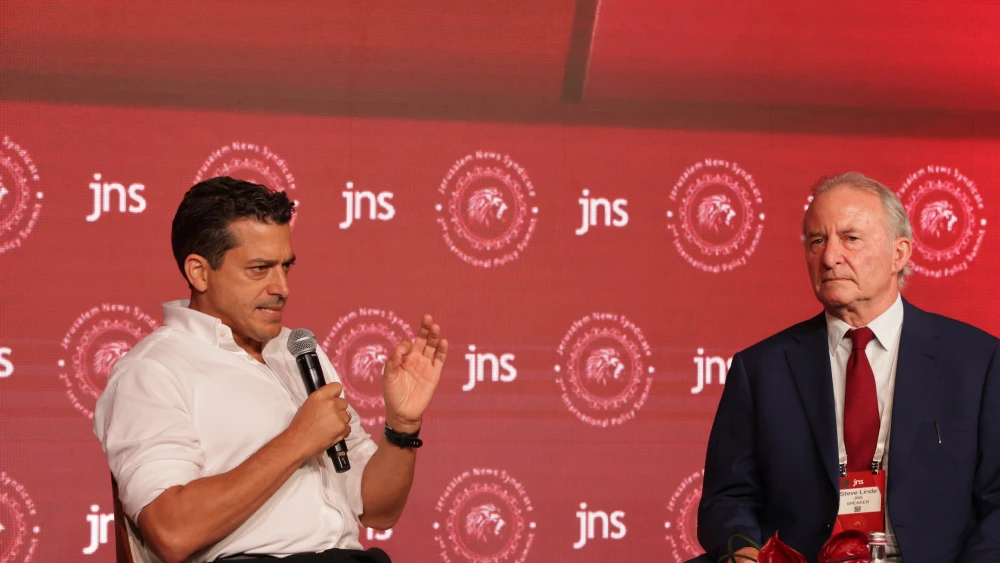
With antisemitism rising around the world, Israel’s Minister of Diaspora Affairs and Combating Antisemitism Amichai Chikli called for arming Jewish community guards with firearms during a discussion at the 2026 JNS International Policy Summit in Jerusalem on Tuesday.
The minister stressed the importance of allowing security forces serving Diaspora Jewish communities to carry real weapons. “What is the meaning of armed security if they can’t prevent horrific incidents?” Chikli asked. “Carrying weapons is very important; that the security forces of the community will be armed. It can save lives.”
In Australia, security is permitted to carry firearms inside institutions, but they were unarmed at the Bondi Beach massacre in December because it took place at a public park. “If they had guns at Bondi Beach, it wouldn’t have taken 12 endless minutes of massacre to do something,” he said.
Chikli also criticized the level of training of the police, to which Jewish communities look for protection, noting reports that a policewoman shot the Jewish civilian victim in Monday’s shooting in Montreal. “You need to have an effective police in order to counter terrorism,” he said.
Chikli had warned Canada’s government months earlier that it was heading down the same path as Australia. He referred to a Jan. 14 letter he had sent to Canada’s Minister of Public Safety, Gary Anandasangaree, warning: “The recent antisemitic terror attack in Bondi Beach, Australia, in which 15 people were murdered, tragically illustrates the lethal cost of ignoring early warning signs and underestimating ideologically driven antisemitic violence. Canada is now exhibiting disturbingly similar indicators. This path leads to a point of no return.”
His warning went unheeded. “Nothing has been done in Canada to stop antisemitism and to stop the spike in radical Islamist incidents against the Jewish community. There are endless cases, incidents of shootings on Jewish schools, Jewish institutions, and, unfortunately, nothing has been done,” Chikli told the attendees.
The minister also blamed rising antisemitism in Canada, Australia and the United States on the decision by their governments to recognize a Palestinian state in the midst of Israel’s war against Hamas.
“When you are recognizing a terror state in the middle of the war, while our hostages are still in the dungeons, you are empowering these radical forces,” he said.
‘Sanctions should continue’
Turning to U.S.-Israel relations and talks surrounding a deal with Iran, Chikli rejected claims that Israeli ministers had criticized U.S. President Donald Trump.
“No cabinet minister has spoken against President Trump. I think we never had such a friend in the White House,” said Chikli, thanking Trump for moving the U.S. embassy to Jerusalem, recognizing Israeli sovereignty over the Golan Heights, facilitating the Abraham Accords and authorizing the January 2020 strike that killed Brig. Gen. Qassem Soleimani, commander of the Quds Force of the Islamic Revolutionary Guard Corps, as well as supporting Israel militarily.
While expressing strong support for Trump, Chikli argued against lifting sanctions on Tehran.
“There is a huge difference between ending the war and relieving the sanctions,” he said. “The sanctions should continue, because every dime that we give to this regime will go straight for terror, for mass destruction, for instability of the entire region.”
Chikli described the Iranian government as a “tyranny,” a “dictatorship” and a “terror regime,” whose main victims are the Iranian people themselves.
The minister devoted significant attention to what he called a new geopolitical alignment centered on the Muslim Brotherhood.
According to Chikli, the decline of Iran’s regional influence and the weakening of Hezbollah have created space for a new threat led by Turkey, Pakistan and Qatar.
He described Qatar as a key promoter of Muslim Brotherhood ideology (“the PR state of the Muslim Brotherhood”) and accused Turkis President Recep Tayyip ErdoğanErdoğan of pursuing a neo-Ottoman vision aimed at expanding Turkish influence throughout the region.
He also expressed concern about Syria under Ahmed al-Sharaa. Formerly known as Abu Mohammed al-Jolani, Chikli described him as a “terrorist with a suit,” and said the former Islamist militia leader couldn’t be trusted despite his efforts to rebrand himself internationally.
“The new axis is the Muslim Brotherhood axis of Erdoğan’s Turkey, Syria and Qatar,” Chikli said. “It’s better to wake up and open your eyes now before it is too late.”
Asked about Israel’s next elections, Chikli praised Israeli Prime Minister Benjamin Netanyahu’s leadership since the Hamas-led Oct. 7, 2023, attacks, arguing that Israel had significantly weakened Hamas, Hezbollah and Iranian-backed forces throughout the region.
He also highlighted the ongoing expansion of Jewish communities in Judea and Samaria, saying the government was working to prevent the establishment of a Palestinian state.
‘World’s most capable terrorist army’
Chikli sharply criticized former Israeli Prime Minister Naftali Bennett, who spoke earlier at the conference. Chikli belonged to Bennett’s Yamina Party before breaking with him to join the Likud Party.
“Bennett is the [Bernie] Madoff of Israeli politics,” Chikli said, accusing him of breaking his campaign promises when he formed a coalition government in 2021 together with the Yesh Atid Party’s Yair Lapid, something Bennett explicitly vowed he would never do.
The minister argued that a future right-wing coalition was necessary to preserve Israeli security gains and continue strengthening Jewish communities in Judea and Samaria.
Addressing security conditions along Israel’s northern border, Chikli said Hezbollah had been substantially degraded from what he described as “the world’s most capable terrorist army” into a mere guerrilla force.
He emphasized the importance of maintaining Israeli control over buffer zones and expressed skepticism toward international peacekeeping arrangements.
“We trust only in ourselves and in God above,” Chikli said.