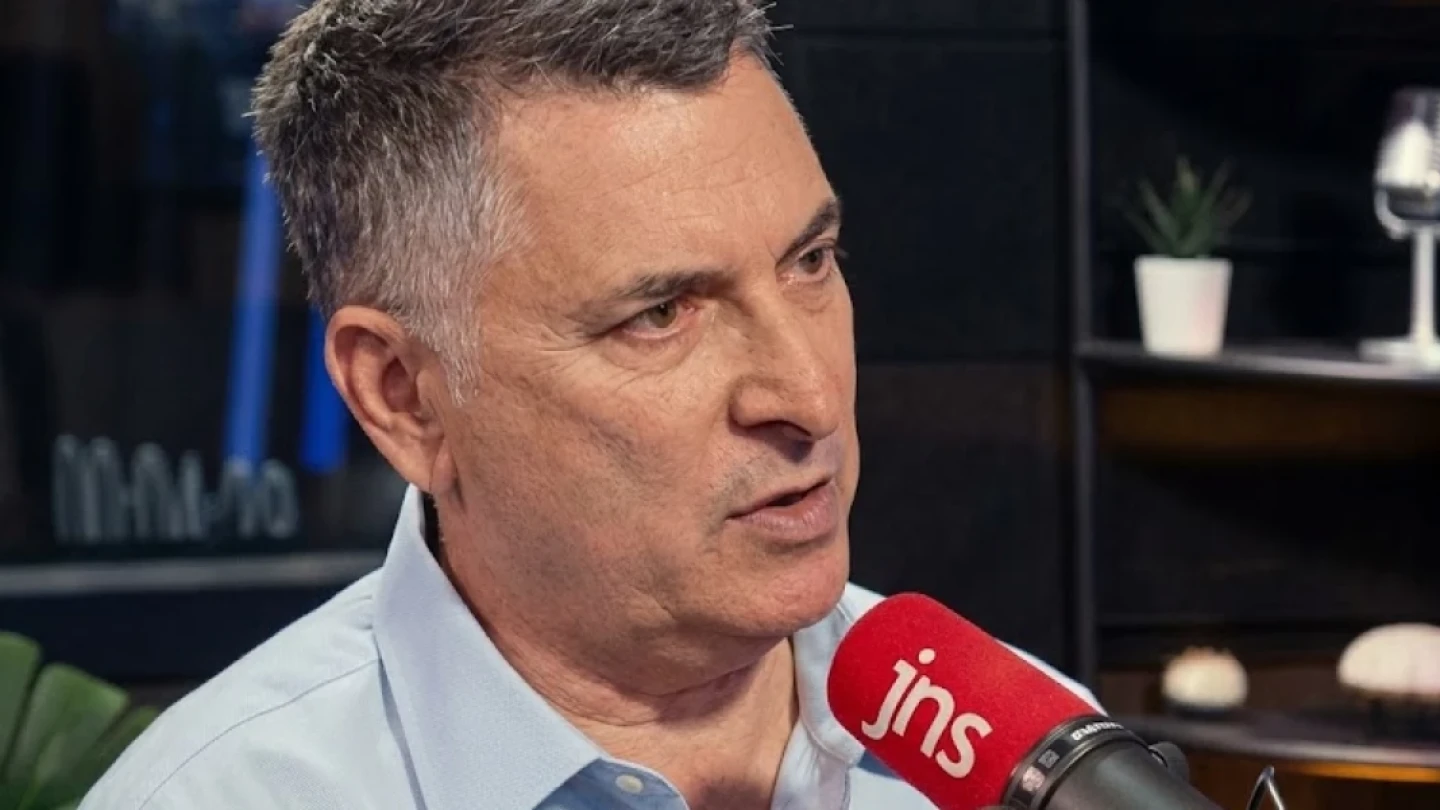
Nickolay Mladenov, high representative for Gaza at the U.S.-backed Board of Peace, told the United Nations Security Council to “use every means at its disposal” to pressure Hamas to disarm.
Amid concern that the stalled effort to get the terror group to lay down its arms will leave Gaza’s recovery paralyzed, Mladenov, a former U.N. envoy for the Middle East peace process, addressed the Security Council on Thursday.
“There is no recovery in Gaza,” he said.
Mladenov briefed the council on the board’s first report on the state of affairs in Gaza, coming six months after Israel and Hamas signed on to a U.S.-brokered ceasefire plan.
The Board of Peace, established by U.S. President Donald Trump, was created to bring about a permanent cessation of hostilities in Gaza and to provide a roadmap for governance, recovery and reconstruction in the Strip following the two-year war between Israel and Hamas.
A central obstacle remains Hamas’s refusal to surrender its weapons, a condition Israel and the board have described as essential to long-term stability and the phased withdrawal of Israel Defense Forces troops from Gaza.
“Reconstruction financing will not follow where weapons have not been laid down,” Mladenov said. “No investment, no movement, no horizon.”
He warned that failure to advance the disarmament process could entrench Hamas’s rule over part of the enclave indefinitely.
“The risk is that the deteriorating status quo becomes permanent—a divided Gaza, Hamas holding military and administrative control over two million people across less than half the territory,” Mladenov told the Security Council.
“This is a version of the future that Israelis, Palestinians and the region should all fear and all mobilize to avoid,” he said.
The Security Council endorsed the broad framework of Trump’s 20-point Gaza plan in a resolution passed in November, backing efforts to establish the proposed groundwork for Gaza’s future governance and recovery.
Tammy Bruce, U.S. deputy ambassador to the United Nations, said at Thursday’s meeting that “there are still significant challenges to overcome.”
She noted that “the virtual elimination of aid diversion and overall increase in humanitarian assistance flowing into Gaza.”
‘Dangerous illusion’
Several council members, including Greece and Panama, welcomed the fact that the ceasefire has largely held despite near-daily violations, while expressing concern that humanitarian aid levels have not been scaled up to desired amounts.
“The path towards a just, dignified and sustainable peace between Israelis and Palestinians doesn’t need to be reinvented,” said Eloy Alfaro de Alba, Panama’s U.N. ambassador. “It needs political will to be implemented.”
France argued that reconstruction efforts should proceed regardless of whether Hamas disarms.
Jérôme Bonnafont, France’s U.N. ambassador, said that Paris can’t “accept that the restoration of decent living conditions is being subject to the success of this disarmament process, because that would be tantamount to giving Hamas the keys of the future” of the Palestinian territories.
That would make the civilian population bear the brunt of the deadlock, he said.
He called for the installation of the Palestinian technocratic transitional government envisioned under the Board of Peace framework, alongside a new Gaza police force and the proposed International Stabilization Force.
Moscow, meanwhile, cast doubt on the initiative’s viability.
Vassily Nebenzia, Russia’s U.N. envoy, noted he abstained on a Security Council vote on the board’s formation to give it a chance, but that the concerns he expressed then have borne out.
“Those who read the Board of Peace report may come under the impression that Hamas alone is to blame for all the misfortunes facing Gaza,” Nebenzia said.
“In fact, Israel continues to withhold aid and dangle promises of skyscrapers and jobs, even as it occupies Gaza and embraces provocative policies,” he added.
Jonathan Miller, Israel’s deputy U.N. ambassador, rejected that criticism, cautioning of a “dangerous illusion taking hold in this chamber.”
That illusion, he said, is that “diplomacy can succeed while terrorist organizations are allowed to hold diplomacy hostage.”
Pointing to similar obstructionist tactics employed by Iran and its Lebanese proxy Hezbollah, Miller said that “diplomacy can only work when the parties involved are prepared to treat it as a path to implementation, rather than as a mechanism for delay.”
“When terrorist organizations use each round of talks to obstruct progress, preserve their weapons and strengthen their position on the ground, the international community must be careful not to confuse process with progress,” he said.