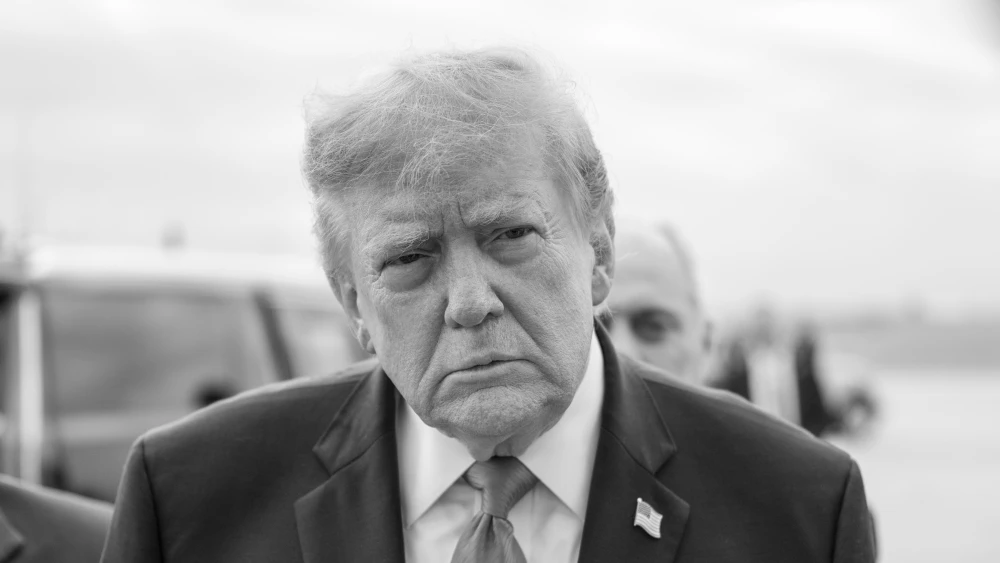

The results of America’s midterm elections have sent a powerful political message. Democrats have made significant gains, Republicans have suffered setbacks, and what many describe as a blue wave has challenged traditional Republican strongholds, including Texas. Washington’s political landscape is changing, and the consequences will be felt throughout the country.
But amid the political headlines, one question matters enormously to Israel: Does this shift mean that U.S. President Donald Trump will change course on Israel?
I believe the answer is no.
America’s midterm elections are primarily a referendum on domestic politics. Voters are concerned about inflation, the cost of living, economic security and the direction of their country. These are legitimate concerns, and the Republican Party must take them seriously. But dissatisfaction with domestic policy should not be confused with a rejection of the U.S.-Israel relationship.
Donald Trump remains president of the United States. He continues to command the executive branch, shape American foreign policy and determine the direction of his administration. A change in congressional power may complicate his legislative agenda, but it does not erase his authority or his ability to pursue his foreign-policy objectives.
There has been considerable discussion about whether the political cost of supporting Israel will cause Trump to reconsider his position. Some Republicans have suggested that the party must rethink its approach to Israel. Vice President JD Vance has also pointed to America’s relationship with Israel as one of the issues that may have contributed to Republican losses.
I respectfully disagree with the idea that Trump will respond by distancing himself from the Jewish state. His relationship with Israel is not a temporary political calculation. It is a defining part of his foreign-policy legacy.
Throughout my career, I have worked to recognize and promote the historic friendship between Trump and Israel. I launched six major billboard campaigns honoring him, presented the Friends of Zion Award in the Oval Office and have written extensively about his contribution to the Jewish state. My support is rooted in a conviction that his presidency represents a historic chapter in the relationship between America and Israel.
And I believe his most consequential chapter may still lie ahead.
Iran will be a defining test
The Iranian threat remains one of the greatest challenges facing both Israel and the United States. The regime in Tehran should not interpret America’s domestic political divisions as an opportunity to achieve through pressure what it could not achieve through confrontation.
Trump understands the stakes. He knew that confronting Iran would carry economic and political costs, including the possibility of higher fuel prices and domestic criticism. Yet he was willing to accept those costs because he believed American security and the security of Israel demanded action.
I do not believe Trump will simply walk away from this challenge or accept an agreement that allows the Iranian regime to preserve its ambitions under the illusion of diplomacy. He is unlikely to repeat the mistakes of the Obama-era nuclear agreement.
Those who assume that political pressure will force him to abandon his objectives misunderstand his character. Trump has never been a president who responds to challenges by quietly retreating. Iran would be making a serious mistake if it interpreted the American electoral results as a sign of weakness or a signal that Washington is prepared to accept a dangerous compromise.
The coming two years will be critical in determining whether the Iranian regime faces a lasting strategic setback or is given another opportunity to threaten the region.
A historic opportunity for the Middle East
Trump’s first presidency produced the Abraham Accords, one of the most important diplomatic breakthroughs in the modern history of the Middle East. These agreements demonstrated that cooperation with Israel could become a source of regional opportunity rather than an obstacle to diplomatic progress.
I believe there is still enormous potential to build on that achievement.
The next two years could bring new partnerships, expanded diplomatic recognition and deeper cooperation between Israel and countries throughout the region. Such progress would strengthen not only Israel but also America’s strategic position in the Middle East.
A Democratic-controlled Congress may create obstacles, intensify political scrutiny and make certain initiatives more difficult. But foreign policy is not determined exclusively by congressional majorities. The president retains significant authority, and Trump has both the experience and the political incentive to use the remaining years of his term to shape his legacy.
He has an opportunity to accomplish something extraordinary: to leave behind a Middle East that is more stable, more connected and less vulnerable to Iranian aggression.
Israel must recognize its own strength
There is another important dimension to this debate: America’s financial assistance to Israel.
The discussion surrounding the approximately $4 billion in annual American assistance should not become the defining measure of the relationship between the two countries. Israel’s strength is far greater than any figure in the American budget.
Israeli Prime Minister Benjamin Netanyahu has already spoken about the importance of gradually reducing Israel’s dependence on American military assistance. That conversation should be viewed as an expression of Israeli confidence and economic maturity, not as a weakening of the alliance.
Israel has developed one of the world’s most advanced technology sectors, a formidable defense industry and remarkable economic resilience. Its achievements in innovation, medicine, science, agriculture and security are extraordinary, particularly considering the challenges it has faced.
Israel also provides universal health care and makes higher education accessible through substantial public investment. Its greatest resource is its human capital: a population that has repeatedly demonstrated an extraordinary ability to innovate, adapt and overcome adversity.
American assistance has played an important role in Israel’s security, and the strategic partnership remains vital to both countries. But Israel is not a nation whose future depends on foreign aid. It is a strong, capable and determined country that knows how to defend itself.
The relationship between America and Israel must be understood in terms of shared values, intelligence cooperation, military partnership, technological innovation and common strategic interests. These bonds are much deeper than any single financial arrangement.
The real measure of Trump’s legacy is still ahead
The midterm elections have changed the political calculations in Washington. They have created challenges for the Republican Party and placed new pressures on the Trump administration. But they have not changed the identity of the president or erased the commitments that have defined his relationship with Israel.
The next two years will test Trump’s leadership on several fronts: Iran, regional stability, the expansion of the Abraham Accords and America’s position as a leading force in the Middle East.
I remain convinced that Donald Trump will not abandon Israel because of electoral setbacks. His relationship with the Jewish state is part of his historic legacy, and I believe he understands that the decisions he makes now will be remembered long after the political battles of today have faded.
Political majorities come and go. Elections change governments and congressional leadership. But history is shaped by leaders who are willing to make difficult decisions and stand by their convictions.
For Israel, the message should be clear: Washington’s political winds may be shifting, but the American president remains Donald Trump. And I believe the most important decisions of his presidency are still ahead.