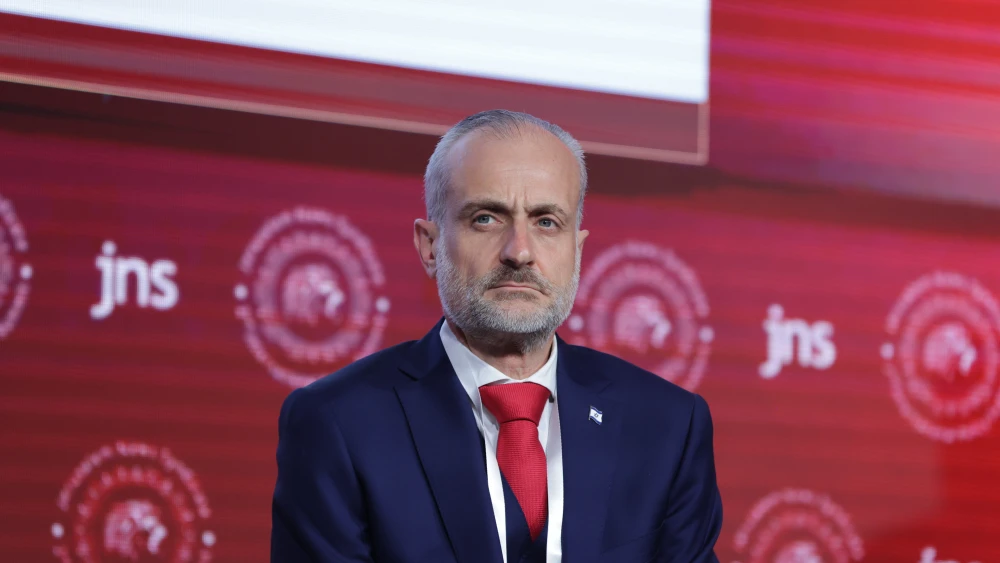
Emmanuel Navon, Israel’s designated ambassador to Japan, on Tuesday accused the organizers of a protest outside the Israeli Embassy in Tokyo of hypocrisy, saying they claim to oppose discrimination yet have called for the Jewish state’s destruction.
Navon told JNS on Wednesday that the organizers are a very small group of Palestinians in Japan who “team up with the Communist Party.” He called them “vocal but marginal.”
In a post on X written in Japanese, Navon wrote: “The organizer of tonight’s demonstration says, ‘We prohibit discrimination based on ethnicity or nationality.’ Last time, they shouted, ‘Abolish Israel,’ ‘Destroy the embassy.’”
“This denies the Jewish people’s right to self-determination. That is discrimination based on ethnicity,” he wrote.
In an accompanying video, Navon accused the protesters of harassing him and his wife with megaphones under their window. He said they also harass embassy staff on their way to work.
今夜のデモの主催者は「民族や国籍による差別を禁じる」と言います。前回は「イスラエルをなくせ」「大使館を壊せ」と叫びました。
— Emmanuel Navon | エマニュエル・ナヴォン 🇮🇱 (@emmanuelnavon) November 3, 2026
ユダヤ人の民族自決権を否定する。これが民族による差別です。イスラエル人が日本に自国の大使館を持つ権利を否定する。これが国籍による差別です。… pic.twitter.com/dG3bxbd6yD
In a separate post on Thursday, Navon said that the protesters held a placard that read, “Israel is the enemy of humanity.”
The post was accompanied by antisemitic illustrations from the Nazi and Soviet regimes, alongside a photo of the placard held in Tokyo the previous day.
“The Nazis depicted Jews as spiders that prey on people. Soviet propaganda used the same imagery, labeling it ‘Zionism.’ And now, ‘Israel’ is branded as the enemy of humanity,” the envoy wrote.
“The name of the target may change, but the logic remains the same. It casts Jews and their state as absolute evil, justifying their elimination as ‘justice,’” he added.
昨日11月4日、東京のイスラエル大使館前のデモで「イスラエルは人類の敵」というプラカードが掲げられました。… pic.twitter.com/57GQf74Q3W
— Emmanuel Navon | エマニュエル・ナヴォン 🇮🇱 (@emmanuelnavon) November 5, 2026
Strengthening ties with Japan
Speaking at the JNS 2026 International Policy Summit in Jerusalem in June, Navon said, “Today, Japan is not a strategic partner, but the idea is to turn it into one. Israel, I think, today understands the need to diversify its alliances and relations.”
Japan, Navon said, is increasingly recognizing that it can no longer rely solely on the United States for its security, given the challenges posed by China’s growing military power, North Korea’s nuclear capabilities and Russia’s increasingly aggressive posture.
“All this creates potential for interaction between Israel and Japan. The main challenges are that Japan is still very much reliant on Middle Eastern energy, which pushes them to maintain good relations with Iran and Qatar,” Navon said.
Addressing the Jewish presence in Japan, Navon said the country has historically not had a large Jewish community.
“You do have a significant community of Jewish business people from Europe, America and Israel. There is a nice Jewish community center in Tokyo. There are also a few Chabad houses in Tokyo and other cities like Kyoto, Osaka and Kobe. The size of the Jewish community in Japan doesn’t compare, though, to countries like the United States, France or the United Kingdom,” he said.