Newsletter
Newsletter Support JNS

In first, Israel’s Education Ministry regulates laying of tefillin in schools

“The laying of tefillin in the State of the Jews is not a subject for controversy; it is part of our Jewish identity,” Minister Yoav Kisch said.

Holocaust
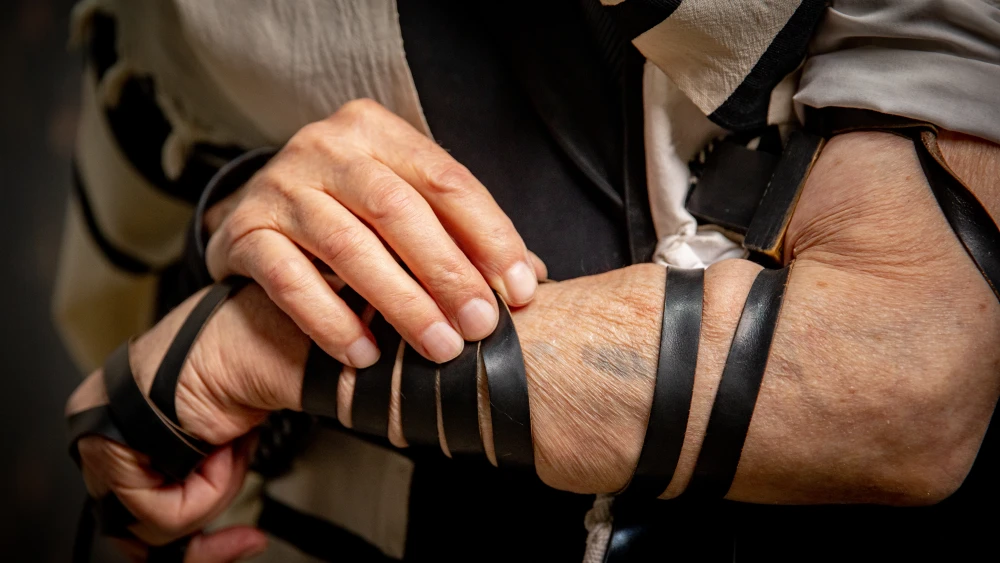
Holocaust survivor Moshe David Meir, 92, wearing tefillin and displaying the number tattooed on his arm at the Auschwitz II–Birkenau concentration camp, at his home in Jerusalem, June 21, 2023. Photo by Chaim Goldberg/Flash90.

Israeli Education Minister Yoav Kisch said on Monday that the issue of laying tefillin in schools has been regulated for the first time, so that every pupil who wishes to lay tefillin can do so.

Tefillin, a pair of small, black leather boxes containing parchment scrolls, are traditionally worn by Jewish men during weekday morning prayers.

“The lack of regulation that accompanied the system for years created frictions and uncertainty that harmed students, parents and education staff,” Kisch wrote on X.

“The laying of tefillin in the State of the Jews is not a subject for controversy; it is part of our Jewish identity,” he continued.

The minister noted that a directive issued by the ministry’s Director General Meir Shimoni now provides principals with clear guidelines, and ensures that every student can voluntarily pray and lay tefillin “in a respectful, regulated and natural manner.”

The United States is “shutting down the financial infrastructure that allows the regime to continue its threats to U.S. national security and global shipping,” the U.S. treasury secretary said.
“The American people are crying out for an end to U.S. tax dollars subsidizing Israel’s military,” Rep. Greg Casar, chair of the Congressional Progressive Caucus, told colleagues.
A U.S. Department of Homeland Security spokesman told JNS that the administration “acted well within its statutory and constitutional authority” in Khalil’s case, “as it does with any alien who advocates for violence, glorifies and supports terrorists, harasses Jews and damages property.”
“The Strait of Hormuz is open to all ship traffic except for Iran,” the U.S. president wrote.
The amendment “would restrict our country’s ability to confront Hamas, Hezbollah and other terrorist organizations in the region who are sworn enemies of both the United States and Israel,” the House minority leader said.
“We are prepared for any scenario,” the prime minister assured.