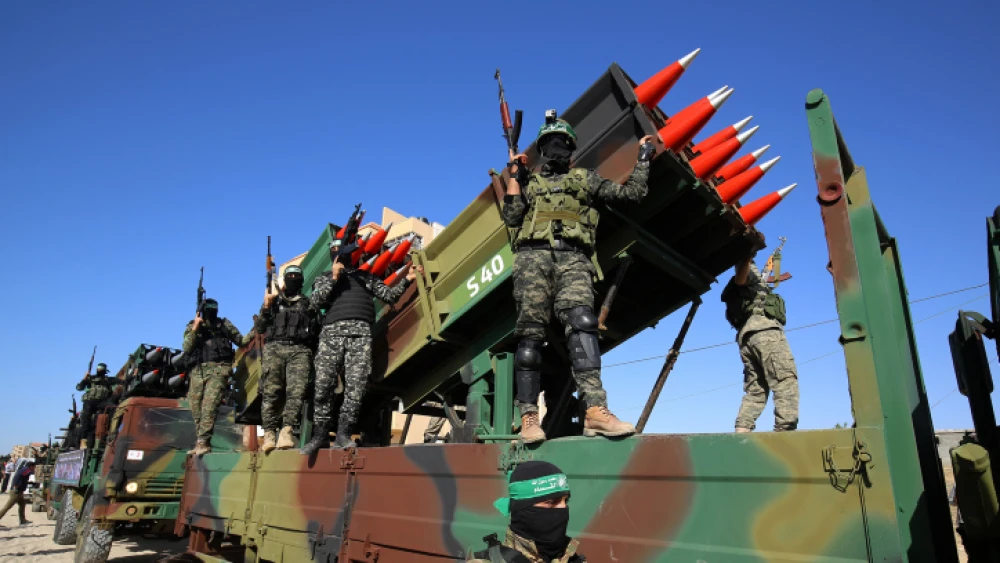
Hamas announced on Monday it was dissolving one of its key “civilian” bodies that administers the Gaza Strip while saying employees of the terrorist organization would remain in their posts, in what appeared to be a largely symbolic move.
Hamas’s Governmental Emergency Committee said the move came in response to the “higher interests” of Gazans amid “the continuing war, blockade, delayed reconstruction and Israel’s refusal to withdraw.”
In a statement cited by Qatar’s Al Jazeera outlet, the committee called on mediators to press for the U.S.-backed National Committee for the Administration of Gaza (NCAG) to enter the Strip immediately and begin carrying out its duties, “thereby strengthening the resilience of our people and helping to heal their wounds.”
The committee’s statement said that all current employees of Hamas’s “civilian” apparatus would continue to serve under the NCAG.
An anonymous Hamas official told AFP that the terrorist group “decided to dissolve the Gaza government committee and to appoint a nationally accepted figure to oversee the committee’s work until the National Committee for the Administration of Gaza formally assumes its responsibilities.”
An Israeli official told Kan News public broadcaster that the purported resignation of the Hamas government, while all of its members remain in office, was “a spin that means absolutely nothing.”
The official added, “Hamas fears it will be found to be in violation of the agreement, so it is buying time and engaging in spin.”
Under the second phase of U.S. President Donald Trump’s 20-point peace plan, Hamas is to cede power and Gaza is to be deradicalized and disarmed, with the deployment of an International Stabilization Force to parts of the Strip currently held by the Israeli military.
Meanwhile, the NCAG would be responsible for restoring public services, managing infrastructure projects and overseeing civil institutions.
Trump’s Board of Peace, under which the NCAG operates, acknowledged Hamas’s decision to disband the Governmental Emergency Committee, in a statement on Monday.
“Ultimately, our assessment will be guided by actions, not promises, to meet the critical needs of the people of Gaza. Decisions must be comprehensive with respect to the requirements as set out in the Roadmap for advancing governance, security, and transition in Gaza,” the Board of Peacecstated.
“A genuine transfer of authority must enable the NCAG to exercise its mandate independently, including taking the administrative and governance decisions entrusted to it,” it added.
Nickolay Mladenov, the Board of Peace’s high representative for the Gaza Strip, said Hamas’s announcement “underscores the importance of bringing the Roadmap discussions to a successful conclusion.”
“The sooner agreement is reached on the outstanding implementation provisions, the sooner the NCAG can assume its responsibilities, the decommissioning of weapons and the withdrawal of Israeli forces can begin, and large-scale reconstruction can commence,” Mladenov wrote on X.
Top Hamas leaders, including Khaled Mashaal and Musa Abu Marzouk, have rejected key parts of Trump’s plan for the second phase in recent months, including disarmament, despite having agreed to the proposal in October.
Prime Minister Benjamin Netanyahu said last week that the Gaza Strip no longer poses a military threat to Israel, while acknowledging that Hamas’s civilian rule has yet to be dismantled.
“A few days ago, we eliminated one of the last remaining [senior Hamas leaders], Izz al-Din al-Haddad, who was their military commander and one of the architects of the terrible [Oct. 7, 2023], massacre,” he told Channel 14. “What was the response? Nothing. Zero. Not a single bullet, because we are in control.”
However, the premier noted, “We also had a third objective, and that objective has not yet been achieved: to eliminate their civilian rule.” He added, “We will get there. There is still work to do.”