Newsletter
Newsletter Support JNS

Israel counts 111,000 Holocaust survivors in 2026

Global Jewry reaches 15.8 million, with most survivors in their 80s and 90s, according to Israel’s Central Bureau of Statistics.

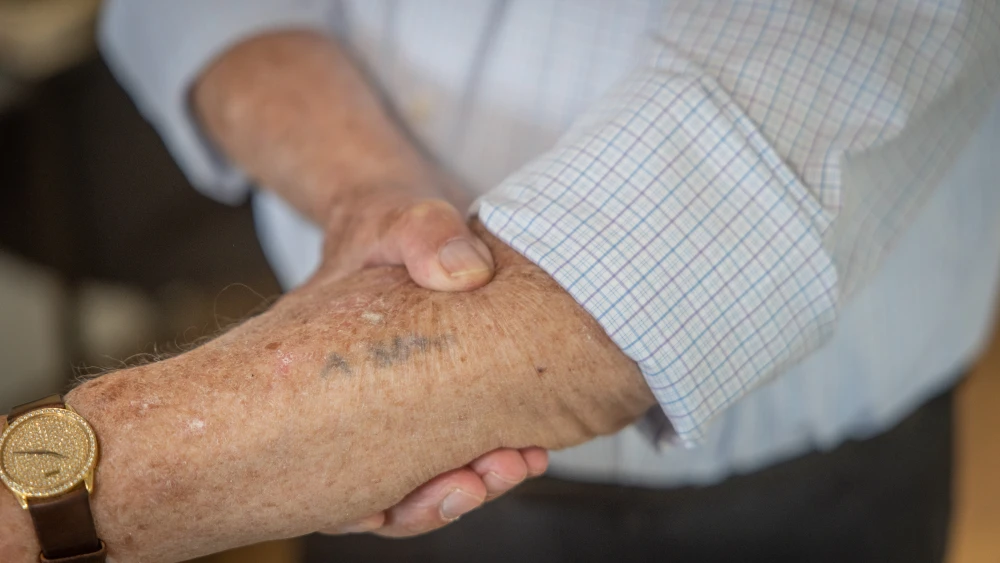
Holocaust survivor Jerry Stein, who survived the Auschwitz concentration camp and immigrated to Israel this year from the United States, is photographed at his home in Jerusalem ahead of his 97th birthday this week, Feb. 18, 2026. Photo by Chaim Goldberg/Flash90.
Holocaust survivor Jerry Stein, who survived the Auschwitz concentration camp and immigrated to Israel this year from the United States, is photographed at his home in Jerusalem ahead of his 97th birthday this week, Feb. 18, 2026.
Photo by Chaim Goldberg/Flash90.

Israel is home to some 111,000 Holocaust survivors and victims of antisemitic persecution, according to new government estimates released ahead of Holocaust Remembrance Day 2026. Women make up about 63% of survivors, most of whom are in their 80s and 90s.

Israel’s Central Bureau of Statistics said on Sunday that the global Jewish population stood at 15.8 million at the start of 2025, including 7.2 million Jews in Israel, or roughly 45% of the total, and 6.3 million in the United States. About 60.5% of survivors in Israel were born in Europe, led by immigrants from the former Soviet Union, Romania and Poland, while significant numbers also came from Morocco, Iraq, Tunisia, Libya and Algeria.

Roughly 6% of survivors immigrated to prestate Israel before 1948, about 30% arrived in the mass immigration wave immediately after independence, and a similar share came between 1952 and 1989. About one-third have arrived since the 1990s, mainly from the former Soviet Union.

Around 95% of survivors live in urban communities, with about 42% concentrated in major cities such as Jerusalem, Tel Aviv–Yafo, Haifa, Ashdod, Netanya, Petah Tikva, Beersheva and Rishon Letzion.

Yom HaShoah will be observed in Israel from Monday evening through Tuesday.

See more from JNS Staff
Abdulkadir Al-Jelani, 58, is due in court on July 1 and faces charges of making the threats and three counts of assault with a weapon.
The designations include Hezbollah-linked institutions that “threaten regional stability, international security, mutual interests and global trade,” the U.S. Treasury Department stated.
Gerard Filitti, of the Lawfare Project, told JNS that “lax immigration policy” has always been the main driver of importing “terrorist ideology” into the United States.
“The teachers we have, we don’t respect and support in the way that they deserve,” Paul Bernstein told JNS. “If we’re successful and we grow enrollment, that problem only gets bigger.”
“The message being sent is that you can get away with attacking someone in broad daylight because you disagree with their opinions, especially if it involves feelings about Israel,” Joshua Burt, of the Anti-Defamation League, told JNS.
“Not identifying Hamas as a terrorist organization is, I think, a failure, Marc Miller told the Canadian Press. “And not clearly stating that, for example, Hamas intended to kill Jews is, I think, an unfortunate error in curation and should be rectified.”